Measuring memory (4 types of task)
- Conscious behavioural methods:
- objective (accuracy/RT)
- subjective (confidence, ratings)
- Unconscious behavioural methods
- priming
- conditioning
- habits (past affects future)
- Physiological methods (SCR, GSR, HR)
- Electrophysiological methods (EEG, MEG)
- Haemodynamic methods (PET, fMRI)
Multi-store model (picture) - outline parts
Atkinson & Shiffrin (1968)
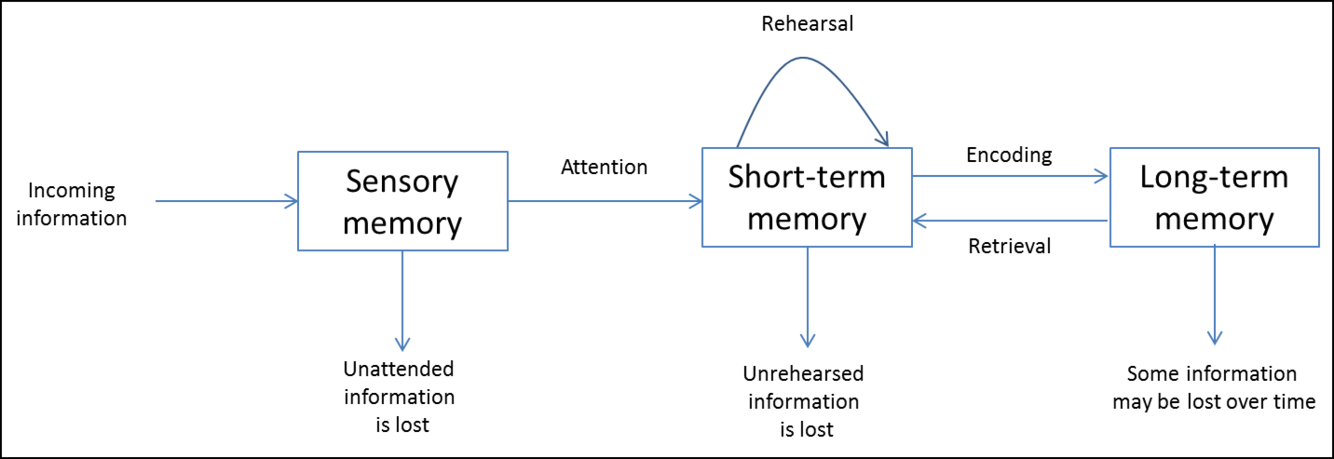
Sensory stores (multi-store model):
- Iconic store
- Auditory
Sensory stores - different store for different modality (modality specific)
- typically unaware of it unless we attend to it (limited capacity)
Iconic store (George Sperling, 1960): visual
- visual array (e.g. 4x4 digits) presented for 50ms –> could report 4 or 5
- partial report condition (repeat specific row)
- could report most letters on row
- rapid timeframe –> array and prompt have to be <1s apart or there is decay
Auditory:
- Triesman (1964) –> dichotic listening
- if second message starts <2s after first - recognise that they’re the same
- unattended information stays in echoic store for ~2s
Short-term memory (multi-store model)
- what is it?
- capacity
- rehearsal
- forgetting
Limited capacity (~7 ) - often unreliable, currently held in mind
Capacity:
- George Miller (1956): investigated span of STM - digit string recall
- ~7+- 2 digits OR 7 chunks
- Simon (1974) - digit span decreases as chunk size increases
Rehearsal:
- information can be retained in STM by rehearsing it
- longer it is held in ST store, greater chance of LT storage (A+S, 1968)
- Rundus (1971) - rehearse list of 20 words –> more rehearsed = more likely to be recalled
- recency effect - last word in list always had high likelihood of recall
STM forgetting
- Peterson & Peterson (1959) - forgetting curve - recall decreased as time interval increased (with no rehearsal)
- Waugh & Norman (1965) - STM forgetting due to decay or interference?
- if decay - fast presentation would increase recall (less chance to decay)
- if interference - fast = slow presentation recall
- found fast = slow presentation recall –> so interference due to new info not passage of time
Short term vs long term stores
- difference?
- recency + primacy effect definition
- Neuropsychological studies (proving separate)
William James (1890): primary memory = psychological present (in consciousness); secondary memory = psychological past (has left consciousness)
Recency effect = remember last few items better (STM)
Primacy effect = more resources available for initial items (LTM)
Neuropsychological studies –> STM + LTM distinct:
- Shallice 1988 –> double dissociation = patient 1 has A not B; patient 2 has B not A
- Scoville & Milner (1957) - HM, medial temporal damage, LTM impaired, intact digit span
- preserved recency effect (STM fine)
- no primacy effect (LTM impaired)
- Shallice & Warrington (1970) - KF, parieto-occipital damage, intact LTM, poor digit span
- preserved primacy effect (LTM fine)
- no recency effect (STM impaired)
Criticisms of the multi-store model:
- 3 assumptions and their weaknesses
- Strictly serial progression
- STM required for LTM encoding
- BUT: not the case in patient KF (Shallice & Warrington, 1970)
- Longer item is held in STM storage, greater likelihood of entering LTM storage
- rehersing items in ST store does correlate with LT retention (Rundus, 1971)
- BUT: other factors more important - such as depth processing (Craik & Tulving, 1975)
- ST + LT stores are unitary and operate in a single uniform way
- there is a single ST store and a single LT store
- BUT: Warrington & Shallice (1972) - KF had worse STM for auditory stimuli than visual
- BUT: Baddeley & Hitch (1974) - dual task methodology
- if concurrent performance decreases assuracy or increases RT - there is interference so they must tap into same cognitive systems
- auditory reheardal of digits does not increase errors made in concurrent grammatical reasoning task
Addition to multi-store model: working memory
Baddeley & Hitch (1974):
- Phonological loop - storage system for auditory/visual information
- Visuo-spatial sketchpad - analogous system for non-auditory/visual information
- Central executive - modality-free processing system - coordinates operations of others
Baddeley (2000):
- Added episodic buffer –> limited capacity system that holds + integrates diverse information
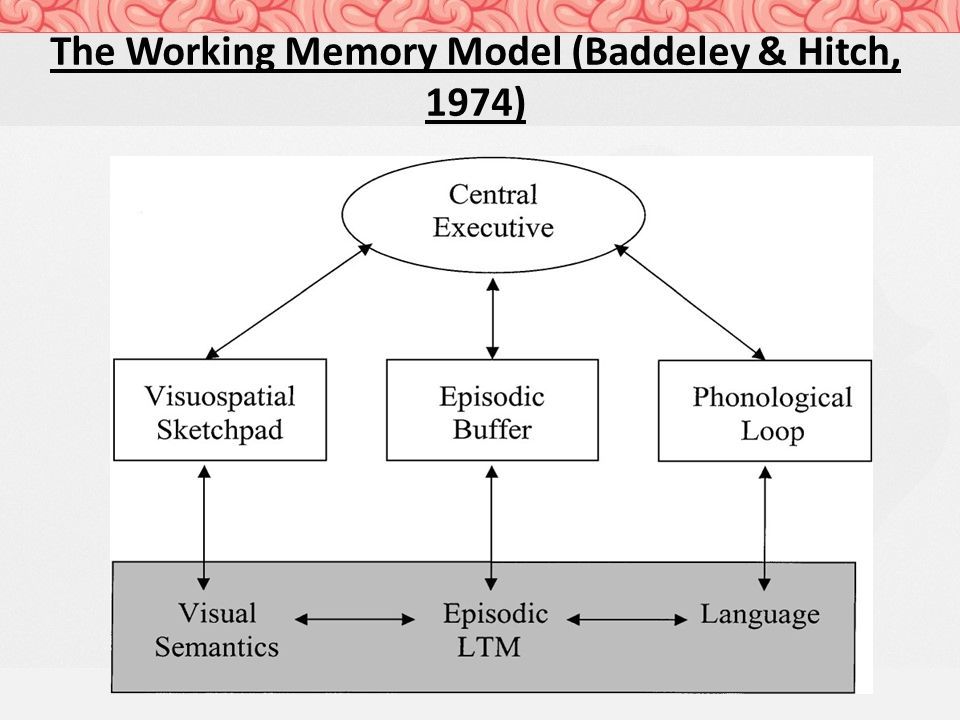
Evidence for Baddeley & Hitch’s working memory model - dual task methodology
Robbins et al., 1996:
- play chess while doing three tasks that tap into different aspects of WM:
- rapid word repetition (phonological loop)
- sequential key pressing (visuospatial sketchpad)
- random number generation (need executive processing)
- Chess performance worse for 2+3 (not 1) –> visuospatial + central executive involved in chess
Phonological loop (WM):
- phonological similarity effect
- word length effect
- phonological store vs articulatory control process
Phonological similarity effect (Baddeley, 1966)
- serial recall of list of phonologically similar words worse than phonologically dissimilar words
- visual + semantic similarity has little effect on recall
- so we must use speech-based representations when storing words:
- phonological memory traces
Word length effect (Baddeley et al., 1975)
- serial recall significantly worse for longer words
- the lower the digit speech duration (e.g. in Chinese vs English), the higher mean digit span (number of digits remembered)
- Articulatory suppression during presentation and recall eliminates word length effect
- so capacity of phonological loop is determined by how much you can rehearse it
Phonological store vs articulatory processes (Baddeley, 1990)
- phonological store = speech perception; articulatory processes = speech production
- if presented with word auditorily - goes straight into phonological store (rapid)
- if presented with word visually - goes into loop via articulatory control process (not automatic)
Visuospatial sketchpad (WM):
- Behavioural evidence
- different processes involved
- different components of it
- Neuropsychological data
VS = temporary storage and manipulation of visual and spatial information
Behavioural data:
- Baddeley et al., 1975: encode info via rote learning or imagery-based strategy
- task combined with pursuit rote tracking (a visuospatial task)
- imagery-based strategy was disrupted but not rote learning
- Baddeley & Lieberman (1980) - rote vs imagery task again
- combined with brightness judgements (visual) or judging position of pendulum auditorily (spatial)
- imagery-based task was disrupted during spatial task
- Logie (1995) - split visuospatial sketchpad into: visual cache and inner scribe
- visual cache = passive store of visual info. - subject to decay and interference
- inner scribe = processes spatial info. + allows for active rehearsal of info in visual cache
Neuropsychological data:
- Beschin et al., (1997) - NL - preserved perceptual skills but couldn’t describe scene details from memory
- Farah et al., (1988) - LH –> better at spatial processing tasksthan visual imagery tasks
Episodic buffer (WM)
- more than just modality-specificity of VS + PL
- verbal + visual info need to be integrated and stored somwhere in WM
- neuroimaging studies
- Baddeley et al., (1984) –> articulatory suppression decreases memory span for visual information but doesn’t eliminate it
- lack of rehearsal should stop storage completely - yet can recall 5
- must be temporarily stored somewhere (EB)
- can’t just be using articulatory control processes to store visual info
- Chincotta et al., (1999) –> use combined verbal + visual representation when performing tasks with Arabic numerals but not with digit words
- Arabic - used verbal + visual –> in integrated way
- Baddeley et al., (1987) - memory span for meaningful sentences = 15-16 words
- more than PL capacity
- draw on semantic memory to boost capacity?
BUT:
- Baddeley & Wilson (2002) - amnesiacs with impaired LTM have normal immediate sentence span –> not drawing on semantic memory
- Baddeley (2000) - recalls densely amnesic patients able to play bridge - requires memory
Neuroimaging studies:
- Prabhakaran et al., (2000) - fMRI of WM tasks –> just verbal; just spatial; or integration; recall
- posterior regions (medial temporal gyrus) - material specific WM effects
- consistent with PL + VS
- right frontal cortex (medial/superior temporal gyrus) - retention of integrated information
- need episodic buffer
- posterior regions (medial temporal gyrus) - material specific WM effects
Central executive (WM)
- what is it?
- functions
- evidence
- Dysexecutive syndrome
CE - coordination, attention, problem solving –> coordinates cognitive processes
Functions (Smith & Jonides, 1999):
- switching attention betweentasks
- planning subtasks to achieve goals
- selective attention of certain stimuli + ignoring others
- monitoring + evaluating contents of other WM stores
Evidence: Baddeley (1996)
- hold 1-8 digits in mind while generating random series of key presses
- randomness decreases as digit span increases
- due to greater demands on CE - switching attention
Dysexecutive syndrome –> CE breaks down after frontal lobe damage
- Rylander (1939) - review:
- disturbed attention, hard to grasp new task, personality change, increased distractability
- D’Esposito et al., (1995)
- dorsolateral regions (in frontal lobes) important for EF
- greater activity in dual-task than single-task conditions
- Duncan et al., (2000)
- lateral frontal cortex - neural basis of general intelligence (g)
Long-term memory:
- capacity
- Finite number of neurons + synapses
- humans can take in 100 stimuli per minute (~3 billion over 70yr lifetime)
- Standing (1973) - couldn’t find LTM limit - even for 10,000+ pictures - perform above chance
- Lindauer (1986) - conceptual approach
- capacity contrained by rate of acquisition
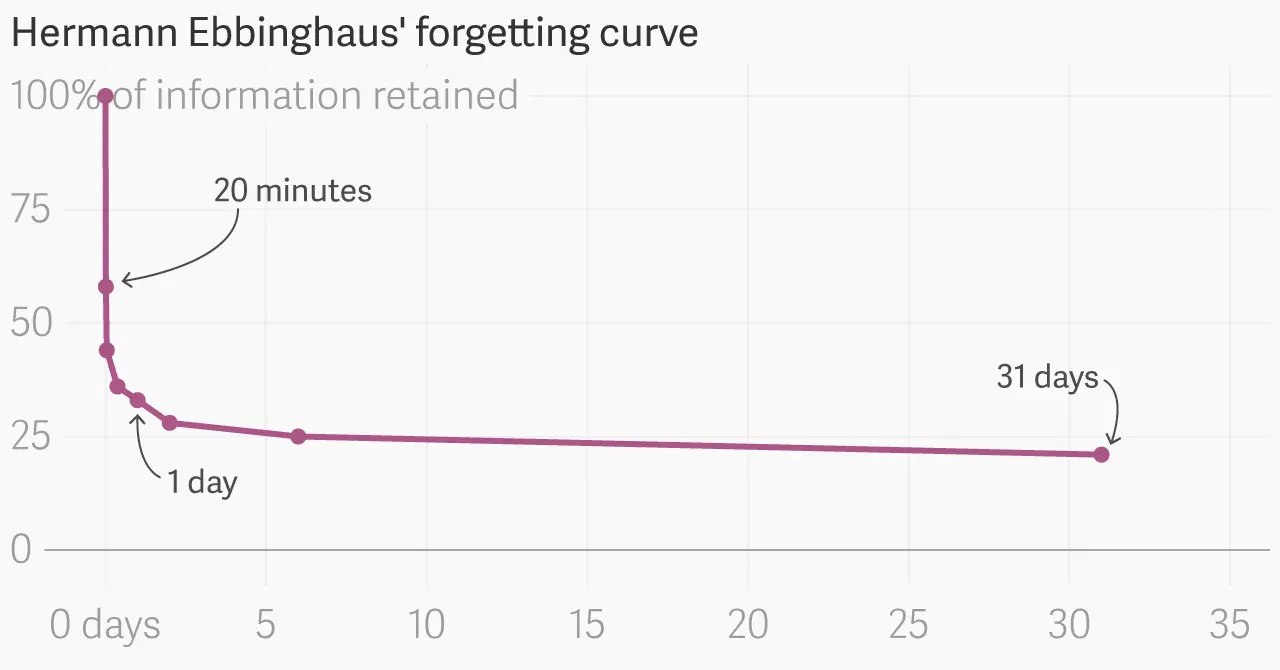
- Ebbinghaus (1885) - retention decreases with longer intervals
- rapid loss then decreases until stabilising point
- see forgetting curve
Long-term memory: maximising retention
- practice
- level of processing
- elaboration
- organisation
- spacing
Practice:
- Pirolli & Anderson (1985) - LTM retrieval improved with practice
- linear growth of long-term potentiation with practice (fMRI)
- as practice increased, recognition time decreased
Level of processing:
- Craik & Lockhart (1972) - processing affects memorability
- greater accuracy if think of meaning
- less accurate if just repetition
- Craik & Tulving (1975) - perceptual (captial letters?); phonological (rhymes); semantic (meaning)
- semantic qualities helped accuracy of recall the most
- deep-level processing boosts long-term retention
Elaboration - relate new material to associated info + prev. knowledge
- Anderson & Bower (1972) - elaboration condition improved memory from 57%-72%
- because it was self-generated –> knowledge/details/explanations/e.gs/information
Organisation
- Bower et al., (1969) - group 1 = words in organisational hierachy; group 2 = randomly presented
- recall almost doubled in 1
- order of reproducing words mirrored the hierarchical representation (in memory)
Spacing - between coding episodes
- Massed practice =many trials with same stimulus undertaken without interruption
- spaced practice = increased intervals of time used between repetitions of stimuli
- Bahrick (1979):
- massed study - better for immediate retention (STM)
- spaced study - better for later retention (LTM)
What causes forgetting (LTM) –> decay or interference?
- Jenkins & Dallenback (1924): sleep condition (decay) vs wake condition (decay + interference)
- greater forgetting during wake than sleep
- BUT: now we know sleep = memory consolidation
- Baddeley & Hitch (1977) - rugby players - some played 6 games, some only 1 (over 2 months)
- if decay - memory of game should be same
- if interference - 6 games should be worse at recalling
- there was a correlation between recall + number of games –> interference
Types of interference (LTM)
Proactive interference –> previous learning disrupts later learning
- Underwood (1957) - more previous lists learned - greater forgetting occurred
Retroactive interference –> later learning disrupts earlier learning
- Slamecka (1960) - learn sentences 2,4, or 8 times THEN either 0,4,or 8 different trials
- amount learned was a function of initial learning (8>4>2)
- forgetting was a function of number of sentences learned after (0>4>8)
- misinformation effect - distortion of memory by inserting other information (e.g. leading questions)
Forgetting –> amnesia
- HM
- types
- tests
HM:
- medial temporal lobes removed (epilepsy), anterograde + retrograde amnesia (of ~3 years pre-surgery)
- no change in intellectual functioning, language comprehension, semantic knowledge or perception
- impaired explicit memory (demonstrative) –> impaired primacy effect
- intact implicit memory –> STM, recency effect, can learn new motor skills
Retrograde amnesia = memory loss of event prior to brain damage/surgery/lesion
Anterograde amnesia = can’t form new memories or retain new information
Tests:
- Rempel-Clower et al., (1996): amnesia patient impaired at recalling complex figure
- Rey Complex Figure task
- copied it fine (no motor/perceptual difficulty) BUT couldn’t recall later
- Hassabis et al., (2007): amnesia patients impaired at imagining the future too
- patients with medial-temporal lobe amnesia/damage
- impaired prediction/estimation of future
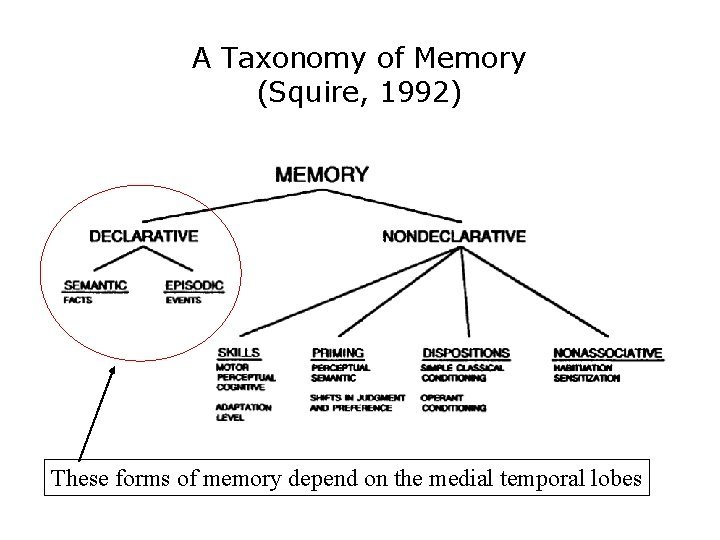
Long-term memory: Squire (1992) diagram
- LTM –> explicit (declarative) + implicit (non-declarative)
- Explicit (conscious) –> episodic (personal events) + semantics (meaning/facts/knowledge)
- Implicit (unconscious) –> perceptual representation (priming) + procedural memory (motor skills/conditioning)
Implicit vs explicit memory tasks (LTM)
- 2 potential issues
Explicit memory tasks:
- recognition (old/new)
- cued recall (all of category x)
- free recall (all from list)
Implicit memory tasks:
- fragment completion (part of word missing: a*pl*)
- word stem completion (complete word: ap-)
- degraded word naming (word partially obscured/masked)
Process purity –> important to note that even in explicit responses there may be implicit influences
Fallacy of reification –> treating a task as if it definitely taps into an actual system
Explicit and implicit memory - 2 separate systems
- behavioural evidence
- neuropsychological evidence
- functioning neuroimaging studies
Behavioural:
- Jacoby & Dallas (1981) - words encoded using perceptual; phonological; or semantic processes
- implicit memory shows little impact
- explicit shows classic memory effect (see Craik & Tulving, 1975)
- better accuracy for semantic
- Jacoby & Dallas (1981) - modality difference between study + test
- explicit shows little impact
- implicit shows significant reduction in accuracy
- different modality - perceptual representation is different (so no priming)
Neuropsychological (medial temporal lobe amnesia):
- Warrington & Weiskrantz (1970) - pursuit rotor and Gollin figures task - performance increases over trials
- preserved implicit memory even if no explicit memory of having done it
- Graf et al., (1984)
- patients with amnesia impaired on recall + recognition (explicit) but not word completion
- Gabrieli et al., (1995) - MS (lesion affecting occipital cortex) vs amnesiacs
- MS performed as well as controls on explicit memory tasks
- MS impaired on implicit memory tasks
- double dissociation from amnesiacs
Functional neuroimaging:
- Schacter & Wagnr (1999) - medial temporal lobe activity in explicit encoding and retrieval
- Simons et al., (2003) - priming associated with activation of bilateral fusiform cortex
- activity along visual cortex = ventral visual stream
- early in visual stream –> priming is very perceptual
- as activity moves along temporal lobe base - priming is more semantic
Episodic and semantic memory (explicit LTM)
- what are they
- evidence for distinction
- behavioural
- neuropsychological
Episodic memory - about specific events in specific time + place; specific to individual
Semantic memory - general knowledge about objects/people/fact/concepts + word meanings
Behavioural evidence:
- Jacoby & Dallas (1981) - processing at encoding affects episodic but not semantic memory
- accuracy the same for semantic memory if encoded based on perception, phonology, semantics
- Jacoby (1983) - at encoding, reading word out of context improved seemantic memory
- generating word themselves improved episodic memory
Neuropsychological evidence:
- HM - episodic impaired, semantic not
- Vargha-Khadem et al., (1997) - children with selective hippocampal damage
- impaired episodic memory, good semantic memory (vocab)
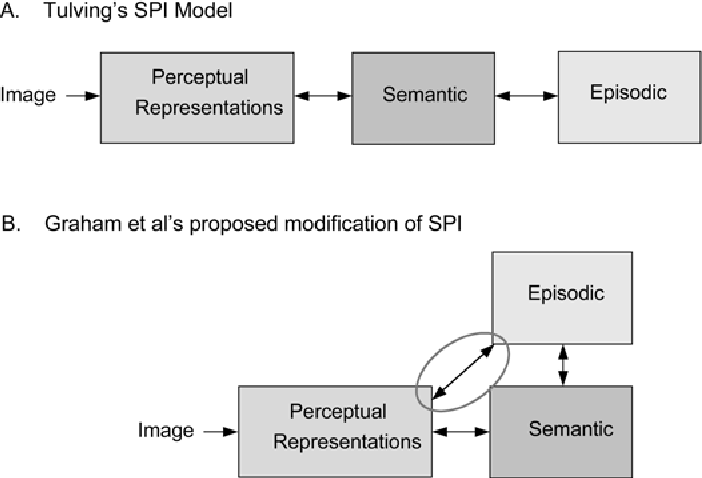
Tulving’s SPI model:
- what it is
- ISSUES - Dementia
serial encoding (s); parallel storage (p); independent retrieval (I)
- can have semantic withough episodic
- can’t have episodic without semantic
- perceptual representation semantic memory episodic memory
BUT: Dementia
- Early Alzheimer’s - medial temporal lobe atrophy
- impaired episodic, intact semantic
- Semantic dementia - lateral temporal lobe atrophy
- degradation of semantic knowledge
- Simons et al., (2002) - double dissociation between AD + SD:
- AD - no episodic, ok semantic
- SD - ok episodic, no semantic
So…Multiple Input Hypothesis
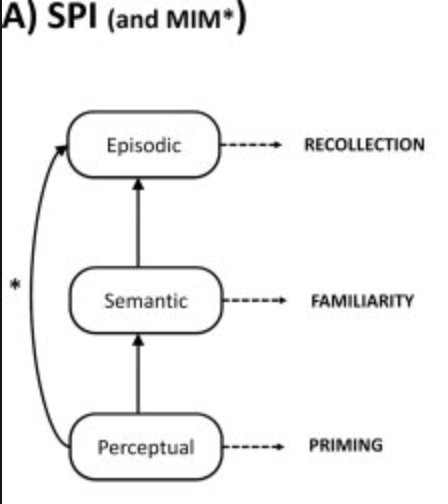
Adapting Tulving’s SPI model –> Multiple input hypothesis
Graham et al., (2000) - perceptual feeeds episodic memory too
- controls - rely on perceptual + semantic controls to drive episodic memory
- if one is missing, can draw on the other
- SD - did just as well as controls in perceptually identical condition
- only impaired when perceptually different - because can’t rely on perceptual representation