Name four types of hardness tests?
Brinell, Vickers, Rockwell and Shore scleroscope
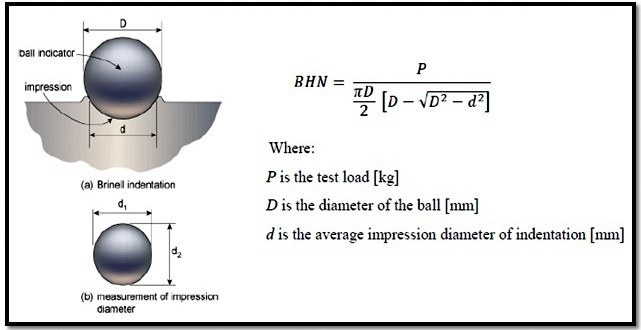
What is the Brinell hardness test?
A hardened steel ball is forced into an object under specified load conditions.
The hardness number is determined by measuring the depth and surface area of the impression and by using a formula, which also incorporates the load.
What is the Vickers hardness test?
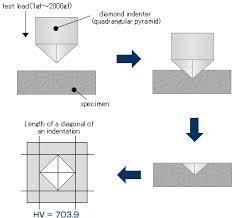
A small pyramid is forced into a test piece under specified load conditions.
The hardness number is derived from a formula that contains the load and area of the indentation.
More useful for thin metals as the loads are lower and the indentor is smaller.
What is the Rockwell hardness test?
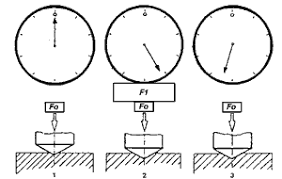
A diamond cone (or sphere) is forced into a test piece under specified load conditions and a reading is displayed on the dial.
There are different scales for different loads depending on the material used.
There is no formula as it is a number from 100-500.
What is the Shore Scleroscope hardness test?
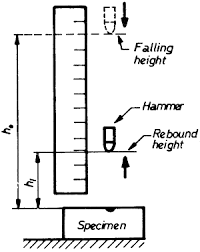
This test involves a small striker in a tube.
The tube is placed over an item and the striker is dropped, the height the striker rebounds from the item is the measure of the hardness.
What is the definition of hardness
The resistance of a material to localised plastic deformation.
What is the definition of toughness
The measurement of a materials resistance of fracture when subjected under stress
Define the Izod impact test
A pendulum is swung from a height and fractures the material and the energy absorbed is measured
What is the importance of hardness testing in the car market
Parts of cars are designed specifically to crush under force to reduce the impact impact force of high speed crashing, these are called “crumple zones”
How will a low toughness metal break or fracture
A low toughness metal will generally fracture in a brittle manner in which the crack is able to propagate without the absorption of additional energy
Why do metals show different hardness in different tests
Hardness = resistance to denting, scratching, or bending.
Tests are different:
Brinell: big ball, averages hardness.
Rockwell: small indenter, measures depth.
Vickers: tiny diamond, small area.
Metal properties (grain size, heat treatment, crystal structure) affect results.
Same metal can give different hardness numbers.
Difference between hardness and toughness
Hardness: Resists scratching, denting, or permanent shape change
Toughness: Resists breaking or cracking, absorbs energy before breaking
Why Vickers test is better for thin metals
Uses a tiny diamond indenter → makes a small indentation
Tests small surface area → doesn’t damage thin metal sheets
Better than Brinell or Rockwell, which use bigger indenters and can bend or break thin metals
Relationship between hardness and strength
Hardness shows how well a material resists scratching, denting, or permanent deformation
Strength shows how much force a material can take before breaking or deforming
Harder metals are usually stronger, but a material can be hard yet brittle
What a Rockwell scale number represents
Shows how deep an indenter goes into a material under a load
Higher number → harder material → indenter goes less deep
Lower number → softer material → indenter goes deeper
It is a relative measure of hardness, not a direct force value
Practical Applications of Hardness Testing
Measures resistance to indentation, scratching, and wear
Helps select materials for machines and structures
Hard materials like cutting tools, gears, and engine parts resist wear
Soft materials allow flexibility and shock absorption
Used in quality control to check heat treatment and specifications
Ductile vs Brittle Fracture
Ductile-
Stretches and deforms before breaking
Absorbs energy
Shows bending, necking, and distortion
Example: mild steel
Provides warning before total failure
Brittle-
Breaks abruptly with little or no deformation
Absorbs little energy
Examples: cast iron and glass
Hazardous because it fails suddenly with no warning
Factors affecting hardness results (indentor size, load, material structure):
Indenter Size
Larger indenter → larger indentation area → averages hardness over a bigger region.
Smaller indenter → more sensitive to surface defects and microstructure.
Load
Higher load → deeper indentation → may give lower hardness readings due to more material deformation.
Lower load → shallower indentation → results may be influenced by surface finish or coatings.
Material Structure
Grain size, phases, and heat treatment affect hardness.
Fine grains / hardened structures → higher hardness.
Coarse grains / softer phases → lower hardness.
Types of materials suitable for the Brinnell
Soft to medium hardness metals
Cast iron
Aluminium alloys
Copper alloys
Mild steels
Materials with coarse grain structures
Types of materials suitable for the Vickers
Very wide range of materials (soft to very hard)
Hardened steels
Thin materials or coatings
Small or precision components
Ceramics and hard alloys
Micro-hardness testing of small areas
Types of materials suitable for the Rockwell hardness test
Metals and alloys of medium to high hardness (steel, stainless steel, aluminium)
Materials where a quick, direct hardness reading is needed
Can test thicker or bulkier pieces because the indenter and load are larger
Types of materials suitable for the Shore Scleroscope test
Metals and hard alloys where rebound hardness is useful
Materials requiring assessment of impact or surface hardness
Best for solid, rigid materials (not soft plastics or thin sheets)
Limitations of hardness tests
Not accurate for very thin samples (may penetrate or damage)
Rough or uneven surfaces can give false readings
Results may vary depending on test method, load, or indentor size
Some tests are less suitable for very soft or very hard materials

-
Units14
-
Formulas- identifying variables9
-
Module 5. Key terms and concepts12
-
Module 5 - Type of bridges6
-
Module 5: Mechanics of beams14
-
Module 5. Material testing (Stress and strain)22
-
Module 5 mechanics - Shear Stress4
-
Communication - Bolts Drawing5
-
Module 6 : Hardness tests23
-
Module 6. Mechanics12
-
Ferrous metal forming processes13
-
Surface Hardening8
-
Module 6 Ferrous and Non-ferrous metal hardening treatment15
-
Module 6: Forming processes Ferrous metals18
-
Module 6: Glass8
-
Module 5: Concrete5
-
Module 6: polymers9



