Define what normal birth is
What characteristics make a birth ‘normal’?
The process in which the fetus, placenta and membranes are expelled via the birth canal
To be normal:
- Spontaneous
- 37-42 weeks gestation
- Fetus presenting by the vertex
- Results in spontaneous vaginal birth (SVD)
What physiological changes happen to allow normal birth?
The cervix softens
Myometrial tone changes to allow coordinated contractions
Hormonal changes:
- Progesterone decreases
- Oxytocin & prostaglandins increase
Give an overview of the stages of labour
There are three stages of labour, which are subdivided further:
- First stage:
- Latent phase
- Active first stage
- Transition
- Second stage:
- Passive & Active element
- Third part:
- active or physiological
Describe what happens in the first stage of labour
Latent phase (aka early labour):
- can be the longest part (days)
- Irregular contractions
- Cervical dilation up to 4cm
Active phase:
- 8-12 hours
- Regular, painful contractions
- Cervix is now 4-10cm
Transition:
- Transition to 2nd stage of labour
- Cervix 8-10cm
- The mother will experience physical changes - shaking, need to vomit/empty bowels
- May express they can no longer cope
What happens in the 2nd stage of labour?
What are its features?
Birthing stage - will have active and/or passive element
Passive - fully dilated but with no involuntary expulsive contractions
Active - is when either:
- part of the baby is presented
- there are expulsive contractions
- there is maternal effort
How long is the second stage of labour?
2-3 hours but depends whether woman is nulliparous or multiparous
Define what the third stage of labour is?
From the birth of the baby to the expulsion of the placenta ad membranes
The third stage of labour can be managed physiologically or actively
What do these mean?
Physiolgical management:
- No uterotonics
- No chord clamping (until pulsation has stopped)
Active management:
- Use of uterotonics such as:
- Syntocinon (synthetic oxytocin)
- Syntometrine ( “ oxytocin/ergometrine mix)
- Optimal chord clamping
Which is faster, active or physiological management of the third stage of labour?
Active (ie using drugs) is quicker - 30 mins
Physiological - 60 mins
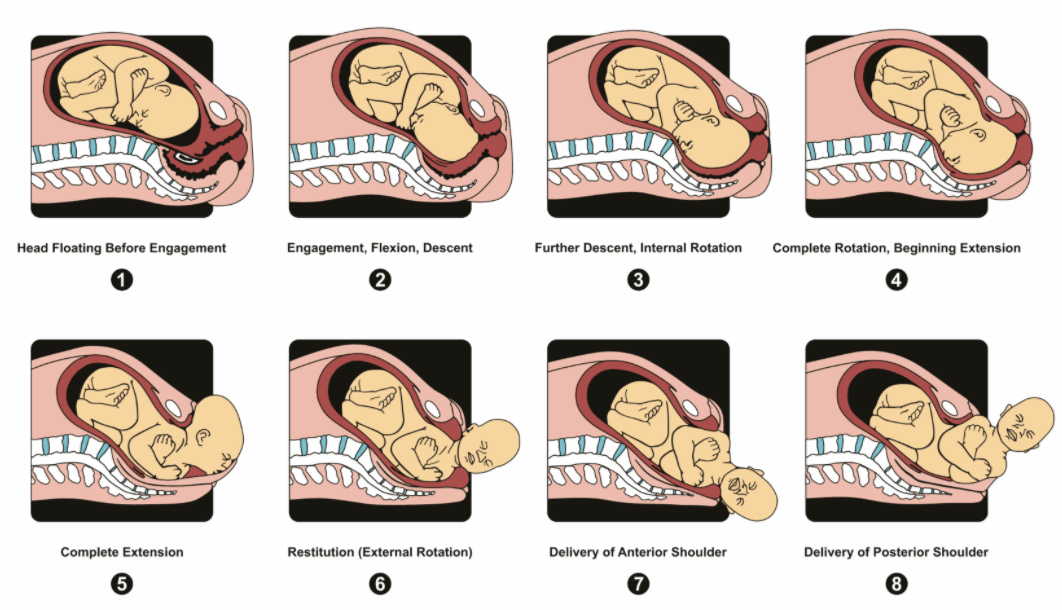
What are the mechanisms (stages) of vertex presentation of birth
Before engagement (would be latent stage of labour)
Engagement & descent, Flexion
Internal rotation of the head
Crowning & extension of the head
Restitution (external rotation)
Delivery of anterior shoulder
Delivery of posterior shoulder
What are the types of fetal ‘lie’?
Longitudinal
Oblique
Transverse
What are the types of fetal presentation?
Cephalic (head first)
Breech (bottom first)
Shoulder (have a guess)
Note there are different types within this - Vertex (a type of cephalic) is the most common/normal
What are the different types of fetal positions?
These describe how the fetus is rotated within the uterus:
- Occipitoposterior R/L
- fetus faces anterolateral
- Occipitotransverse R/L
- faces lateral
- Occipitoanterior R/L
- faces posterolateral
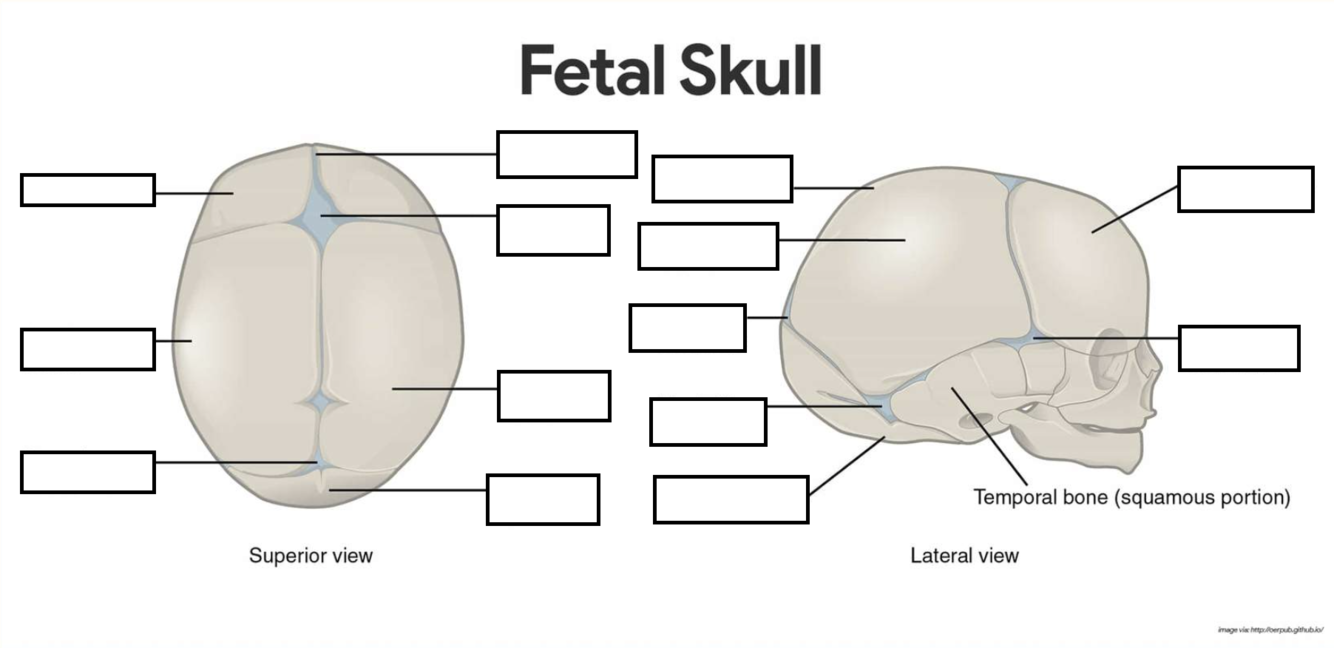
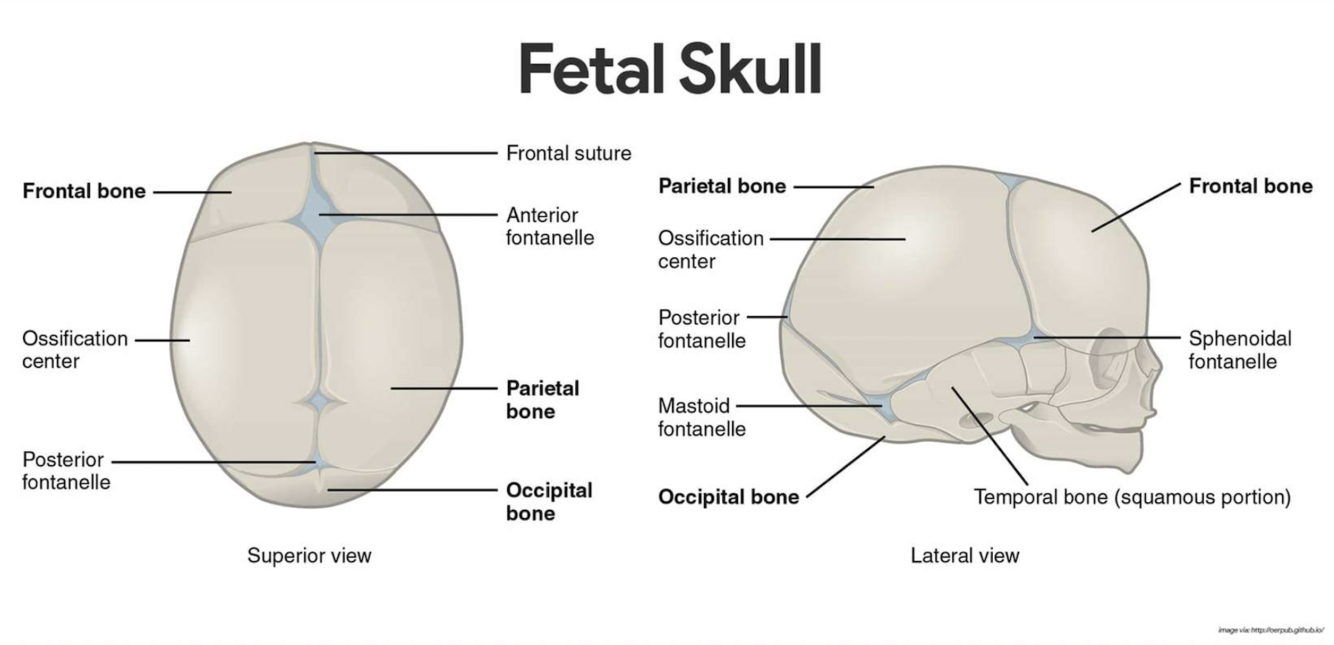
Identify the parts of the fetal skull
How is fetal weelbeing assessed in labour?
What equipment can be used?
Monitoring fetal heart rate is important
This is done either intermittently (low risk) or continuououosly (higher risk)
Equipment:
Pinard’s stethoscope (intermittent)
Hand held doppler (intermittent)
Cardiotocograph - CTG (continuous)
How can the mother be monitored during labour?
Maternal observations (incl HR, resp rate etc)
Abdominal examination
Vaginal examination
Monitoring of liquor
Palpation of contractions
External signs (eg Rhomboid of Michaelis and anal cleft line)
What support options are available for women during labour?
maternal position and mobility
breathing and hypnobirthing techniques
massage
aromatherapy
TENS machine
oral analgesia
water baths
Entonox
opioids
Remifentanil PCA
epidural

-
Male basic Physiology (BJ)17
-
Male basic Physiology 2 (BJ)14
-
Female reproductive physiology16
-
Embryology - male24
-
Embryology - female20
-
Antenatal Care (bj)35
-
Pharmacology in preggo25
-
Physiology in Pregnancy31
-
Sexual helf - Genital symptoms17
-
Sekshuwal helf - STIs11
-
Normal labour18
-
Less normal labour23
-
Obstetric emergencies14
-
Common pathologies of pregnancy15
-
Common genital syndromes (non-STI)25
-
Maternal and perinatal mortality21
-
Complications of pregnancy 139
-
Complications of pregnancy 2 (preeclampsia)18
-
Complications of pregnancy 2 (management of PET)10
-
Complications of pregnancy 2 (other stuff)15
-
Infertility 1 & 2 (Pphysiology and diagnosis)25
-
Infertility 3 (management)15
-
Menstrual disorders (unfinished)21
-
Menstrual Disorders (copy)26
-
Menstrual Disorders - Dysfunctional Uterine Bleeding16
-
Contraception33
-
Pharmacology29
-
Pelvic Organ Prolapse9
-
Female Urinary Incontinence13
-
Genetics13
-
Menopause24
-
Secondary Amenorrhoea5
-
Cervical Screening22
-
FGM15
-
Ovarian Cancer18
-
Endometrial Cancer16
-
Vulval Cancer16
-
Breast Anatomy23
-
Breast Radiology & Cytology12
-
Breast Pathology24



