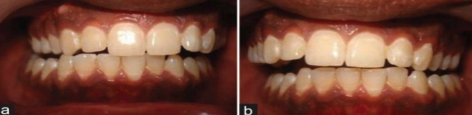
2 states for examining the occlusion
- dynamic
- static
tools used to mark teeth contacts
- Millers forceps
- fine articulating paper - 40microns
- deally 2 colours – 1 to mark static ICP and 1 dynamic in excursive positions
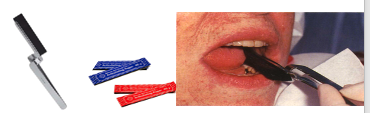
how to record how teeth meet in occlusion
Dry teeth
place in articulating paper held by Millers forceps
tap together for ICP or move side to side for lateral excursive/forward for protrusion
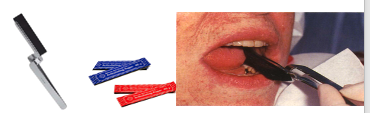
4 times to mark teeth contacts
- Before
- Preparing a tooth
- Removing a restoration
- After
- Placement of a crown
- Placement of a restoration
why do you mark contacts before you change anything
If the occlusal scheme is good….
- stick to it (conform)
- These are called tripodised contacts and show where the opposing cusps contact (ICP stops)*
- hard to achieve
- more commonly – cusp tip to fossa*
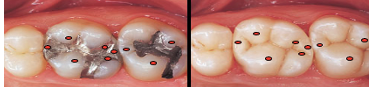
4 components of ICP contacts (static occlusion)
- functional cusps
- non-functional cusps
- fossa
- ICP contacts
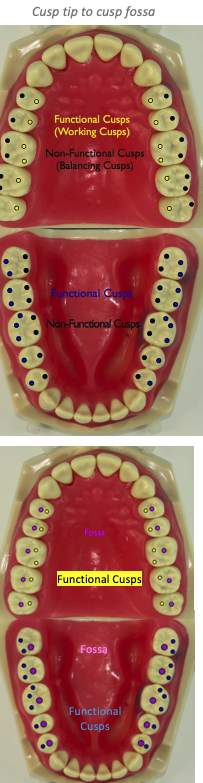
functional cusps in ICP contacts (static occlusion)
- Cusps that occlude with the opposing teeth in the intercuspal position
- The palatal cusps of the upper posterior teeth and the buccal cusps of the lower posterior teeth
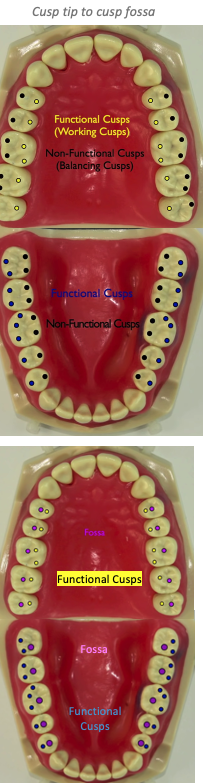
non functional cusps in ICP contacts (static occlusion)
- Cusps that do not occlude with the opposing teeth in the intercuspal position
- The buccal cusps of the upper posterior teeth and the lingual cusps of the lower posterior teeth
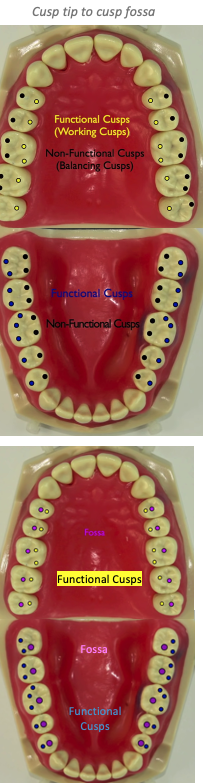
fossa in ICP contacts (static occlusion)
- Depression or concavity on tooth surface
- Functional cusp of a tooth contacts the fossa of the opposing tooth
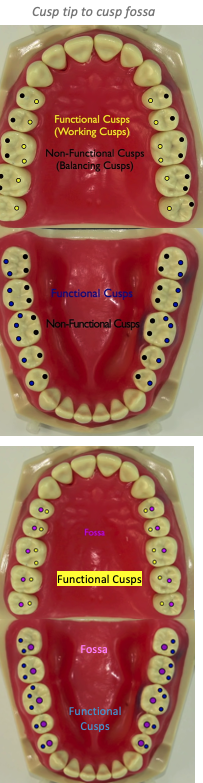
ICP contacts in static occlusion
- The lingual cusp of an upper molar contacts the fossa of a lower molar
- The buccal cusp of a lower molar contacts the fossa of an upper molar
tap for ICP contacts in static occlusion
- Dry first
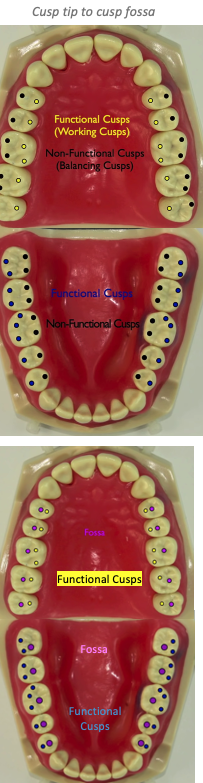
way to remember function and non functional cusps
Functional cusps
- Palatal upper
- Buccal lower
Non-functional cusps
- Buccal Upper
- Lingual Lower
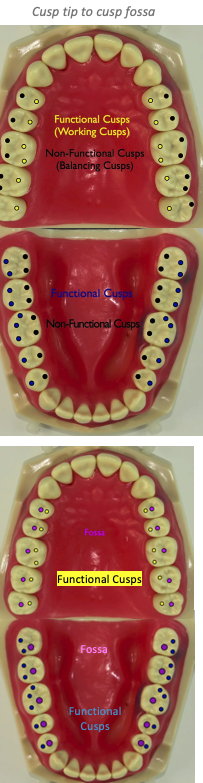
buccal cusps occlude….
palatal cusps occlude..
buccal cusps occluding with upper fossa
palatal cusps occluding with lower fossa
maxillary tooth looks more buccally placed than mandibular tooth
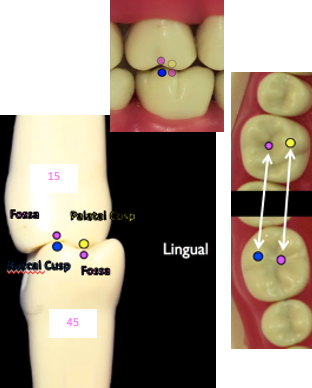
problems in static
- Incisor Relationship
- Molar relationship
- Overjet/Overbite
- Cross bites
- Open bites
- Individual tooth contacts
- RCP – ICP slide (freedom in centric)
incisor relationship classified by
angle’s
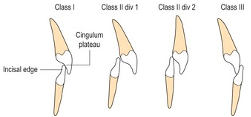
overbite
Vertical overlap of the incisors
2-4mm normal range
Akerly classification
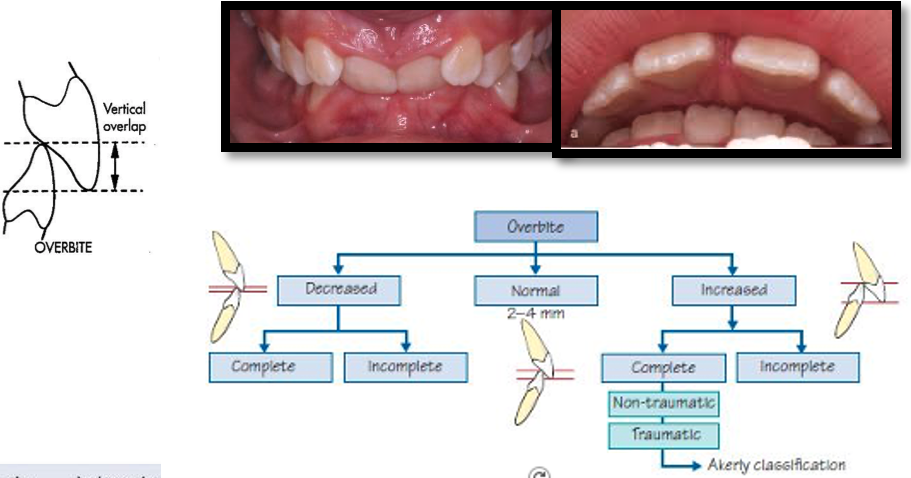
Ackerly classification for overbite
I
- lower incisors impinge on palatal mucosa
- inflammation of palatal mucosa with the imprine of lower incisal edges
II
- lower incisors incisal edge occlude into palatal gingival crevices of maxillary teeth
- labial splaying of maxillary incisors
- palatal pocket
III
- class II div2 type of incisor relationship
- stripping of the gingiva in relation to palatal surfaces of upper anterior teeth and labial surfaces lower anterior teeth
IV
- lower incisor causing progressive abrasion of palatal surfaces of maxillary teeth
- abrasion of palatal surfaces of upper anterior teeth
- dentine hypersensitivity
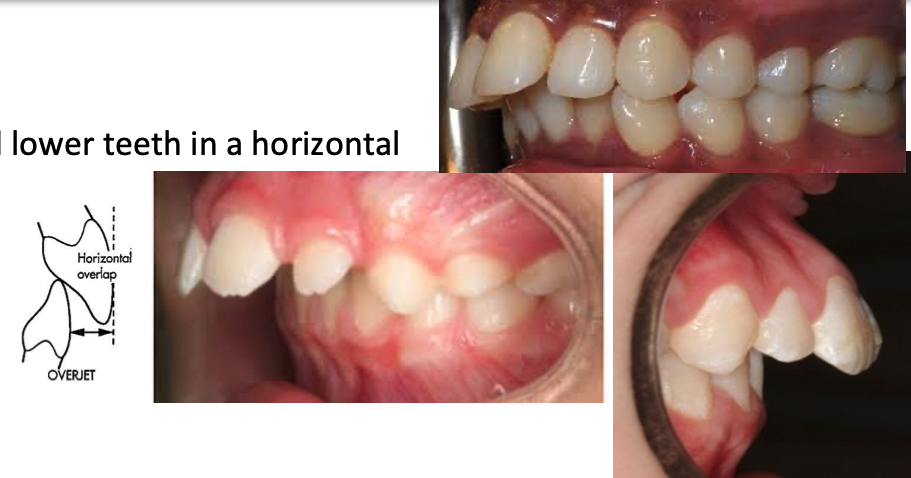
overjet
Relationship between the upper and lower teeth in a horizontal plane
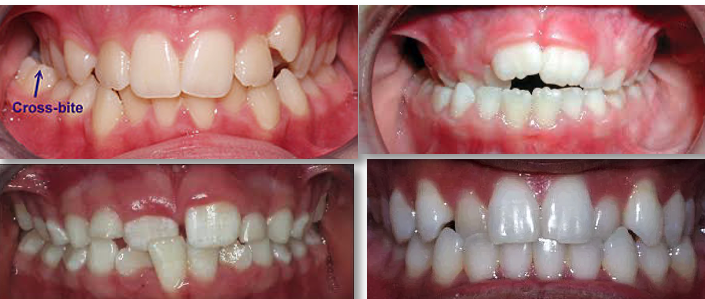
crossbite
- condition where one or more teeth may be abnormally malpositioned buccal or lingually or labially with reference to opposing teeth
- posterior
- anterior
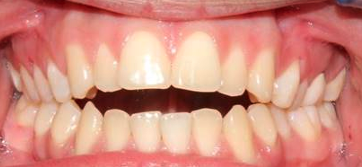
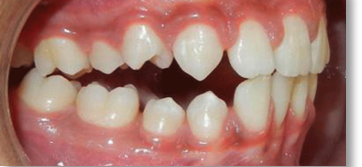
anterior open bite
- Lack of vertical overlap of anterior teeth when posterior teeth in full occlusion
- Often due to digit sucking
- Here 3-3
posterior/lateral open bite
- Failure of contact between the posterior teeth when the teeth are in full occlusion
- here From 16-12
why 2 colours articulating paper
Better to use a different colour articulating paper to show canine guidance/dynamic from static
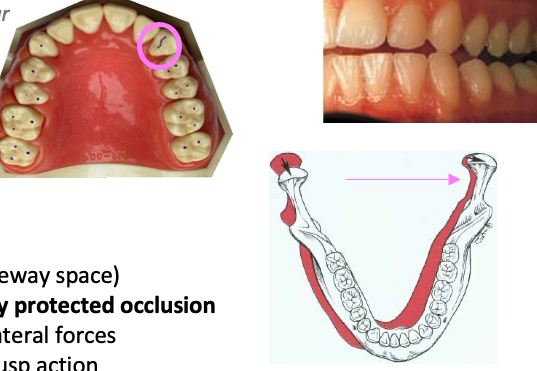
canine guidance
Dynamic
- Mandible moves to the left (working side)
- Contact only between the canines
- No posterior tooth contacts (a space – freeway space)
- This is what’s known as a mutually protected occlusion
Canine roots are strong – adapted to withstand lateral forces
Unlike molar teeth – up and down and grinding cusp action
tooth wear case design for wax up
- ideal
canine guidance
GOLD standard
mutually protected occlusion
gold standard
- Canine guidance
- Posterior disclusion in lateral excursions
- No non-working/working side contacts
- No protrusive interferences
- Teeth slide edge-edge, no posterior contacts too