what is the anterior chamber in the eye
the space between the cornea and the iris - it is filled with aqueous humour
what is the posterior chamber in the eye
it is the space between the iris and the lens - it is filled with aqueous humour
where does aqueous humour get produced and where does it drain?
it is produced by the ciliary body and it flows around the lens under the iris, through the anterior chamber, through the trabecular meshwork and into the canal of Schlemm where it enters general circulation
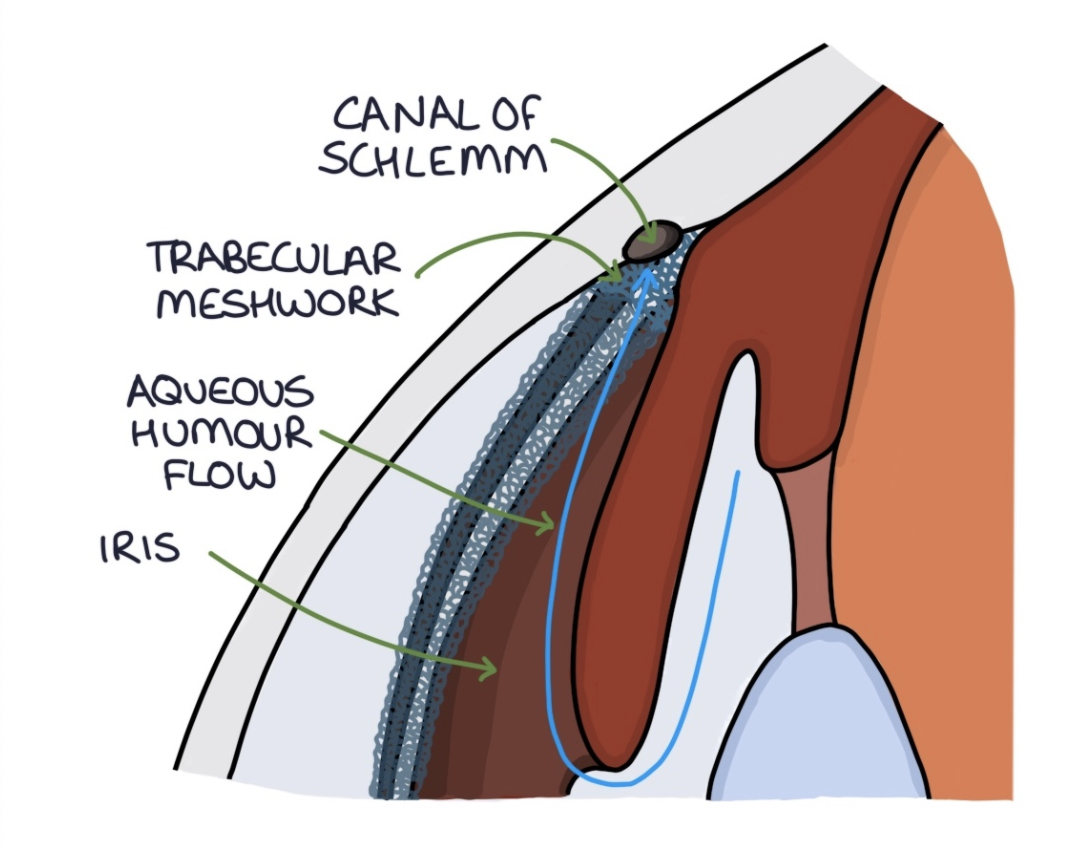
describe the pathophys of open angle glaucoma
- gradual resistance through the trabecular meshwork
- aqueous humour slowly builds up in anterior and posterior chambers
- intraocular pressure builds, giving slow and chronic onset of glaucoma
describe the pathophys of acute angle glaucoma
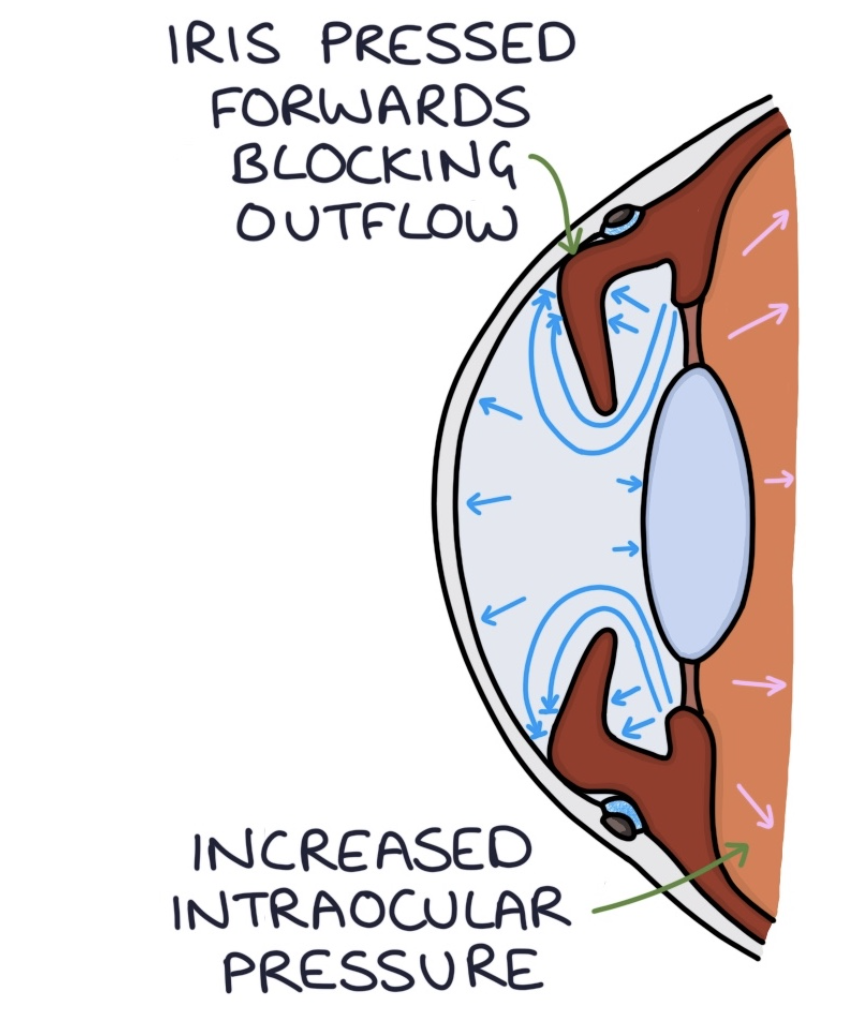
- the iris bulges forward and seals of the trabecular meshwork from the anterior chamber
- this prevents aqueous humour from draining
- this is a continual build up of pressure
- opthalmology emergancy
what happens to the optic nerve in glaucoma
- increased intraocular pressure causes cupping of the optic disc
- in the centre of a normal optic disc is an optic cup
- usually less than half the size of the optic disc
- in glaucoma the optic cup enlarges due to pressure
- this is called cupping
- an optic cup greater than 0.5 the size of the optic disc is abnormal
risk factors for open angle glaucoma
increasing age
family history
black ethnic origin
nearsightedness (myopia)
presentation of open angle glaucoma
- rise in pressure is asymptomatic for a long time so often diagnosed by routine screening during eye checks
- affects peripheral vision first gradually until tunnel vision
- can present with gradual onset of
- fluctuating pain
- headaches
- blurred vision
how do you measure intraocular pressure
- non contact tonometry
- puff of air
- less accurate but gives helpful estimate for screening
- goldmann applanation tonometry
- gold standard
- device on end of slip lamp that makes contact with cornea and applies pressure
diagnosis of open angle glaucoma
goldmann applanation tonometry
fundoscopy
visual field assessment
management of open angle glaucoma
- prostaglandin analogue eye drops are first line
- latanoprost
- other options
- beta blockers
- timolol
- carbonic anhydrase inhibitors
- dorzolamide
- sympathomimetics
- brimonodine
- beta blockers
- trabeculectomy surgery if eye drops are ineffective
- creates a bleb under the conjunctiva where aqueous humour can be reabsorbed
risk factors for acute angle glaucoma
increasing age
female sex
family history
chinese and east asian ethnic origin
rare in black people
which medications can precipitate acute angle-closure glaucoma
- adrenergic medications
- e.g. noradrenaline
- anticholinergic medications
- e.g. oxybutynin
- tricyclic antidepressants
- e.g. amitryptyline
presentation of acute angle glaucoma
severely painful red eye
blurred vision
halos around lights
associated headache nausea and vomiting
examination findings in acute angle glaucoma
red eye
teary
hazy cornea
decreased visual acuity
dilatation of the affected pupil
fixed pupil size
firm eyeball on palpation
initial management of acute closed-angle glaucoma
- ambulance
- lie patient on back without a pillow
- pilocarpine eye drops
- constricts pupil and causes ciliary muscle contraction
- opens pathway of flow of aqueous humour to trabecular meshwork
- oral acetazolamide
- reduces production of aqueous humour
- analgesia and antiemetic if required
secondary care of acute closed-angle glaucoma
- pilocarpine
- oral acetazolamide
- timolol
- beta blocker reduces production
- dorzolamide
- reduces production
- brimonidine
- reduces production and increases uveoscleral flow
- laser iridotomy is usually required
- makes hole in iris to facilitate flow
what is the most common cause of blindness in the UK
age related macular degeneration
what is the key finding seen during fundoscopy in macular degeneration
drusen
these are yellow deposits of proteins and lipids
what are the types of age related macular degeneration and which is more common and which has the worse prognosis
wet and dry
90% of cases are dry
10% of cases are wet
wet has the worse prognosis
three features common in both wet and dry AMD
atrophy of retinal pigment epithelium
degeneration of the photoreceptors
drusen
pathophys of wet amd
new vessels grow from choroid layer to the retina
these leak fluid and cause oedema
more rapid loss of vision
caused by vascular endothelial growth factor
risk factors for amd
age
smoking
white or chinese ethnic origin
family history
cvd
presentation of AMD
gradual worsening of central visual field
reduced visual acuity
crooked or wavy appearance of straight lines
wet can present more acutely with symptoms coming on over days and progress to full vision loss by 2-3 years

-
Cardiology266
-
Respiratory188
-
Neurology Brief140
-
ENT Brief122
-
Ophthalmology Brief121
-
Endocrinology147
-
Renal and Urology123
-
GI and Liver162
-
Dermatology105
-
Haematology108
-
COTE peer teaching91
-
Psychiatry and Neurology182
-
Liver and Friends209
-
Respiratory from Passmed83
-
Rheumatology and Orthopaedics89
-
Acute and Emergency106
-
OSCE123
-
Big Hitters and stuff you've got wrong152
-
mr bigstuff4



