Neonate
< 4 weeks old
- premature: born before 37 weeks gestation
- term: born after 37 weeks
Infant
4 weeks - 1 year
Child
> 1 year but < 18 years
What two things affect drug mvmt from plasma to tissues?
CO and VRG
- peds have a higher CO going to VRG plus higher surface area
What organ is the primary determinant of biotransformation?
Liver
- high extraction ratio if drugs are flow dependent clearance (ie: propofol… if liver enzymes aren’t fully developed, drugs can accumulate)
- low extraction ratio drugs are enzyme activity dependent clearance (alfentanil and methadone)
What is the primary excretion organ?
- kidneys (renal CO x extraction ratio)
– Small, unbound drugs pass from plasma to GF
– Nonionized (uncharged) drug reabsorbed in tubules
– Ionized (charged) drug is excreted.
– GFR 30-40% adult for 34+weekers; 60% by 3rd week nml @6 mos.
t1/2 life elimination
- time for [] to fall 50%
- anesthesia drugs have multiple t1/2 b/c multiple compartments model
Oral Absorption
• Principle site of absorption is small intestine.
– Rate at which drug leaves the stomach determines speed of absorption.
• Rate of absorption is slower in neonates and young infants than in older children due to delayed gastric emptying.
– Matures through infancy and doesn’t reach adult rates until 6-8 months.
Rectal Absorption
- Absorption of drugs administered rectally is erratic and variable.
- Bioavailability of rectal acetaminophen in premature neonates and infants is variable.
– It is approximately 80% of oral dose and the rate of absorption is slower.
– Rectal bioavailability is formulation dependent and
decreases with age.
– Peak blood levels achieved at 60 to 180 minutes.
Intranasal
• Rich vascular plexus of the nasal cavity provides a direct route into the blood stream for medications that easily cross mucous membranes.
- For many IN medications the rates of absorption and plasma concentrations are comparable to intravenous administration, and are typically better than subcutaneous or intramuscular routes.
- Poor patient cooperation can be a factor in absorption
Transdermal/IM
• Increased cutaneous perfusion, thinner skin in neonates increases absorption of topically applied drugs in neonates.
– More tendency to form methemoglobin so use of EMLA in neonates need to be done cautiously.
- Skin thickness, perfusion, and hydration in infancy increases percutaneous absorption.
- IM in neonates/children is not altered.
Pulmonary Absorption
• Pulmonary absorption is more rapid in infants and children than adults.
• Increased respiratory rate and cardiac index.
• Greater proportional distribution of cardiac output to vessel rich organs.
• Anesthetic levels can become toxic more quickly than adults
• Congenital anomalies with right to left shunting can delay the FA/FI of inhalational anesthetics.
Distribution
• Children exhibit different drug distributions from adults due to
– different body composition
– altered protein binding
Baby Fat/H2O and distribution: implications for anesthesia drugs
- Water soluble drugs are more diluted and have lower receptor concentrations
- The loading dose must be increased in younger children to achieve effect
- Succinylcholine dose in infants up to 4mg/kg
- Less pronounced with lipid soluble drugs
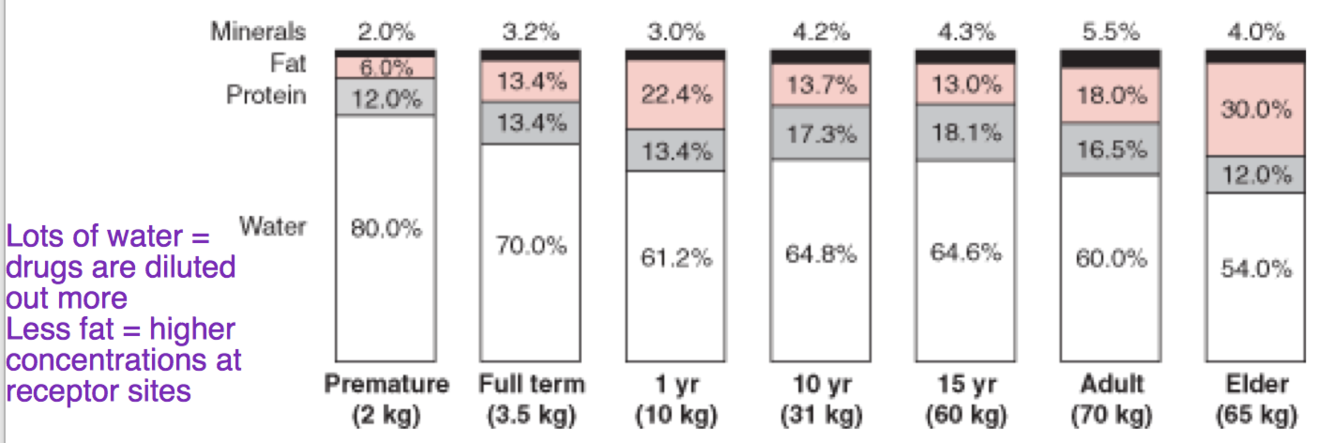
Peds Drug Distribution
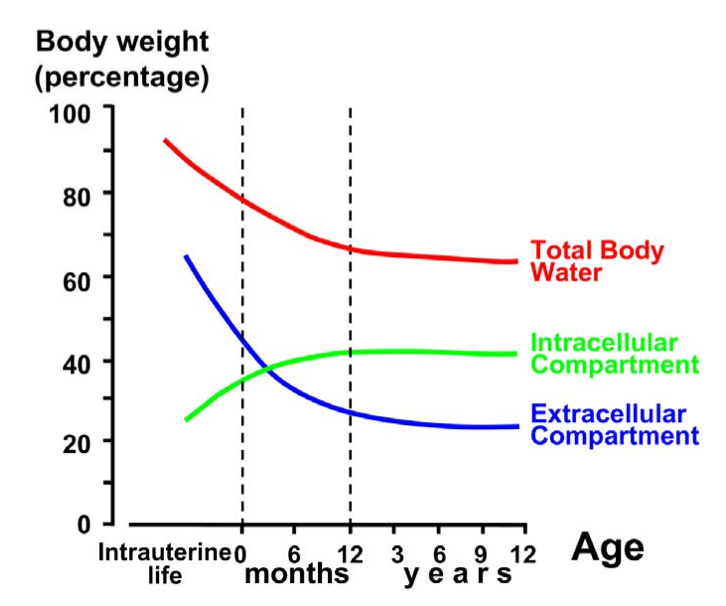
• Total body water is:
– 80-85% for premature infant
– 70-75% for term infants
– 50-60% adults
– 40% infants body weight is in ECF
– 20% adults body weight is ECF
– Vd H20 soluble drugs is >> in peds than adults
– Vd lipid soluble drugs is ??? In peds than adults
• Lower amounts of body muscle prolongs action of the drugs because?
– They can’t redistribute from site of action (Contact sensitive T 1/2 )
Compartments
- Reduction in total body water is due to a gradual decline in ECF.
- Increased Vd for water soluble drugs
– NMBDs distribute rapidly to the ECF but into cells more slowly.
– Initial dose is higher in neonates and infants.
Protein Binding
• Degree of protein binding is less in the pre-term and term infants than in older children and adults.
– Lower concentrations of total body proteins and albumin
– Many drugs that are highly protein bound in adults have less of an affinity for protein in neonates
– Bilirubin can displace protein bound drugs and vice versa
– Affects weakly bound drugs more than highly bound
Implications of lower protein binding in infants than in children/adults
– Lower concentrations of total body proteins and albumin
– Many drugs that are highly protein bound in adults have less of an affinity for protein in neonates
– Bilirubin can displace protein bound drugs and vice versa
– Affects weakly bound drugs more than highly bound
– What does this mean for anesthetic drugs?
• Lower protein binding means more free medication and a greater pharmacological effect for drugs that are highly protein bound
– What are the implication for anesthesia?
- Albumin binds Benzodiazepines, Barbiturates, and ASA
- α 1 AAG binds Amide local anesthetics, α-blockers, opioids, NMBs
Drug Metabolism
- Majority of drug metabolism happens in the liver, GI tract, gastric mucosa, and lungs
- Neonates have
– decreased Hepatic BF
– immature hepatic enzymes
—decreased biotransformation
– decreased GFR &
– decreased renal tubular fxn
– Lipid soluble compounds are converted to more water- soluble compounds.
• Water soluble drugs may be excreted unchanged in the kidneys.
What are drug metabolism implications for peds?
• Drug doses need to be adjusted accordingly and should be reduced until liver enzymes and renal function approaches adult levels.
– GFR ~ 3 months
– Tubular fxn ~ 8-12 months
Drugs w Prolonged t1/2 at Birth
– Bupivacaine-25hrs
– Meperidine-22hrs
- Diazepam-100hrs
- Phenytoin-21hrs
Hepatic Metabolism - Maturation
- Hepatic blood flow also increases as infants mature.
- Phase I metabolism (oxidation, reduction, hydrolysis)
- The cytochrome P450 enzyme system is also immature in the neonate.
– Ondansetron, acetaminophen, fentanyl, ibuprofen, codeine
– Immature system decreases the formation of some toxic metabolites, like those with acetaminophen.
• Phase II metabolism processes are immature in neonates and mature within the first year of life.
– Issues with conjugation (bilirubin)
– Beware acetaminophen, sulfonamides, chloramphenicol
Extrahepatic Elimination Implications
• Non Specific Esterase activity may be increased
– Remifentanil clearance:
- is greater in neonates (4.5 L/hr/kg)
- than in infants (3.7 L/hr/kg)
- or in adults (2.1 L/hr/kg) meaning what? keep remi infusions running when transporting pts!!!
What is the implication of decreased plasma pseudocholinesterases in neonates?
- ester LA may have a prolonged effect!
- decrease doses
- avoid sux for undiagnosed DMD






