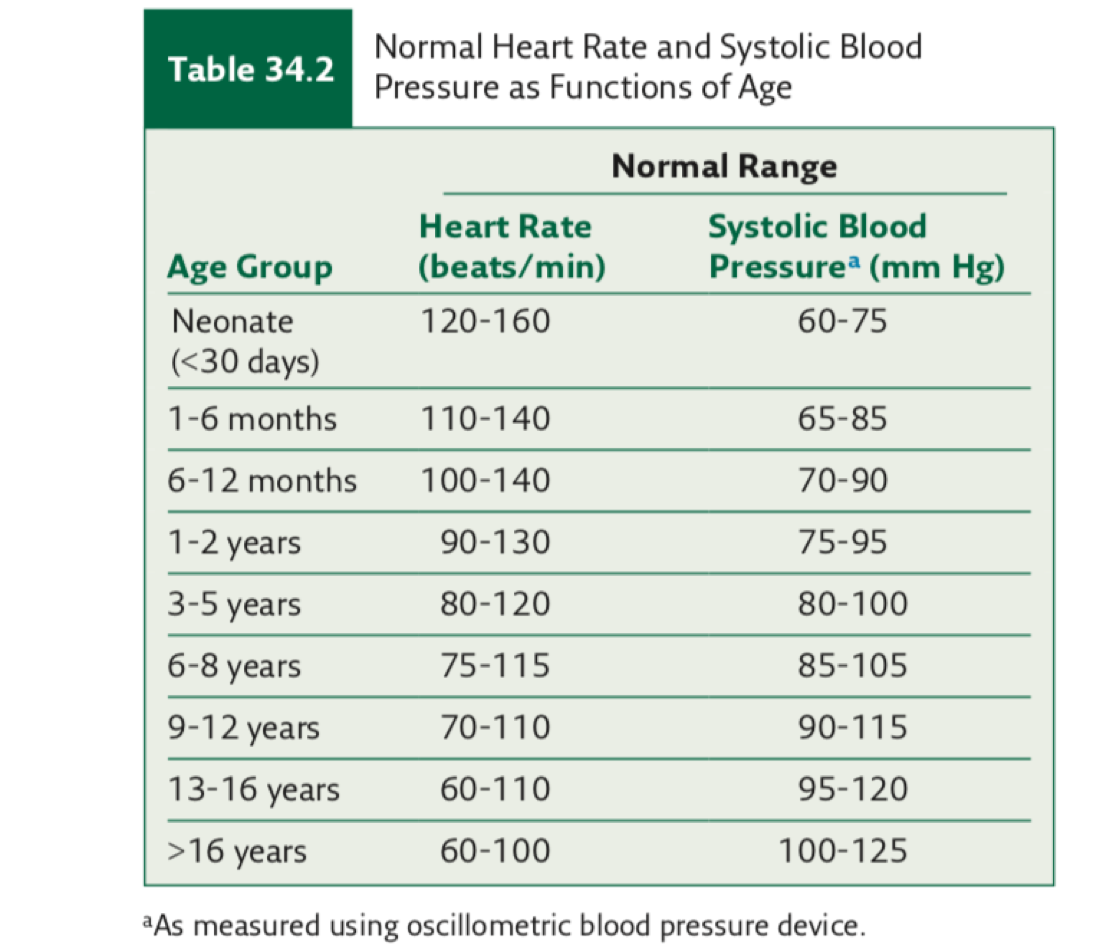
How can you calculate the low range of age appropriate SBP?
Age 2-10 years: 70 + (age * 2)
At what age do you usually need to pre-medicate with oral versed?
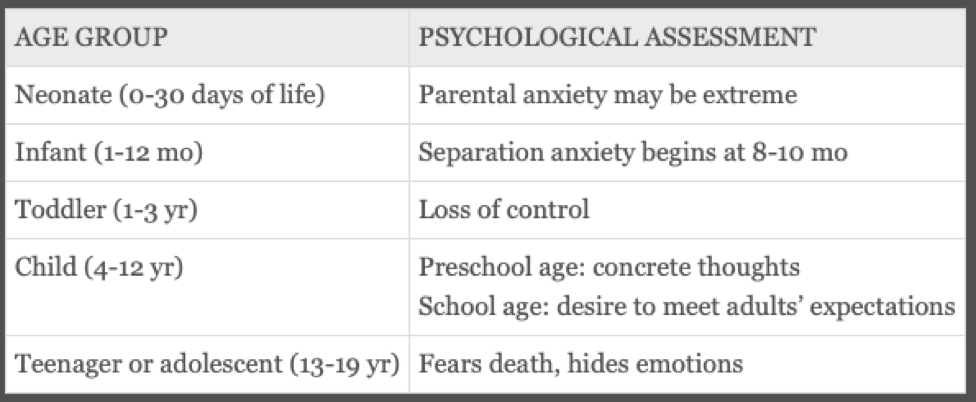
What are some noteable developmental ages? (table)
neonate
infant
toddler
child
teenager
10 mo d/t separation anxiety.
**nasal versed can burn!
What should be emphasized in the pre-op evaluation?
- birth history
- neological development (appropriate for age?)
- airway anomalies, previous intubations
- Genetic or dysmorphic syndrome
- routine pregnancy test age 10+
- No laboratory workup for healthy kids with minimal blood loss surgery
- Standard adult assessment
What patients are at higher risk for latex allergy?
- spina bifida
- myelodysplasia
- urinary tract malformations
- multiple previous surgeries
What should you ask during the respiratory focused portion of the Pre-op assessment?
- Frequent URI?
- Hx of wheezing?
- Hx of noisy breathing?
- Hospitalizations?
- previous intubations?
- Hx of eczema/skin allergy?
- In daycare? Immunization status?
- Smokers in house?
- Infant: Frequent vomiting or choking with feeds?
- Child? Frequent tonsillitis? ear infections? snoring?
What should you ask during the CV focus portion of the pre-op assessment?
- Any family history of CHD or chromosoma abnormalities?
- family hx of sudden/premature death
- maternal illness or infections (both chronic or during pregnancy)
- maternal medications/drug use
- Infant: problems with poor feeding, sweating during feeding, poor weight gain, FTT (Red flag for undiagnosed cardiac problem)
- Older child: Inability to keep up with activity level of peers, need frequent rest, anorexia, cough, wheezing, rales, chest pain
What should you do if you detect a murmur?
- Investigate further: **Diastolic or symptomatic murmurs need further investigation
- cyanosis
- syncope
- arrhythmias
- tachy
- poor feeding
- activity intolerance
- Innocent murmors are found in up to 50% of normal children (esp age 2-6)
- these are systolic ejection murmurs and are accentuated by stress, anemia, fever
Where should you find the liver?
What would a bigger liver be indicative of?
- Palpate liver 1-2 sm below costal margin
- If larger, could be fluid overload or RV failure
How can you distinguish central cyanosis from peripheral cyanosis?
What is acrocyanosis?
- arterial desaturation or central cyanosis is best detected in the perioral area, the mucous membranes of the mouth, lips and gums
- Peripheral cyanosis can occur in a cold environment
- Acrocyanosis is due to sluggish circulation in the fingers and toes
How is does pain work for neonates?
- C fibers are fully functional from early fetal life
- unmyelenated/slow for somatic pain
- Connections btw C fibers and dorsal horn neurons are not mature before second week of postnatal life
- nociceptive stim transmitted to dorsal horn by C fibers elicit long-lasting responses
- neonates have an exaggerated response to stimuli
- inhibitory control pathways are immature at birth and develop over first 2 weeks
- **painful procedures during the neonatal period modify subsequent pain responses in infancy and childhood
- pre-emptive analgesia can reduces this
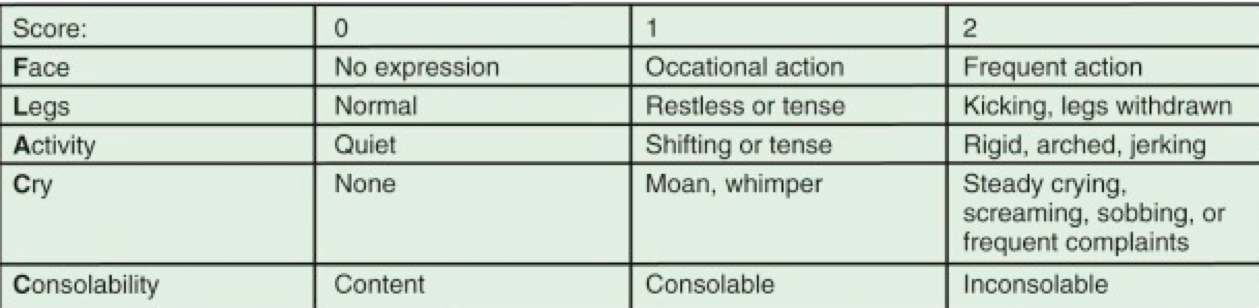
What is the commonly used pain scale in infants and young children?
- < 3 yo cannot self report
- FLACC used
- face
- legs
- activity
- cry
- consolability
What are some key points to setting up a room for a pediatric case?
- Always have a range of sizes of airway equipment
- straight blades are commonly preferred d/t pediatric airway anatomy
- Calculate drug doses, ABL, and fluid replacement
- prepare a pediatric circuit and preset vent settings
- Emergency drugs:
- wt app sch and atropine with IM needle
- syringe of propofol
- epi diluted to 10 mcg/ml (for a sick pt)
- warm the room
How is an inhalation induction done?
- Pt can be seated or supine
- Higher flows with 70% N2O and 30% O2
- Fully open APL
- allow a few breaths of N2O then incrementally turn Sevo up to 8%
- Turn off N2O to provide 100% O2
- Assist spontaneous ventilation prn
- caution with high inspired volatile agent with assisted or controlled ventilation
- if HR starts to lower, TURN DOWN GAS!
- Obtain IV
- Once IV is in, induction proceeds
- propofol, narcotic, +/- NMB then proceed with airway management
- Be sure to turn Sevo down to normal MAC for child
What should you consider for an RSI in children?
- +/- cricoid pressure–may obstruct airway with little proven benefit
- Need to have all equipment ready, including functioning IV
- Drugs:
- Propofol 2-4 mg/kg (stable)
- Ketamine 1-2 mg/kg (unstable)
- etomidate 0.2-0.3 mg/kg (unstable)
- Sch 2 mg/kg IV, 4 mg/kg IM with atropine 0.02 mg/kg
- Roc 1.2 mg/kg if sch is contraindicated (expect 45-75 min duration)
- Calcium should be immediately available in the event sch leads to unanticipated hyperkalemia with ventricular arrhythmias
What is the formula for ETT in a pt >2 yo?
How do you calculate depth?
What should leak be at?
(16 + age) / 4
* subtract 0.5 if using a cuffed tube
Depth is tube size x 3
Leak should be at 20-30 cm H2O
Why might you want to use a cuffless tube for a pt who needs a size 3-4 ETT?
Because those tubes are so small they can be difficult to ventilate through so it isnt always worth having a cuff to make it even smaller.
What are the contraindications for LMA use in pediatrics?
- Children at risk of pulmonary aspiration
- mediastinal masses
- children requiring high peak airway pressures to ventilate
- tracheomalacia
- limited mouth opening
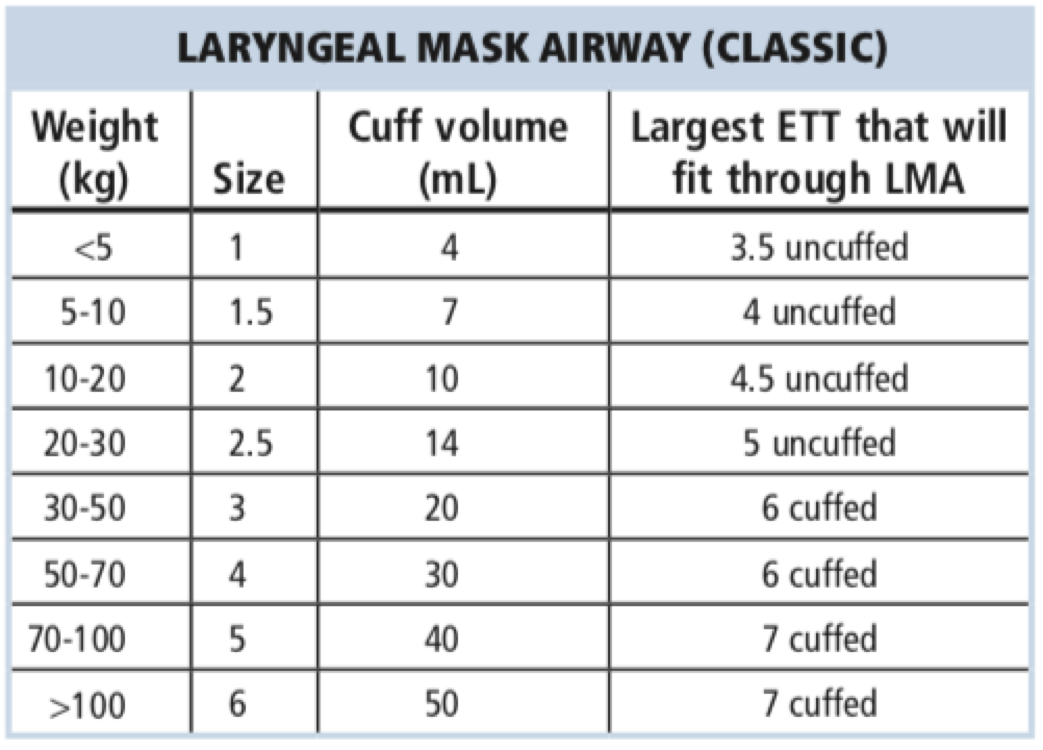
What size LMA would you use for: (table)
<5 kg
5-10
10-20
20-30
30-50
50-70
70-100
>100
What size ETT would you use for: (table)
preterm infant
term infant
1-6 mo
7-12 mo
1-2 years
etc..
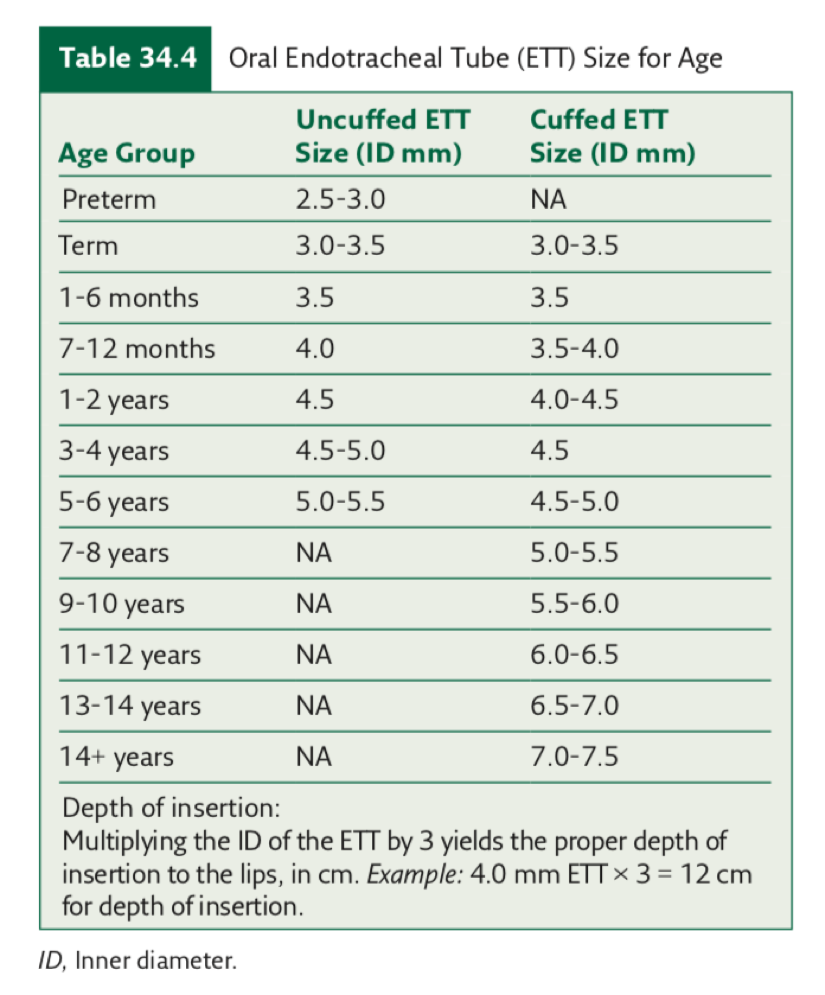
How should you handle a pediatric intubation in a pt with a known difficult airway?
- Plan for nasal intub
- apply monitors, inhalation induction, obtain IV (maintain spontaneous ventilation)
- Administer glyco (5 mcg/kg) and proporol prn to deepen
- prepare nasal cavity with oxymetazoline
- Put nasal airway in smallest nostril and attach ett connector
- place fiberoptic scope with previously loaded nasal RAE ETT through the opposite nostril
- visualize glottic opening, spray cords with lidocaine, enter trachea and spray trachea
- lubricate the tube and slowly pass trhough the nose into trachea
- confirm placement
Pediatric vent settings
- 6-8 ml/kg
- Sustained plateau pressure >35 can lead to barotrauma:
- pneumothorax
- pneumomediastinum
- sub q enphysema
- Use lung protective strategies
What causes subglottic stenosis?
How can it be avoided?
- 95% of subglottic stenosis is acquired
- usually postintubation injury
- Risk factors:
- trauma during intubation
- ETT movement during intubation
- prematurity
- presence of infection at time of intubation
- Avoid:
- avoid oversize ETTs
- monitor cuff pressures through long cases and extended intubations
- maintain < 20-30 cm H2O
Laryngospasm!
Who?
symptoms?
treatment?
- More frequent in infants and risk decreases with age
- recent uri
- secondhand smoke
- stimulation while “light”
- secretions in airway
- Sx:
- stridor- may be absent if completely closed
- retractions
- flailing of lower ribs (rocking horse chest movement)
- Tx:
- continuous postitve pressure
- 100% O2
- jaw thrust
- suctions
- deepen
- atropine and Sch- IV or IM
What is considered bradycardia?
Infant
1-5 yo
>5 yo
What can cause bradycardia?
Treatment?
- Bradycardia:
- Infants: <100 BPM
- 1-5 yo: <80 BPM
- >5 yo: <60 BPM
- Causes:
- hypoxia (leading cause)
- vagal stim
- increased ICP
- meds (Sch)
- CHD
- hypothermia
- air emboli
- tension pneumo
- Treatment:
- Treat the cause!
- think oxyganation and ventilation first!
- Atropine if of vagal origination 0.02 mg/kg
- Epi if decompensated 10 mcg/kg
- Treat the cause!

-
Pediatrics43
-
Pediatrics 232
-
Pediatric Disorders and Problems33
-
Neonatal31
-
Neonatal 226
-
Transplant36
-
Transplants II41
-
ENT I33
-
ENT II45
-
OB I39
-
OB II28
-
Renal I- Physiology Review26
-
Renal II18
-
Renal III- procedures23
-
Obesity34
-
Obesity II19
-
GI23
-
Liver - Anatomy28
-
Liver- Disease28
-
Liver- Periop management18



