What is the likely cause of the gingival recession seen in the lower anterior sextant?
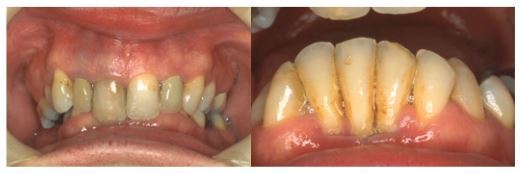
Traumatic overbite
When would mechanical root surface debridement not be successful in eliminated pocket bacteria?
* Difficulty with access (especially in furcation). * Non compliant patient. * Inadequate RSD/inexperience of clinician. * Patient is immunocompromised. * Sites inaccessible to instruments. * Failure to disrupt biofilm
When would antibiotics not be effective in periodontal disease?
* Antibiotics resisted by biofilms. * Concentration inadequate and not within the therapeutic range. * May not reach site of disease activity
How would you manage a periodontal abscess with systemic involvement?
* Incision and drainage. * Gentle sub-gingival debridement. * HSMW * Extraction of tooth if poor prognosis. * Antibiotics * Follow up HPT
What would be clinical signs of improved periodontal health?
* Reduced probing depth (<4mm). * BoP <10%. *Plaque scores <15%
*A photo showing a space between 13 and 14*
What investigations should be carried out and why?
* BPE; a screening tool for periodontal health. *PGI to assess plaque and bleeding levels. *6PPC to assess periodontal disease. * Periapicals to assess prognosis of teeth, drifting by periodontal disease. * Study models (offers a point of reference)
What bacteria are involved in ANUG?
P. Intermedia and fusobacterium as well as spirochetes such as treponema
What are the clinical signs and symptoms of ANUG?
* Blunting of interdental papilla. * Halitosis. * Grey slough that wipes off to reveal ulcerative tissue. * crater like ulcers. * Reverse gingival architecture
List 5 risk factors for ANUG
* Age (young) *Stress *Poor OH *Immunocompromised (HIV) *Smoking
Briefly outline management of ANUG
* Ultrasonic debridement *Oxygenating MW (hydrogen peroxide 3%) *OHI modified for patient *Consider Chlorhexidine *Smoking cessation if needed * ABs if systemic or immunocompromised (Metronidozole 200mg 3 x daily for 3 days)
Patient is obese and a reformed smoker, history of ischemic heart disease. Despite excellent OH he still has pockets of 6/7mm that BoP. You elect to undertake open flap curretage. What do you discuss with the patient to get informed consent?
* Risks; gingival recession, infection, pain, bleeding, swelling, bruising. *Benefits; effectively debride area with direct vision *Outcomes; possible reduction of pocket depths *Other treatment options; Repeat NSPT *Risks of no treatment; increase in pocket depth, increase in mobility, increased risk of tooth loss
A patient has just completed surgical periodontal therapy, when should the patient be reviewed and what is the rationale?
8 weeks to allow sufficient time for healing.
What are the clinical signs of improved health following HPT?
* Pocket depths <4mm *BoP <10% * Plaque score <15%
Why might antibiotics not work for chronic periodontal disease?
* Biofilms resistant to antibiotics. * Antibiotic resistance. * Antibiotics inactivated by first pass metabolism. * Poor patient adherence to regime
Describe how a modified plaque score is recorded
* Recorded for every patient
* 16, 21, 24, 36, 41, 44 (Ramfjords teeth)
* Each tooth is split into buccal/lingual.interproximal surfaces
* 2 = visible plaque
1 = Plaque revealed with probe
0 = no plaque
Describe how a modified bleeding score is recorded
* Recorded for every patient
* Measures marginal bleeding rather than BoP
* Each Ramfjords tooth has a perio probe run gently at 45 degrees around the gingival sulcus in a continuous sweepl For up to 30 seconds after probing, check for the presence or absence of bleeding.
* mesial, distal, buccal, lingual
* Score of 1 or 0
What are the four stages of periodontal disease?
Worst site of bone loss is used
Stage 1; (early/mild) <15% or <2mm from CEJ
Stage 2; (moderate) Coronal third of root
Stage 3; (severe) Mid third of root
Stage 4; (very severe) Apical third of root
How is periodontal disease graded?
% of bone loss divided by patients age
Grade A slow rate of progression, <0.5
Grade B Moderate rate of progression, 0.5-1
Grade C Rapid rate of progression >1
How do you rate the assessment of current periodontal status?
Currently stable; BoP <10%, PPD = 4mm, No BoP at 4mm sites
Currently in remission; BOP >/= 10%, PPD = 4mm, no BoP at 4mm sites
Currently unstable; PPD >/= 5mm
PPD >/= 4mm and BoP
What clinical and lab investigations can be carried out to help aid a periodontal diagnosis? (3marks)
* Thorough history including family history.
* Periodontal pocket chart
* Microbiological analysis of swab of crevicular fluid
In a patient with periodontal disease, how would you decide the prognosis for individual teeth? (3)
* Loss of attachment
* Mobility
* Furcation involvement
What are some proposed biofilm resistance mechanisms?
*Antimicrobials may fail to penetrate beyond the surface layers of the biofilm
*Antimicrobials may be trapped and destroyed by enzymes.
*Antimicrobials may not be active against non-growing microorganisms
*Expression of biofilm specific resistance genes (eg efflux pumps)
*Stress response to hostile environment conditions
Give 3 features of apical periodontitis
*Chronic poly-microbial infection
*Stimulation of host response
*Connective tissue destruction
Besides the lower anterior sextant, where else might you expect to see signs of a traumatic overbite?
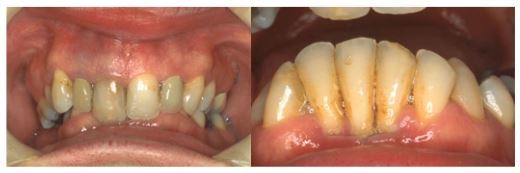
Palatal gingivae of upper anteriors



