- A 15 year old high school wrestler sustains a left shoulder dislocation during a match. After the shoulder is relocated, he has difficulty abducting his arm, although he has a strong grip and normal sensation to pin in his hand and fingers. Your examination demonstrates normal function of the biceps, triceps, and external rotators of the shoulder. The MOST likely explanation of these findings is injury of :
A. Axillary nerve
B. C5 nerve root
C. Suprascapular nerve
D. Diffuse brachial plexus stretch
A. Axillary nerve
The patient has an isolated axillary nerve injury. This is a well recognized, though relatively infrequent, complication of shoulder dislocation. A diffuse plexus injury is ruled out by the evidence of motor and sensory preservation in other upper extremity muscles. The presence of shoulder external rotatory function rules out both C5 nerve root injury and suprascapular injury.
- A 38 year old male experiences severe acute right arm pain and then develops severe deltoid wekness and mild biceps and triceps weakness. After 6 weeks he seeks consultation. Axial MRI imaging at C4 – 5 and C5 – 6 are shown. The next appropriate step is :
A. EMG/NCS
B. Epidural steroid injection
C. Physical therapy
D. CT myelogram
E. ACDF C4 – 5 and C6 – 7
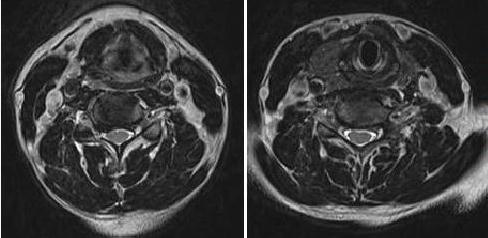
A. EMG/NCS
The correct answer is EMG/NS. This patientis presenting with brachial plexitis, or Parsonage – Turner syndrome (PTS). The classic presentation of PTS is acute polyradicular pain without weakness which resolves over two weeks, only to develop into weakness affecting multiple nerve root distributions, most prominently the proximal arm and shoulder girdle. Significant supraspinatus and deltoid muscle weakness result in the complete inability to abduct the shoulder, which is a hallmark of PTS. The etiology is unknown, but preceding risk factors include recent viral illnesses, trauma or infection. An EMG/NS could confirm multiple motor and sensory abnormalities suggesting brachial plexus involvement and not radiculopathy, which would establish the diagnosis.
ACDF is not an appropriate next step given the likehood of PTS. The severity of weakness in the deltoid.
- A 40 year old patient undergoes resection of a facial schwannoma that is infiltrating the facial nerve from the cisternal segment to the mastoid segment. The nerve is resected with the tumor for a gross total resection. When considering a facial to hypoglossal anostomosis, what is the ideal timing of surgical intervention to maximize return of facial nerve function?
A. Within 12 months of facial nerve paralysis
B. Within 6 months of facial nerve paralysis
C. Within 2 months of facial nerve paralysis
D. Within 24 months of facial nerve paralysis
E. There is no relationship between the duration of facial nerve paralysis and functional recovery
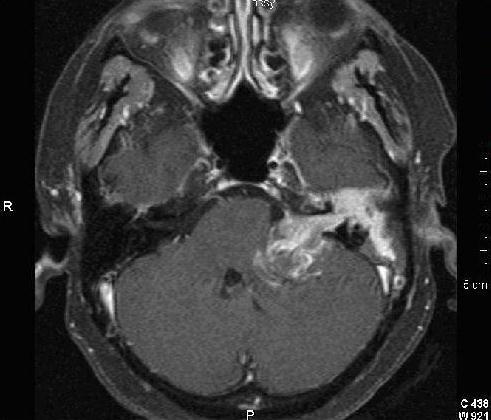
E. There is no relationship between the duration of facial nerve paralysis and functional recovery
Ther is no relationship between the duration of facial nerve paralysis and functional recovery following hypoglossal – facial nerve anastomosis (E). in comparing patients treated between 7 to 23 months as caompared to those treated within 3 months, no significant difference was identified in the degree of facial nerve recovery. Patients can display up to a 2 month delay in functional recovery with delayed repair. However the final results are equivalent in nearly and delayed facial nerve repair. Patients older than 50 years have been found to have a slightly poorer but still acceptable result as compared to younger patients.
- A 65 year old man is seen for continued left medial hand pain after a failed submuscular ulnar nerve decompression procedure two months ago. Upon re – evaluation, new (less than 1 month) left ptosis and myosis is observed. The MOST likely diagnosis is :
A. Raeder’s Para – trigeminal neuralgia
B. Superior sulcus tumor (Pancoast tumor)
C. Parsonage Turner syndrome of the medial cord
D. Ulnar injury at an elbow level
E. Thoracic outlet syndrome
B. Superior sulcus tumor (Pancoast tumor)
A superior sulcus tumor (a.k.a Pancoast tumor) can invade the lower trunk of the brachial plexus and the sympathetic fibers arising from T1 (a.k.a Pancoast’s syndrome). While thoracic outlet syndrome can affect the lower trunk, ptosis, and myosis are not characteristic findings. Raeder’s paratrigeminal neuralgia is associated with ptosis and myosis and facial pain. It would not explain persistent medial arm pain. Similiarly neither medial cord inflammatory injury nor ulnar nerve trauma would account for the ptosis and myosis observed.
- An 18 year old man undergoes an excisioanal biopsy of an enlarged lymph node in his posterior cervical triangle. Followng the procedure it becomes evident that his spinal accessory nerve was accidentally damaged. You see this patient in consultation 3 months post operatively regarding a possible repair. Which of the folowing clinical findings is LEAST useful in confirming a trapezial palsy secondary to spinal accessory nerve damage :
A. Ipsilateral scapular winging
B. Absent shoulder shrug
C. Ipsilateral trapezius atrophy
D. Affected shoulder lower at rest
E. Difficulty abducting affected arm > 90 deg
B. Absent shoulder shrug
The answer is absent shoulder shrug (i.e. ipsilateral scapular elevation). The ability to elevate the scapula is usually maintained in patients with spinal accessory palsies. Spinal accessory palsies are often undiagnosed because patients maintain their ability to shrug the affected shoulder. This is because two muscles elevate the scapula. The upper portion of the trapezius inervated by the spinal accessory nerve and the levator scapula innervated by motor branches from the cervical plexus. However, this residual shoulder shrug movement is often asymmetric, which hints towards the correct diagnosis. Furthermore, posterior cervical triangle lymph node biopsy is the most commoncause of spinal accessory injury, and at this location some early branches to the trapezius muscle may have been spared, which also help maintain scapular elevation. Patients with trapezius palses usually present with scapular region discomfort and
- In doing a nerve transfer procedure to recover elbow flexion which of the following two nerves are coapted?
A. Ulnar and radial
B. Radial and musculocutaneus
C. Spinal accessory and suprascapular
D. Ulnar and musculocutaneus
E. Radial and median
D. Ulnar and musculocutaneus
This procedure is designed to re-innervate the biceps muscle for elbow flexion. It is one of the most important of the nerve transfer procedures. In this procedure approximately 15% of the ulnar nerves is transferred to the musculocutaneous nerve in the arm.
- Lack of function in which muscle indicates a very proximal C5 nerve root injury?
A. Rhomboid
B. Flexor carpi ulnaris
C. Opponens policis
D. Supinator
E. Biceps
A. Rhomboid
The dorsal scapular nerve to the rhomboid muscle is one of the few nerves to ernanate directly off a nerve root. In this case C5. Very proximal nerve root damage or root avulsion will therefore manifest in loss of function of this muscle (among others). A more distal injury will frequently leave the rhomboid intact
- One of the best ways to ascertain that ulnar nerve compression is distal (at the wrist) and not proximal (at the elbow) is to
A. Test for weakness of the adductor policis muscle
B. Test the strength of the first dorsal interosseus muscle
C. Test ulnar nerve sensation on the dorsal and palmar surface of the hand
D. Test the strength of the abductor digiti minimi (V)
C. Test ulnar nerve sensation on the dorsal and palmar surface of the hand
Testing ulnar sensation on the dorsal and palmar surfaces of the hand best distinguishes proximal from distal ulnar neuropathy, as sensory innervations is distinct on these surfaces. The dorsal sensory branch of the ulnar nerve leaves the ulnar nerve at approximately 2 to 3 inches proximal to the wrist and innervates only the dorsal ulnar hand. The ulnar nerve then crosses the volar wrist through Guyon’s canal to supply sensation to the palmar ulnar hand. Thus, ulnar nerve compression at the wrist (e.g. Guyon’s canal syndrome) causes decreased palmar ulnar sensation and normal dorsal ulnar sensation. All the intrinsic hand muscles may be equally affected by compression at either the elbow or the wrist. Depending on the site of the compression within Guyon’s canal, some intrinsic muscles may be spared
- What is the best recommendation for a patient who has moderate carpal tunnel syndrome (confirmed by EMG) but does not want surgery?
A. Steroids
B. Diuretics
C. NSAIDS
D. Botox
E. Vitamin B6
A. Steroids
There is (1) strong evidence (level 1) on the efficacy of local and oral steroids. (2) moderate evidence (level 2) that vitamin B6 is ineffective and splints are effective and (3) limited or conflicting evidence (level 3) that NSAID’s, diuretics, yoga, laser and ultrasound are effective whereas exercise therapy and botulinum toxin B injection are ineffective
- Which of the following is the MOST appropriate surgical treatment for upper extremity hyperhidrosis :
A. Carpal tunnel release
B. Vagal nerve stimulation
C. Thoracic sympathectomy
D. Dorsal rhizotomy
E. Spinal cord stimulation
C. Thoracic sympathectomy
Hyperhidrosis was one of the first indications for thoracic sympathectomy. T2 and T3 sympathectomy are generally sufficient for palmar hyperhidrosis but T4 should be added in for axillary hyperhidrosis. The surgery can be accomplished through a midline posterior incision or through a thorascopic approach. Compensatory hyperhidrosis of other parts of the body may occur and may limit the benefit of the surgery. The T1 sympathetic ganglia should be spared; injury to the sympathetic ganglia at T1 may result in Horner’s syndrome.
A 40-year-old female undergoes biopsy of an enlarged posterior cervical lymph node, which proves to be benign. Post-operatively, she develops severe aching shoulder pain on effort and loss of muscle bulk in her supraclavicular area. The most likely diagnosis is:
A. Long Thoracic Nerve injury
B. Thoracic Outlet Syndrome
C. spinal accesory nerve injury
D. Parsonage Tumor syndrome
C. spinal accesory nerve injury
The cause of the problem is a spinal accessory nerve injury resulting in atrophy and weakness of the trapezius. The shoulder pain with activity is likely due to over-compensation of the remaining shoulder girdle muscles. Biopsy of cervical lymph nodes in the posterior triangle of the neck can cause spinal accessory palsy by direct trauma, or stretching or division of the nerve, which runs obliquely across the posterior triangle. Neither brachial plexitis (Parsonage-Turner syndrome) nor cervical disc herniation affect the trapezius since the spinal accessory is a cranial nerve and not part of the brachial plexus. The same is true of the thoracic outlet syndrome, which only involves the brachial plexus. Long thoracic nerve palsy weakens the serratus anterior, a chest wall-based muscle and thus does not cause supraclavicular atrophy.




