What are the 3 main methods used in the manufacture of compressed tablets?
Direct Compression
Wet Granulations
Dry Granulation
Why do you use granulation in tablet manufaturing?
To increase bulk density
To improve flow properties
To improve mixing quality
To improve compactability
To optimise dissolution process
- If particles are hydrophobic/poorly soluble
- Dissolution improves by mixing with hydrophilic filler and binder.
What are the advantages and disadvantges of low shear granulation?
No advantage
Disadvantage
- Manual transfer of material required
- Long drying times
- Mixing issues due to tray drying
What are the advantages and disadvantages of using high wet shear granulation?
Advantages
- Lower amounts of water used vs. low shear granulation
- Short processing times
- End-point of granulation can be monitored
- Closed vessel and possible transfer to fluid bed drier
Disadvantages
- Risk of overgranulation
What are the pros and cosn of using Fluidised Bed Granulation?
Pros
- All steps completed in the same equipment
- Easy for the optimised process to be automated
Cons
- Initial upfront cost to purchase equipment
- Extensive development work needed to optimise process
- Unlikely to have a one-size-fits all solution that applies to all formulations
How does a spray drier effect granulation?
Dry granules obtained from a suspension or solution
Produces free-flowing, hollow, spherical particles with good compaction properties
Can result in significant changes in material properties
- hard elastic materials can be made more ductile
- e.g. spray-dried lactose is amorphous
What intragranular excipients are used for wet granulation?
Filler/diluent
- microcrystalline cellulose (MCC)
- median diameter of 50 microns
- good compactability
- lactose
- fine grade to ensure sufficient binding
Binder (2-10% by weight)
- added as a dry powder to drug + filler
- water added during granulation process
- added pre-dissolved in water
- water content = 20-50% of the dry powder weight
- need to balance tablet hardness vs. drug release
Disintegrant
Examples of extragranular excipients
- Disintegrants
- Lubricants
What are the Pros and Cons of dry granulation?
Pros
Cost effective
Versatile method
Easy to scale-up
Uniform mechanical strength
Gentler than slugging
Describe the 6 step process of dry granulation.
- Particle size reduction with grinding the drug
- Then, it is mixed with intragranular excipients ( part of the granules)
- Instead of a drying step , as there is no granulation fluid, there will be a particle size reduction step. Roller compaction (flakes/strips) or slugging method (tablets)
- It is then grinded again and screened.
- Extragranular excipients are added to the granules. Excipients that are not part of the granule.
- This mixture will be taken to the tablet press.
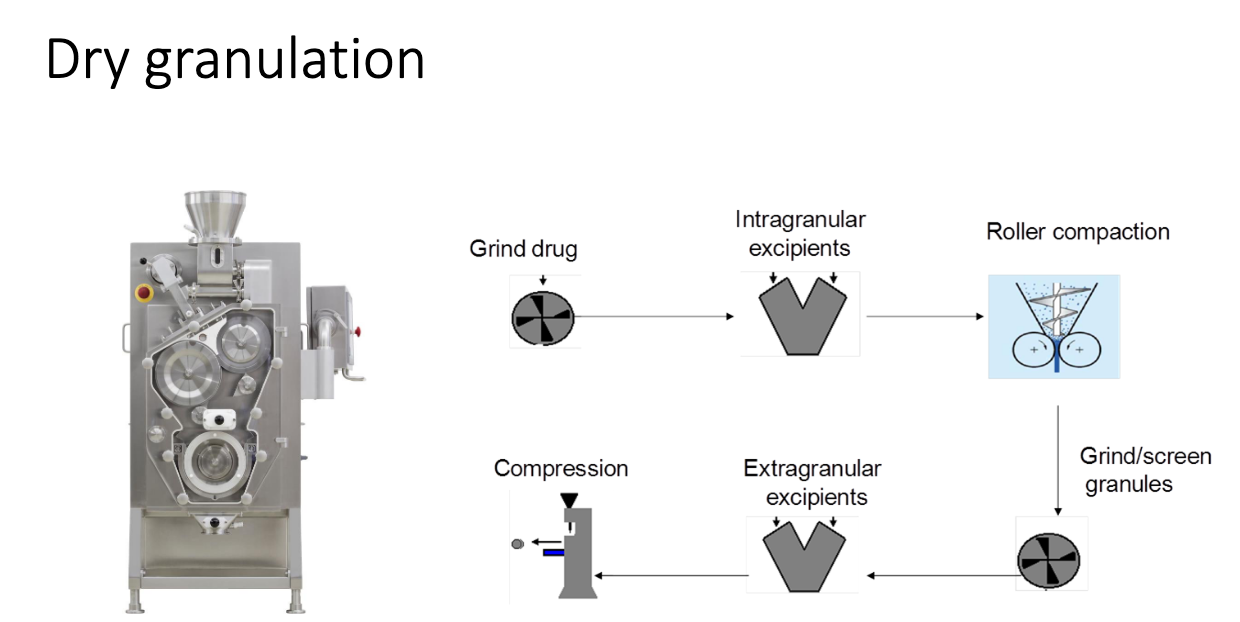
What are examples of exipients used in dry granulation?
Filler
- Anhydrous Lactose popular choice due to the re-compaction properties of the product.
- Micro-Crystalline Cellulose (MCC) for roller compaction.
Binder
- Dry binder used.
- e.g.pregelatinised starch, cross-linked PVP
What are examples of glidants used?
Colloidal silica 0.2%
Talc 1-2%
What are examples of lubricants?
Magnesium stearate
Stearic acid
What extragranular exipients are used in wet granulation?
Disintegrant
Lubricant
Pros and Cons of melt granulation?
Pros
Very soft, and disintegrate quickly
Cons
Small in size, limiting their use to drugs active at low doses.
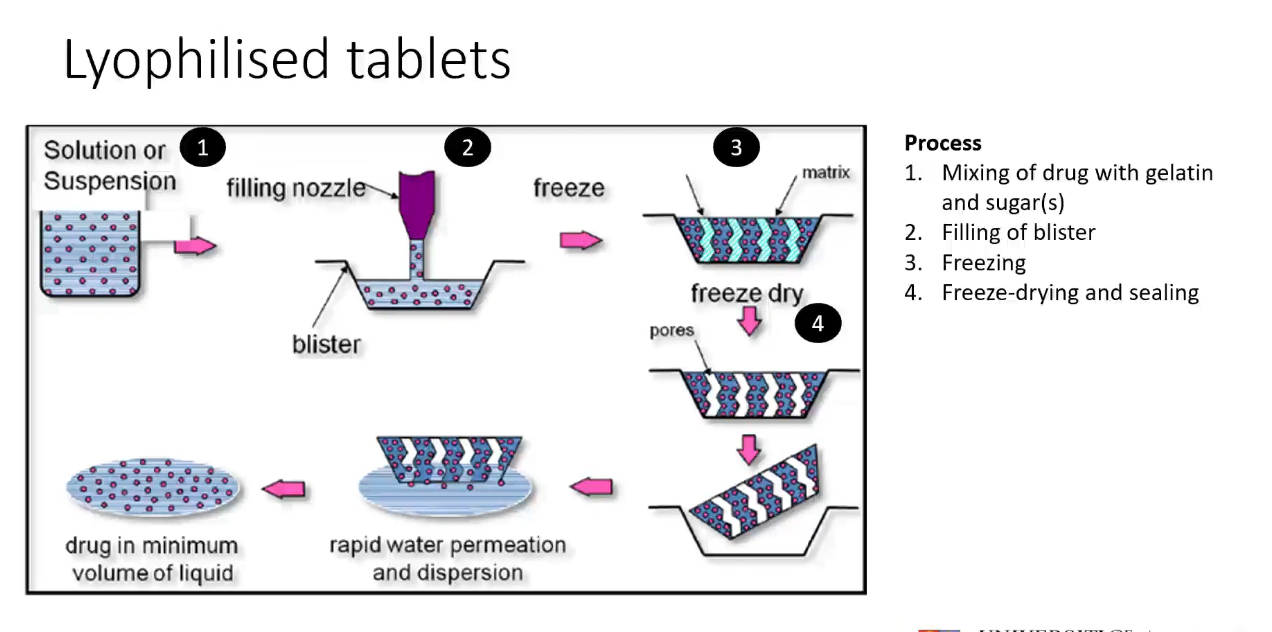
What is the process of manufacturing lyophilised tablets?
- Mix the drug with gelatine and sugar(s)
- Filling of blister pack
- Freezing
- Freeze-drying and sealing
How are moulded tablets prepared?
- The drug is mixed with a diluent- water soluble diluent are preffered ( lactose, dextrose, sucrose, mannitol. Check for incompactiblilites with sugars
- A liquid is added to the powder to wet the powder and allow moulding- alcohol-water mixtures are commonly used for that purpose
- Tablet generated after evaporation under vacuum
- e.g, glyceryl trinitrate sublingual tablets
What is the importance of the freezing step, wehn manufacturing lyophilised tablets?
Freezing rate is important as it effects the size of the crystals and the eventually the size of the pores in the tablet. We need the tablet to be strong enough to not break apart while processing, manufacture and transport but we still need the tablet to porous enough so water can go inside the tablet quickly.
Pros and Cons of manufacturing lyophilised tablets.
Pros
Fast disintegration
Suitable for patients with difficulty swallowing
rapid water permation and dispersion - minimum volume of liquid
Cons
Taste and feel may be an issue
Soft and will brake if forced through the blister (need to peel the seal)
What are the 3 main types of tablet presses?
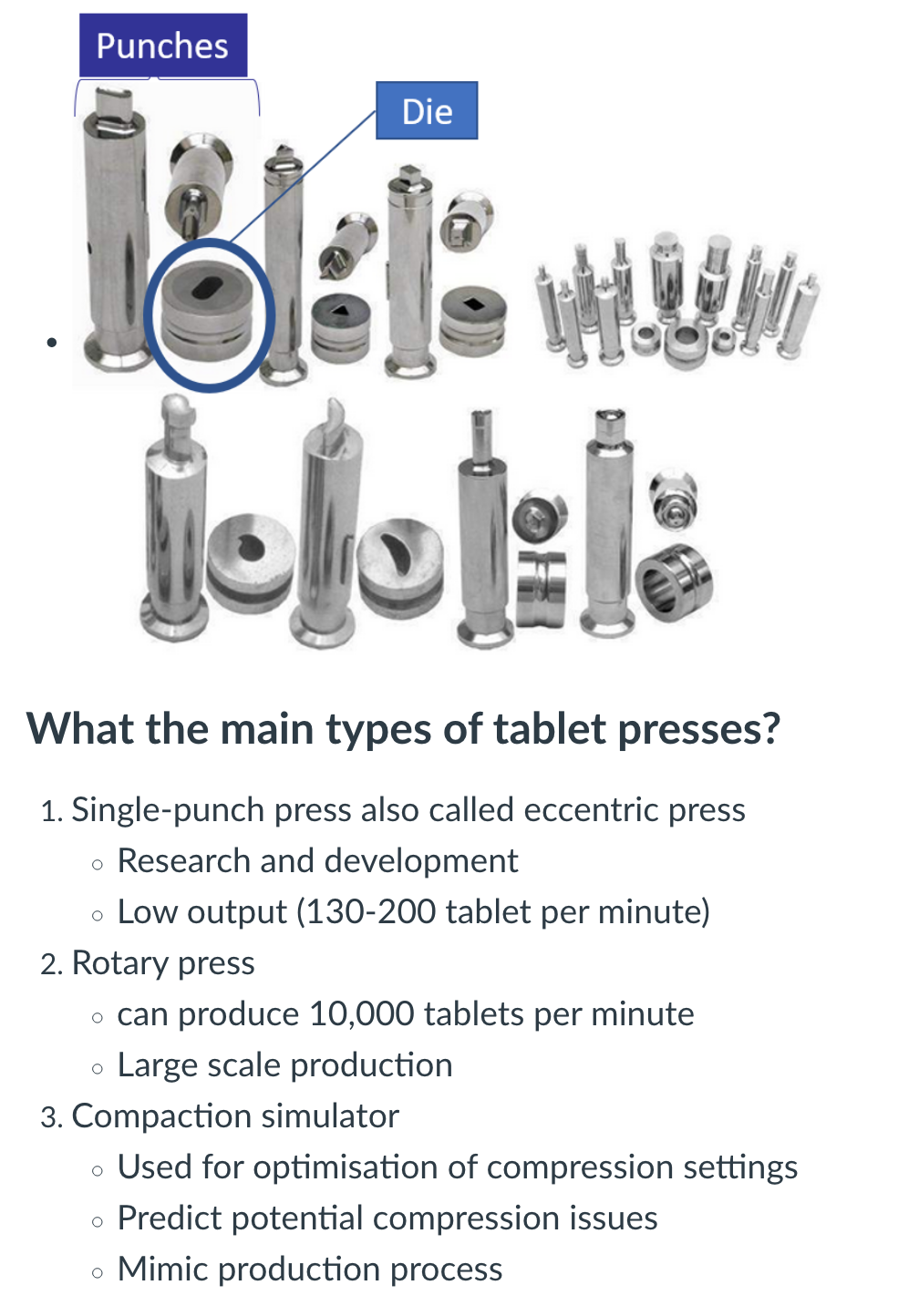
What are the 3 stages tablets are formed during compression of tablets?
Die filling
Compression and compaction
Tablet ejection
Talc 1-2%
- Works as a glidant aswell as antiadherent
- Hydrophobic- impacts wetting/dissolution
Starch
- Glidant
- Large quantities may be required
- Can also help disintegration
- Commonly used as a binder or diluent
Colloidal silicon dioxide
- Efficient glidant
- Small spherical particles
- Particles “glide” over each other under pressure
- Can be hydrophilic or hydrophobic
*
Magnesium stearate <1%
- Glidant
- Commonly used as a lubricant
- Can promote flow at low concentrations

-
Pharmaceutical powders41
-
Hard-shell Capsules42
-
Soft-Shell Capsules32
-
Oro-mucosal Administration41
-
Particle Size Reduction, Mixing, Granulation and Drying58
-
Pharmaceutical Tablets32
-
Tablets: Compression and Compaction17
-
Tablet Testing18
-
Pulmonary Drug Delivery23
-
Pulmonary Drug Delivery: Deposition30
-
Compressed Tablets and Coating18
-
Nasal Drug Delivery16
-
Sterile Products29
-
Contamination Control42
-
Opthalmic Drug Administration32
-
Parenteral Administration26
-
Pharmacokinetics of Parenterals22
-
Stability and Drug Degradation23
-
Kinetics of Drug Degradation15
-
Shelf Life and Overage & Stability Testing11
-
Packaging47



