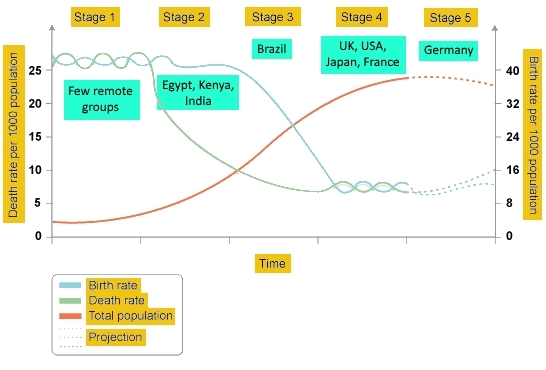
Draw and label the Demographic Transition Model.
Provide an example for each section.
Try to explain what is going on in each stage.
Stage 1) High fluctuating - Birth rates and death rates are high, stable population.
Stage 2) Early expanding - Better medical care, clean water and better food supply.
Stage 3) Late expanding - Improved education, better access to contraception and family planning advice. Change in social attitudes.
Stage 4) Low fluctuating - High levels of education, more women entering higher education. Stable population.
Stage 5) Decline - Aging population, more deaths than births.
What is Natural Increase?
The difference between the birth rate and death rate.
What factors affect population growth?
- Agricultural change - As technology improves, machines take the place of manual labour so it is less important to have a large family.
- Urbanisation - People leave the countryside and move to towns. Children are more likely to go to school and families tend to be smaller.
- Education - As levels of education rise, particularly among women, birth rates fall.
- Women’s status - Countries where women are well-educated and participate in well-paid work usually have a low birth rate.
What is Infant Mortality?
The number of babies who die under the age of five years per 1,000 people.
What are Young dependants?
Children who are dependent on older, economically active people.
What are Elderly dependants?
People who are dependent on younger, economically active people.
What is an asylum seeker?
Someone seeking asylum (Safety).
What is a refugee?
An accepted asylum seeker.
What is a voluntary migrant?
Somebody moving on their own terms.
What is forced migration?
Somebody forced to move elsewhere.
What does GDP stand for?
Gross Domestic Product.
It is the monetary value of all the finished goods and services produced within a country’s borders in a specific time period.
Name ways to improve an ageing population.
- Jobs for elderly people e.g) B&Q.
- Increase country taxes.
- Encourage immigration.
- Incentives to having babies.
- Raise pension age/retirement age.
- Cut pensions.
Name ways to improve a young population.
- Build more schools - More children with an education, more taxes.
- Improve healthcare - Higher life expectancy, more taxes. However, more invested in healthcare.
What are the problems with having a high elderly population?
- Need more care homes.
- Need to pay more pensions, resulting in higher tax for economically active citizens.
- ‘Grey vote’.
- Cost of social activities/leisure.
- Healthcare - Mental health, waiting times, beds, hip replacements.
What are the problems with having a high young population?
- Small economically active population.
- School capacity, demand on education.
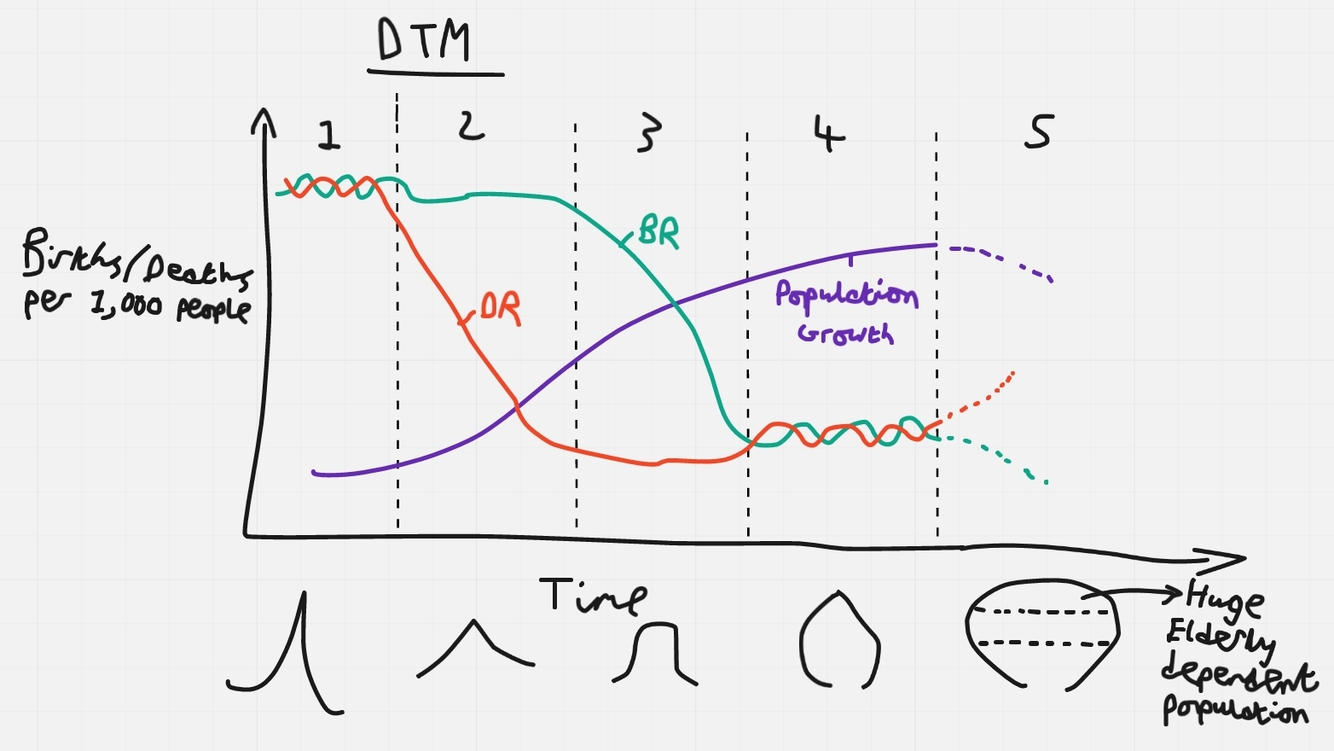
Draw and label the Demographic Transition model and provide Population Pyramids for each stage.
This time, you do not need to explain what is going on in each stage.

-
The Coastal Zone27
-
Tourism14
-
Restless Earth32
-
Water on the Land44
-
The Coastal Zone - [CASE STUDY] The Holderness Coastline11
-
The Coastal Zone - [CASE STUDY] Essex Saltmarshes3
-
The Coastal Zone - [CASE STUDY] London Thames Barrier5
-
Restless Earth - [CASE STUDY] Haiti Earthquake21
-
Restless Earth - [CASE STUDY] Soufriere Hills Volcano (Montserrat)9
-
Restless Earth - [CASE STUDY] Uses of Mountains4
-
Restless Earth - [CASE STUDY] Asian Tsunami8
-
Water on the Land - [CASE STUDY] Flooding in an MEDC6
-
Water on the Land - [CASE STUDY] Yarm Flood Management Scheme3
-
Water on the Land - [CASE STUDY] Kielder water - Managing water supply5
-
Water on the Land - [CASE STUDY] Flooding in an LEDC6
-
Tourism - [CASE STUDY] UK as a Tourist Destination4
-
Tourism - [CASE STUDY] Tourism within the UK8
-
Tourism - [CASE STUDY] Tourism outside the UK6
-
Tourism - [CASE STUDY] Ecotourism9
-
Tourism - [CASE STUDY] Extreme Tourism7
-
Population16
-
Population - [CASE STUDY] Non-birth control policy7
-
Population - [CASE STUDY] Birth control policy11
-
Population - [CASE STUDY] Ageing population5
-
Population - [CASE STUDY] Migration within the EU7
-
Population - [CASE STUDY] Migration from outside the EU8
-
Changing Urban Environments45
-
Changing Urban Environments - [CASE STUDY] Issues in the CBD (MEDC)6
-
Changing Urban Environments - [CASE STUDY] Issues and solutions in Inner Cities (MEDC)6
-
Changing Urban Environments - [CASE STUDY] Rapid Urbanisation in a LEDC5
-
Changing Urban Environments - [CASE STUDY] Solutions to improve problems caused by rapid urbanisation4
-
Changing Urban Environments - [CASE STUDY] Sustainable Urban Living3
-
Water on the Land - [CASE STUDY] Named examples of features1
-
Restless Earth - [CASE STUDY] Earthquake in an MEDC9
-
Coastal Environments - [CASE STUDY] Named examples of features3



