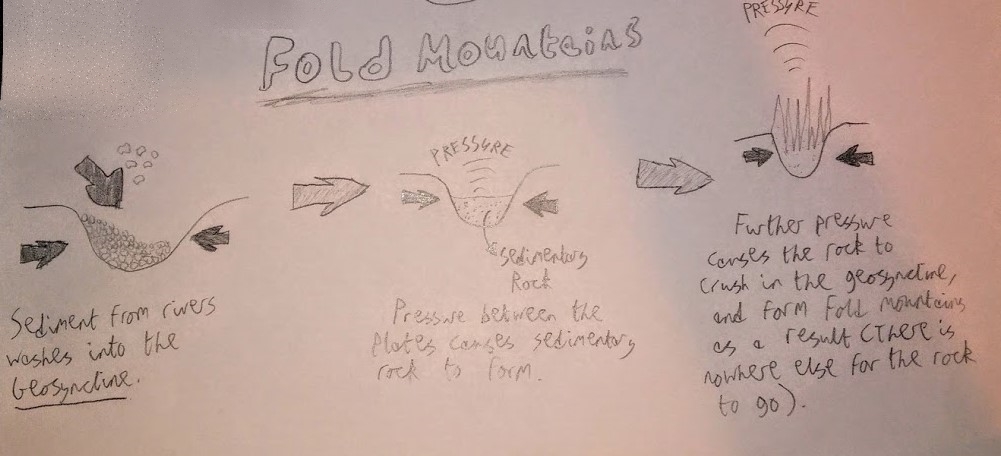
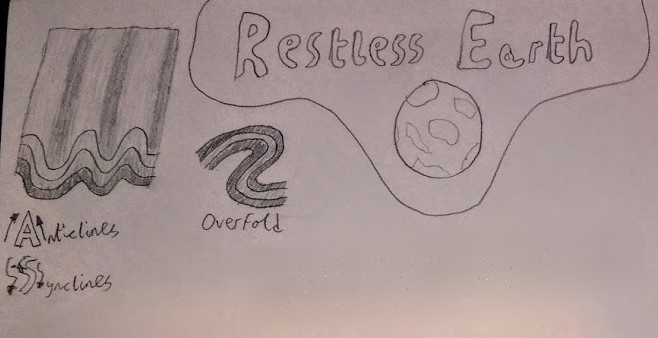
Describe with diagrams how fold mountains form.
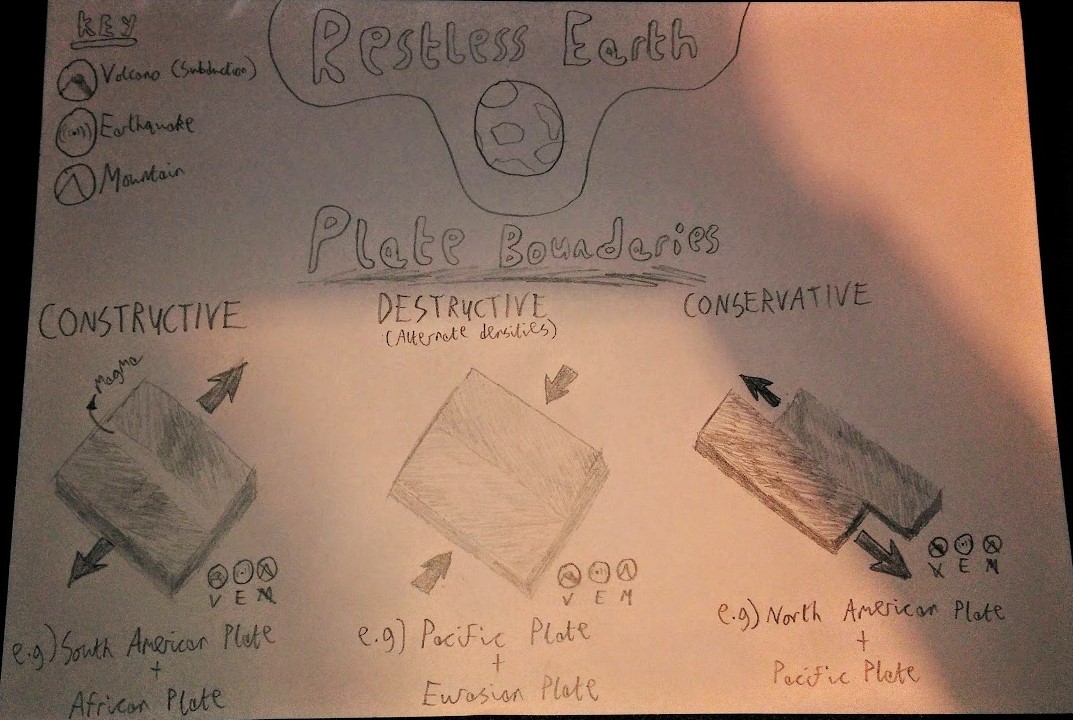
Name the 3 types of plate boundaries, the features found on them and an example.
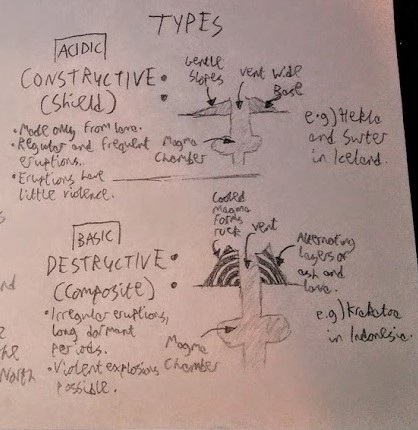
Draw diagrams and compare Shield and Composite volcanoes.
Remember to compare the types of lava, and guess which volcano has which type of lava.
Additional info:
- Pahoehoe lava is less viscous and slightly hotter.
- Aa lava is more viscous and slightly cooler.
- Composite volcanoes have Aa lava.
- Shield volcanoes have Pahoehoe lava.
[IGNORE ACIDIC/BASIC]
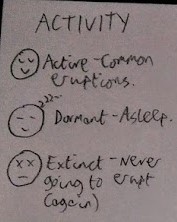
Name the 3 types of volcano states.
What is a lahar?
A type of mud/debris flow caused by a pyroclastic flow, typically across a river valley.
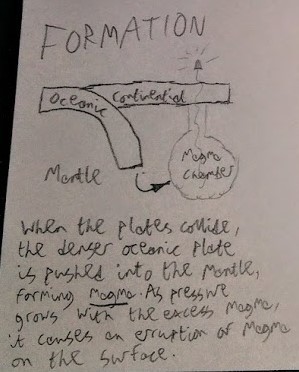
Explain with a diagram how a Volcano is formed.
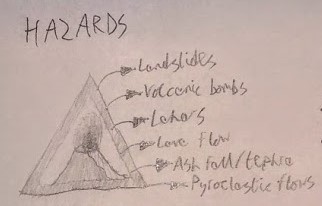
Name some hazards of volcanoes.
Which volcano type has more viscous lava?
Composite volcanoes are more viscous,
therefore we also know that Shield Volcanoes are less viscous.
If lava is more viscous, is it more or less runny?
More viscous means gloopier, and less runny. It will travel shorter distances.
Where do volcanoes tend to be found?
Volcanoes are usually found by plate boundaries.
Most of which are found where the Pacific Plate meets the indo-Australian, North/South American Plates, Eurasian Plate and Philippine Plate; this is known as the Ring of fire.
A high silica content makes lava more/less viscous.
A high silica content makes lava more viscous.
Name an example of a Shield volcano.
Hekla Volcano in Iceland, on the North American and Eurasian plates.
Name an example of a Composite volcano.
Krakatoa Volcano in Indonesia, found on the Indo-Australian and Eurasian plates.
What is a supervolcano?
A very large volcano that erupts with a massive volume of material - at least 1000 cubed kilometers of magma.
Give an example of a supervolcano.
Yellowstone, USA.
What are some facts of supervolcanoes?
- 90% of people in a 60 mile radius would be killed by an eruption.
- There would be a 15 mile vertical blast.
- 250 cubic miles of ash, dust and gas would erupt.
What would people be killed by in a supervolcano?
- Pyroclastic flows - heat.
- Ash inhalation.
- Freezing.
- Explosion from impact.
Name some short-term impacts of a supervolcano.
- Air would be sucked out from underground bunkers.
- Buildings destroyed - roofs collapse under pressure from ash.
Name some long-term impacts of a supervolcano.
Any of the following:
- Covers 1/2 of US.
- Roots covered by ash.
- Cars and planes crash/destroyed.
- Effects visible from space.
- Effects visible for >2 million years.
- Acid rain.
- Could cause mini ice age due to dust volume in atmosphere.
- Farms/plants wouldn’t have much sunlight.
- Darkness.
- Clogged up water supplies.
- Economic impact.
- Social impact.
What is a geosyncline?
The seabed in which sediment is deposited.
What are the three types of rock folds?
An ocean trench forms when…
An ocean trench forms when subduction occurs on the oceanic plate.
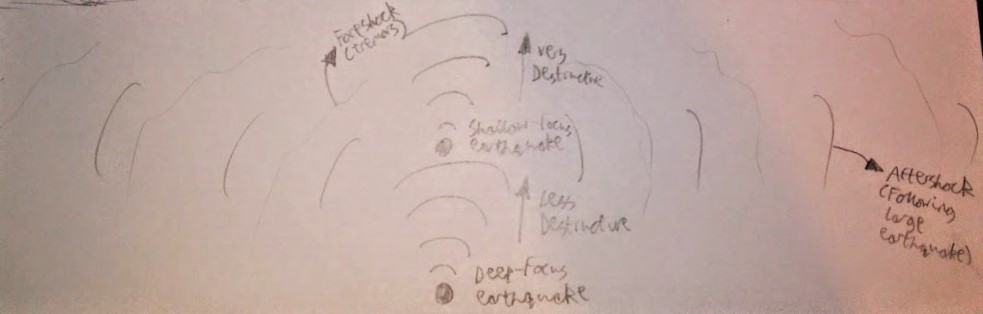
Draw a diagram and label an Earthquake.
Name 3 ways that volcanoes can be monitored.
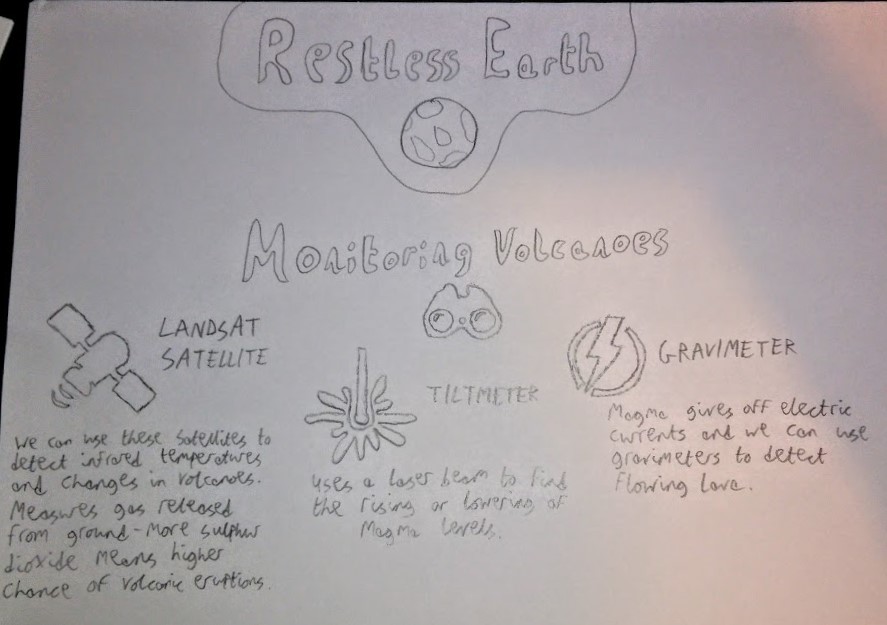


-
The Coastal Zone27
-
Tourism14
-
Restless Earth32
-
Water on the Land44
-
The Coastal Zone - [CASE STUDY] The Holderness Coastline11
-
The Coastal Zone - [CASE STUDY] Essex Saltmarshes3
-
The Coastal Zone - [CASE STUDY] London Thames Barrier5
-
Restless Earth - [CASE STUDY] Haiti Earthquake21
-
Restless Earth - [CASE STUDY] Soufriere Hills Volcano (Montserrat)9
-
Restless Earth - [CASE STUDY] Uses of Mountains4
-
Restless Earth - [CASE STUDY] Asian Tsunami8
-
Water on the Land - [CASE STUDY] Flooding in an MEDC6
-
Water on the Land - [CASE STUDY] Yarm Flood Management Scheme3
-
Water on the Land - [CASE STUDY] Kielder water - Managing water supply5
-
Water on the Land - [CASE STUDY] Flooding in an LEDC6
-
Tourism - [CASE STUDY] UK as a Tourist Destination4
-
Tourism - [CASE STUDY] Tourism within the UK8
-
Tourism - [CASE STUDY] Tourism outside the UK6
-
Tourism - [CASE STUDY] Ecotourism9
-
Tourism - [CASE STUDY] Extreme Tourism7
-
Population16
-
Population - [CASE STUDY] Non-birth control policy7
-
Population - [CASE STUDY] Birth control policy11
-
Population - [CASE STUDY] Ageing population5
-
Population - [CASE STUDY] Migration within the EU7
-
Population - [CASE STUDY] Migration from outside the EU8
-
Changing Urban Environments45
-
Changing Urban Environments - [CASE STUDY] Issues in the CBD (MEDC)6
-
Changing Urban Environments - [CASE STUDY] Issues and solutions in Inner Cities (MEDC)6
-
Changing Urban Environments - [CASE STUDY] Rapid Urbanisation in a LEDC5
-
Changing Urban Environments - [CASE STUDY] Solutions to improve problems caused by rapid urbanisation4
-
Changing Urban Environments - [CASE STUDY] Sustainable Urban Living3
-
Water on the Land - [CASE STUDY] Named examples of features1
-
Restless Earth - [CASE STUDY] Earthquake in an MEDC9
-
Coastal Environments - [CASE STUDY] Named examples of features3



