Derivative of log_a(x)
1/(ln(a)x)
Shannon’s noiseless coding theorem
H(X) is the minimum average numer of bits to store one of Alice’s messages ie a message x_i can be compressed to an average of H(X) bits
How are 0 and 1 distributed for optimally encoded messages?
They have equal frequency
Classical joint entropy =
The information we would get if we observed X and Y at the same time.
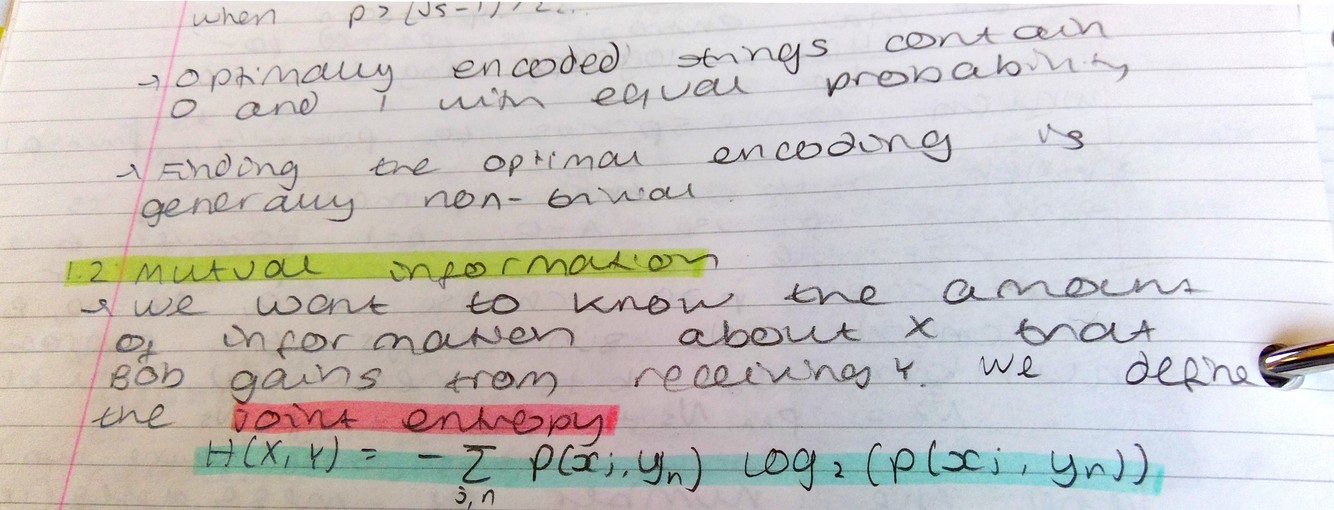
Classical conditional entropy =
The entropy of X conditional on knowing Y - tells us how uncertain Bob is about X after measuring Y.
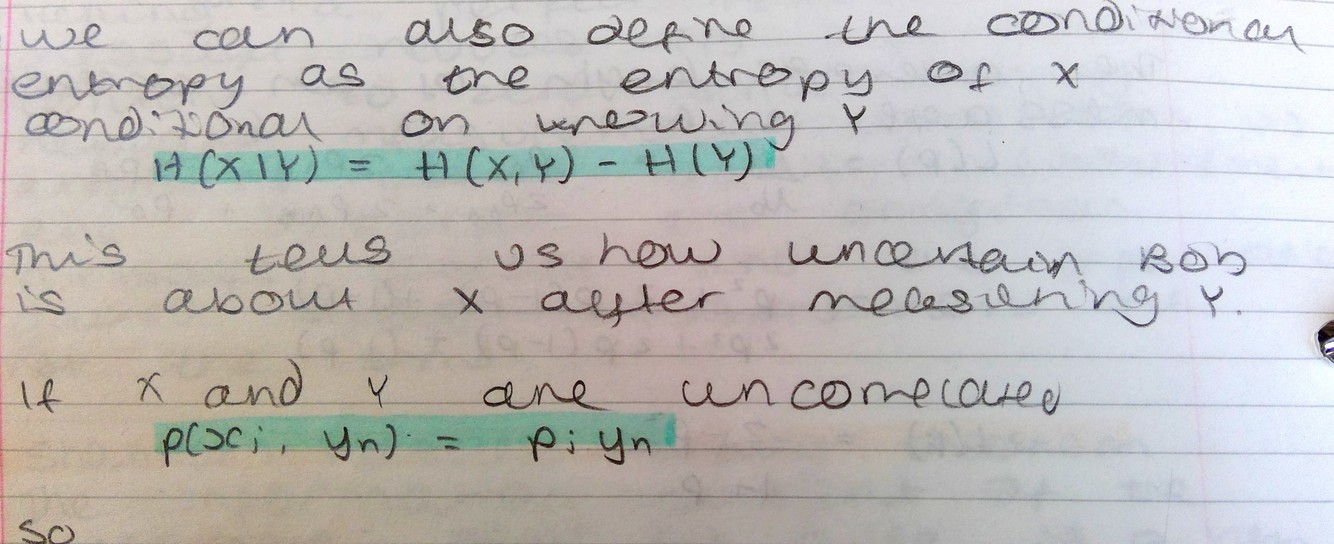
Classical mutual information =
The amount of information obtained about X by observing Y and vice versa
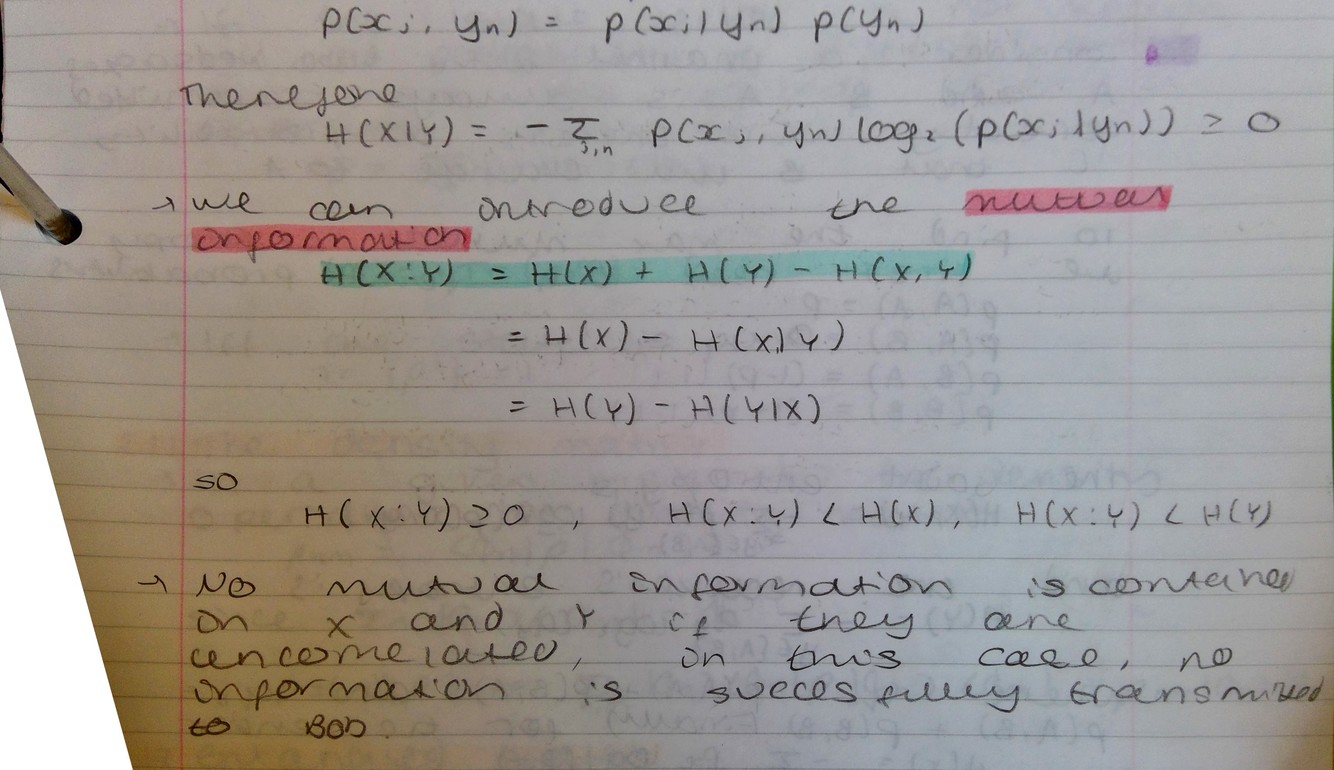
Channel capacity =
The amount of information taht can be transmitted in one use of the channel
Noiseless channel =
A channel where X is perfectly correlated with Y
Shannon’s noisy channel theorem?
Channel capactiy is the max value of the mutual information where the max is taken over all probability distributions of X.
Von neuman entropy
-Tr (p log_2(p))
Schaumer’s quantum noiseless channel coding theorem =
p in a d dimensional Hilbert space can be reliably compressed and descompresssed to a quantum state in a Hilbert space with dimension 2^s(p) ie it can be represented by s(p) qubits.
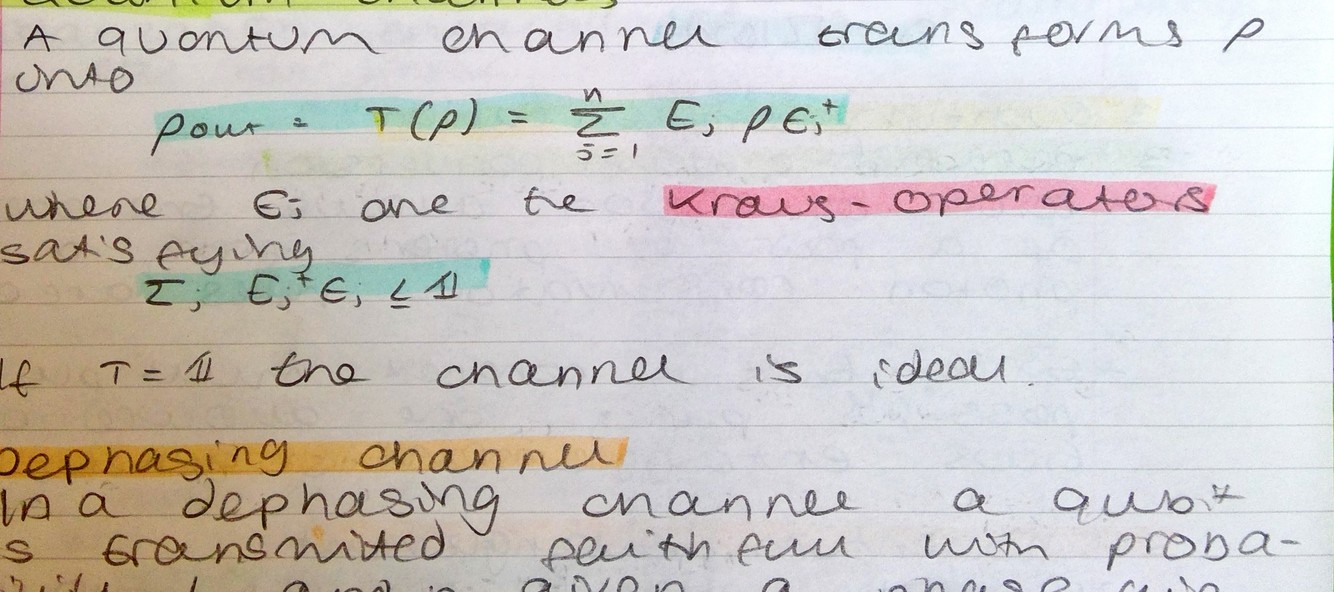
How does a quantum channel transform p
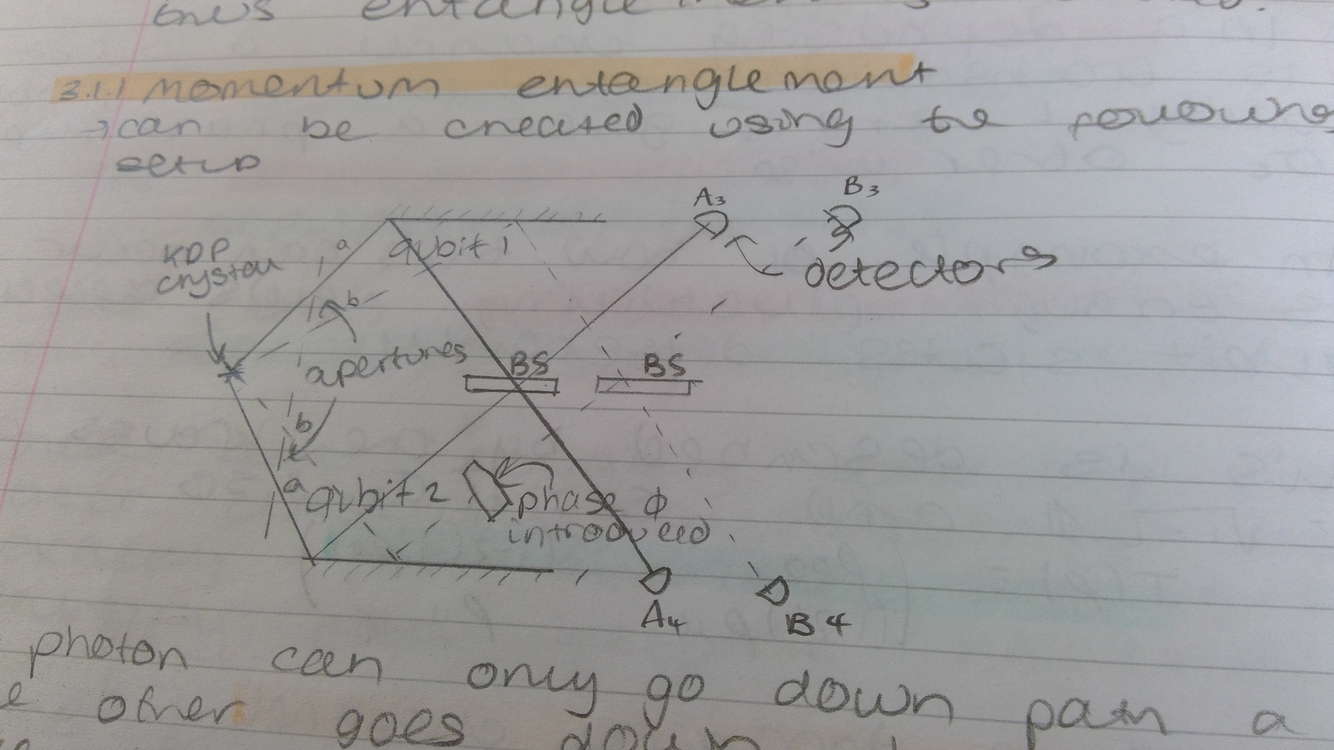
Draw a diagram of how momentum engtanglement is generated
A photon can only go down a if the other goes down b and vice versa due to phasematching
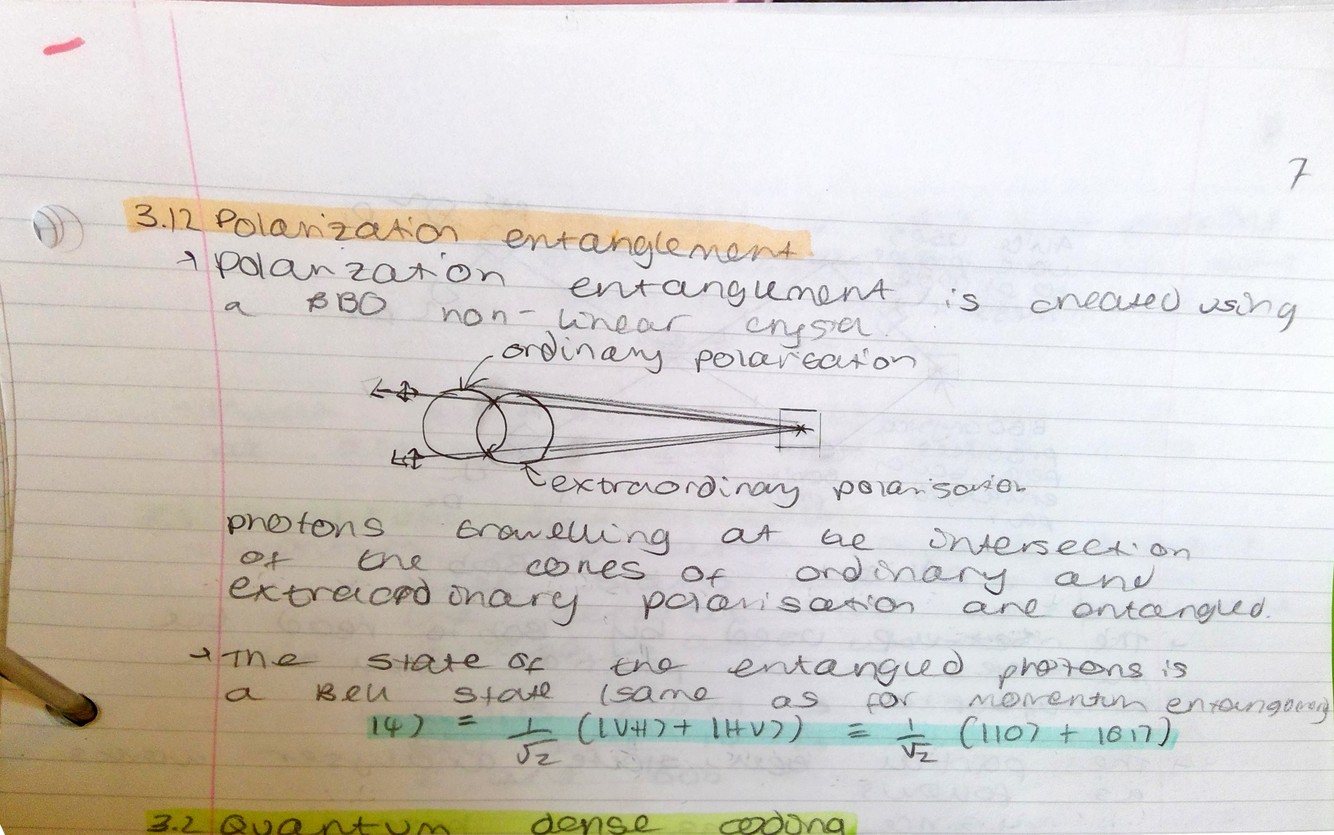
Draw a diagram of how polarisation entanglement is generated
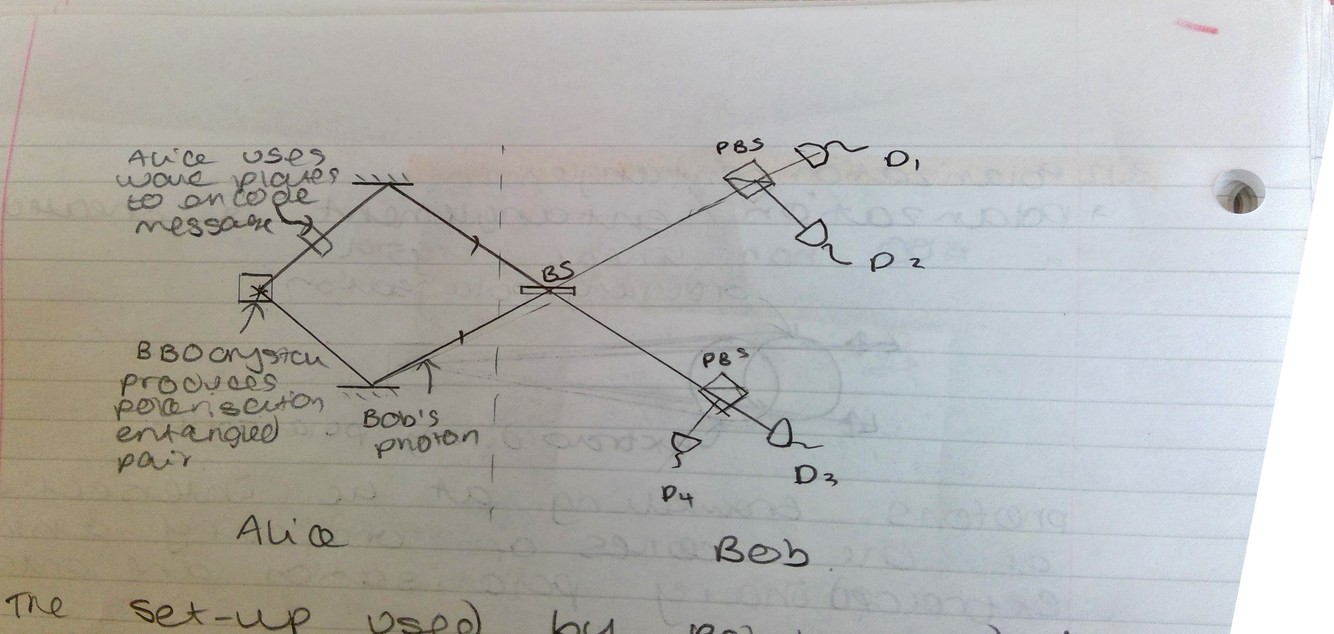
How does quantum dense coding work?
- Alice and Bob share an entangled state eg a Bell state
- Alice encodes a message in her qubit by applying a local operation to it. This transforms the qubit to one of four different Bell states, so 2 bits of information are strored.
- Alice sends her qubit to Bob via the quantum channel.
- Bob measures the qubits in the Bell basis
Sketch a diagram of quantum dense coding with a partial Bell state analyser
Which Bell state has antisymmetric polarisation?
psi -
How does quantum teleportation work?
- Alice starts with qubit 1 in some general state and half of a Bell state (qubit 2). Bob has the other half of the Bell state (qubit 3).
- Alice performes a BSM on qubits 1 and 2 and infroms Bob of the result via the classical channel.
- This measurement projects qubits 1 and 2 onto one of the four Bell states.
- Bob performs the corresponding operation on qubit 3. This puts qubit 3 into the inital state of qubit 1.
Explain the possible GHZ measurements in the XXX basis given local realism and the fact in the YYX basis we have
RLH’, LRH’, LLV’, RRV’
If we measure qubit 3 as V’, we know the other two qubits must have idential cicular polarisation. If we then measure qubit 2 in the X basis and obtain V we know 1 and 3 must have identical ciruclar polarisation. Therefore, one possible measurement is V’V’V’. Now consider if we measure qubit 3 being in H’. This means 1 and 2 must have opposite ciruclar polarisation. If we also measure qubit 3 being H’ we know 1 and 3 must have opposite circular polarisation. This means either 2 and 3 must have the same circular polarisations so qubit 1 must be in state V’. Therefore V’H’H’ is a possible state. Clearly the same argument can be made for switching the positions of the qubits so the four possible states are
V’V’V’ H’H’V’ V’H’H’ H’V’H’
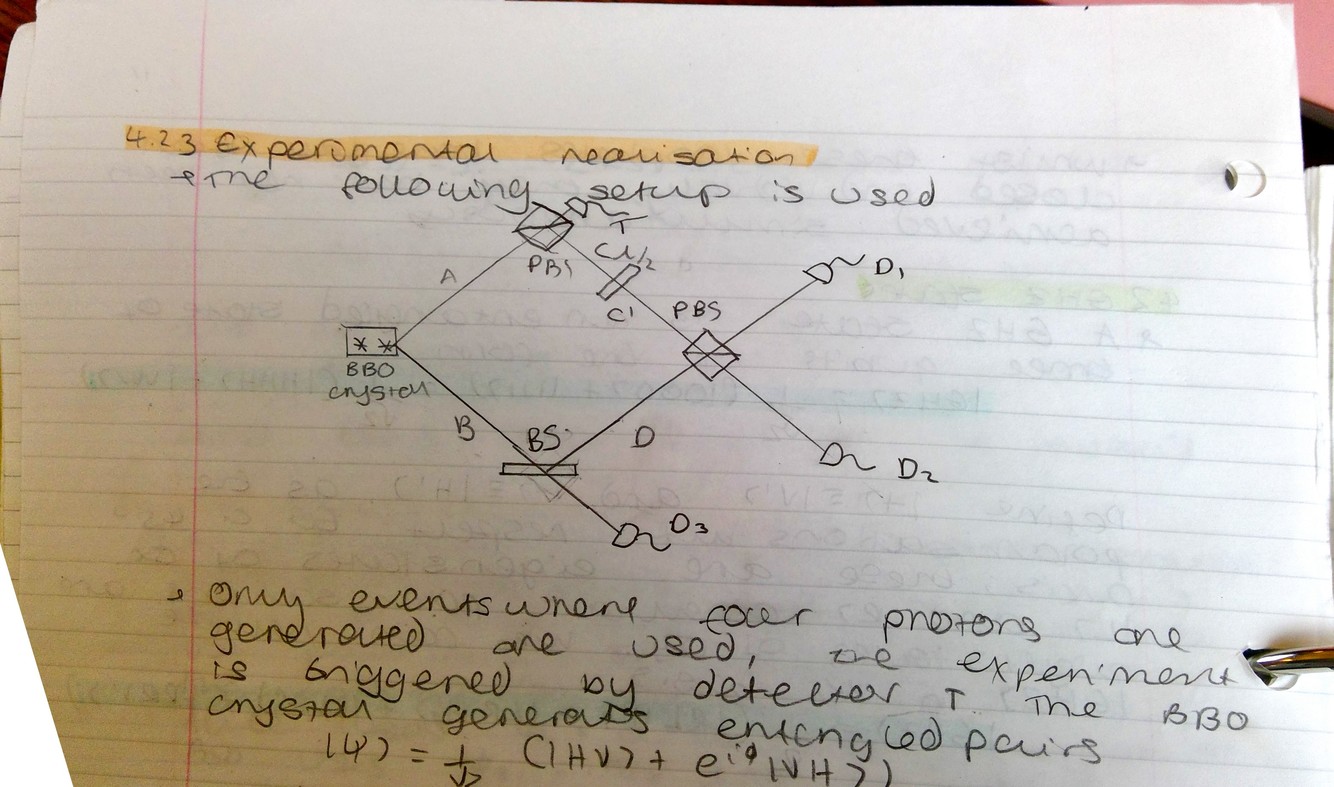
Sketch a set up for generating GHZ states
How does the Vernan cypeher work?
- Alice and Bob each have an n bit identical key string.
- Alice encodes a message by applying an XOR to her message with the key.
- Bob applies the XOR to the message received and the key to obtain the original message.
How does the BB84 protocol work?
- Alice starts with two random strings of 4n bits called A and B. She encodes the values of A in the X or Z basis depending on the value of B
- 00 = 0
- 10 = 1
- 01 = +
- 11 = -
- Alice sends the string to Bob
- Bob creates a random string B’ and uses this to determine whether to measure the string he recieves in X or Z. The result in string A’.
- Alice then anounces B publicly.
- Alice and Bob discard the values of A/A’ corrsponding to measurements where B and B’ were no the same. Assume the now have 2n bits.
- Alice then announces the n bits from A. If they match the first n bits of n’ the chance of eavesdropping is small and the last n bits can be used as a key.
Relies on the indistinguishability of non-orthogonal quantum states.
Probablility of identifying and eavesdropper in BB84
1-0.75^n
How does Ekert 91 protocol work?
- Alice and Bob each receive one photon from an entangled pair psi -.
- Alice and Bob perform polarisation measurements at angles randomly chosen from a selection. Alice can choose 0, pi/4, pi/8 while Bob can chose pi/8, 3pi/8 and 0.
- Alice and Bob publically announce the angles they choose.
- For the pairs where Alice and Bob measure the same angle we expect perfect correlation. These measurements form the secrete key.
- When Alice and Bob haven’t chosen these pairs they announce their results poublically. They can then calculate the B value. If it is not 2root2 it is likely there was an eavesdropper or the measurements were not correctly aligned.




