What are the 3 ways in which protein waste are excreted
- Ammontelism - Direct excretion of NH3 (Fish)
- Uricotelism - Excretion via uric acid (reptiles /birds)
- Ureotelism - Excretion via urea (mammals)
The internal iliac artery is a branch of the common iliac and aorta, What branches come off the internal iliac and what do they supply
- Organ 1 - Bladder - Superior/inferior vesicle areteries
- Organ 2 - Rectum - Middle rectum artery
- Organ 3 - Uterus - uterine artery
- Area 1 - Gluteals - Superior/inferior gluteal arteries
- Area 2 - Inner leg - Obturator artery
- Area 3 - Perineum - Internal pudendal artery
Describe the vasculature of the kidney
Renal artery
Segmental arteries
inerlobar arteries
arcurate arteries
interlobular arteries
afferent arterioles
Glomerular capillaries
Efferent capillaries
Peritubular capillaries
Interlobular veins
Arcuate veins
Intelobar veins
Renal vein
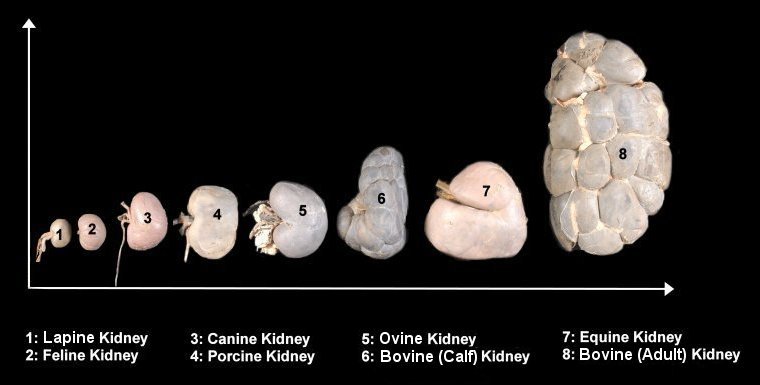
Describe species differences in kidney appearance
- Rabbits/rodents - Unilobar kidney
- Dog/sheep - Complete fusion of cortex in adjacent lobes
- Cats - prominent capsular veins
- Horse - 2 terminal recesses of pelvis, in which collecting ducts drain. Left kidney is bean shaped, right kidney is triangular
- Pig - 2 divisions of pelvis, forming major calyses. 10 funel shaped divisions minor calyses
Describe the development of the kidney
- Pronephros - Formed from intermediate mesoderm. drains into mesophrenic ducts.
- Mesonephros - Pronephros is a vestigual structure that completely disapears. mesonephros outgrowths from intermediate mesoderm. excretory organ. mesophrenic duct joins cloaca
- Metanephros - metanephros develop caudal to mesonephros. Uretic bud arises as a diverticulum from the mesophrenic duct. Uretic bud penetrates metanephritic mesenchyme.
Metanephric mesoderm - forms functional nephron
Uretic bud - forms collecting ducts, calyces, pelvis & ureter
During hindgut development, the urorectal septum divides cloaca into rectum dorsally and urogenital sinus ventrally. Mesonephric ducts drain into urogenital sinus & expland to form bladder. Pelvic portion of urogenital sinus forms ureter. 2 terminal ends of mesophrenic ducts became encorporated into wall of the urogential sinus & forms trigone (sensory)
What are the three filters in the renal corpuscle
- Fenestrated capillaries - Restric passage of blood cells
- Podocytes - epithelial cells covering capillaries. Phagocytose macromolecules and resticts passage of medium sized proteins
- Basement membrane - negatively charged. Main filtration membrane. restriction based on size and charge.
What is glomerular filtration rate and what are the forces that determine it
GFR is the volume of fluid filtered from glomeruli into bowmans space per unit time.
The forces that contribute are hydrosatic pressure which is the largest force, initiating urine formation. oncotic pressure creating by protein concentration and capsular pressure oposing hydrostatic pressure
What are the factors that affect Glomerular filtration rate
- Hydrostatic pressure - initiates urine formation by forcing an essentially protein free filtrate out of glomeruli into bowmans space
- Mesangial cells - Irregular shaped stellate cells lying between glomerular capillaries. Equivalent to vascular smooth muscle. constrict in response to angiotensin II, ADH & sodium
- Renal blood flow - pressure = systemic BP
- a) Sympathetic NS - Decrease in BP=> vasocontriction of afferent & efferent areterioles=> decreased GFR. Can be reversed
- b) hormones- Adrenaline as a result of increased sympathetic tone. moderate release causes efferent constriction, Strong sympathetic activation can stop both blood flow and filtration. Ang II preferentially constricts efferent arterioles. PGI2 & PGE2 are synthesised in response to Ang II and cause vasodilation.
- c ) Autoregulation - Ability to maintain constant pressure & GFR with changing BP. 2 theories.
- Myogenic - When afferent arterioles stretched, smooth muscle constrics
- Tubuloglomerular feedback- Alterations of tubular flow sensed by macula densa (NA+) producing local signals
What is clearance
The volume of plasma from which a substance is completely removed from the kidney in a given time
How are inulin, glucose and PAH clearance used for testing renal function
- Inulin - Filtered into glomerulus. NOT absorbed or secreted. meaning clearance of inulin = GFR
- Glucose - Not usually present in urine, therefore clearance is 0ml/min
- Para amino hippuric (PAH) - Freely filtered, no reabsorption and its completely secreted by kidney. therefore all PAH entering kidney ends up in urine. PAH clearance = Renal plasma flow
Define the term transports maximum
Characteristic of carrier mediated processes. Physical limit to the amount of material that can be transported per unit time. Membrane proteins become saturated & reabsoprtion maxiumum is reached when all carriers are occupied.
Tm reabsoption occurs with glucose
Tm secretion occurs with penicillin and PAH
Describe regulation of sodium in the kidney
- 67% reabsorbed in PCT, active process dependant upon Na/K-ATPase pumps on basolateral membranes
Sympathetic system
- Decreased Na+
- Decreased Na+ in ECM
- Baroreceptor firing decreases and sympathetic outflow increases.
- Increased vasoconstriction
- Decreased GFR
- Decrease in Na+ and H20 loss
Aldosterone stimulates Na+ reabsorption in late DCT and collecting ducts by inducing proteins that cause Na+ absorption
ANP - Atrial naturietic peptide secreted from cells in cardiac atria in response to stretch. Causes Na+ secretion. Does this by causing vasodilation (increases GFR), decrease in aldosterone and renin secretion.
How is water regulated by the kidney
ADH secretions which are controlled by:
- Hypothalamic osmoreceptors
- Atrial volume receptors
Diabetes Insipidus is a disease characterised by excessive thirst due to insensitivity of kidney to ADH (nephrogenic) or defiency in ADH
How does the kidney regulate potassium
Freely filtered and undergoes secretion and reabsorption. Secreted in collecting ducts
Basolateral Na/K-ATPase maintains intracellular potassium in tubular epithelial cells. This allows K+ to pass through channel to tubular fluid
Increase in secretion when aldosterone secreted
Describe the transport processes occuring in the nephron
PCT
- Na+ reabsorbed by active transport by: a)glucose symport (energy driven by na/k pump) b) passive diffusion c)Na-k exchange
- HCO- reabsorbed along with K+ and Cl
Descending loop
- Na & Cl not reabsorbed as wall impermeable to electrolytes
Ascending loop
- 25% of filtered Na reabsorbed
- impermeable to H20
- Na, K and Cl coupled and actively secreted
- Ca & Mg passively reabsorbed
- Fluid hypotonic
Early DCT
- 4% Na reabsorbed along with Cl
- Ca reabsorption due to PTH
- Impermeable to H20
Late DCT
- K & H actively secreted due to increased Na concentration
- Aldosterone acts on this segment to increase Na reabsoption and K secretion
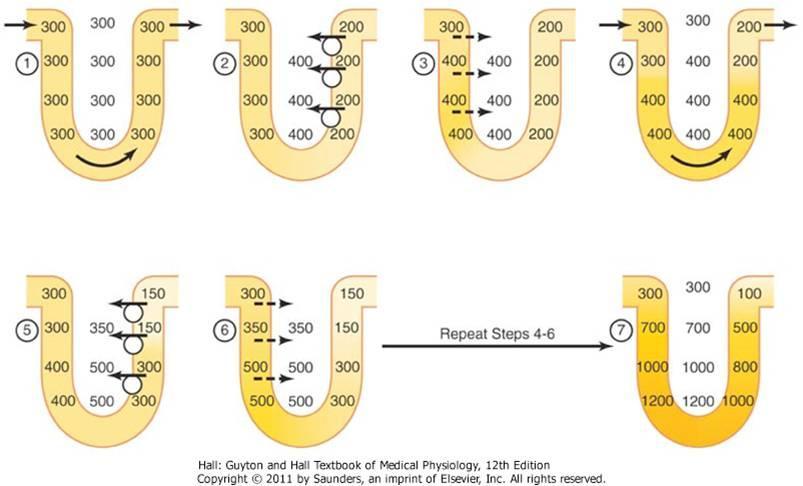
Explain how the osmotic gradient is maintained in the loop of henle and the countercurrent multiplier system
Initial state has constant osmolarity. Nacl is actively pumped into intersitium in thick ascending limb. fluid in descending limb equilibrates with intersitium by diffusing out the descending limb. As new filtrate moves down it distrubs the horizontal 200mosm/lit gradient, therefore furthur active transport of ions out of ascending limb. Eventually a maximum osmolarity of 1,400mosm/litre at the bottom of loop. Although theres only a horizonal 200mosm/litre difference, the effect is multiplied by large vertical gradient… countercurrent multiplier
Describe urea cycling in kidney
- With the loss of water in collecting ducts urea becomes concentrated and diffuses into intersitium
- Increased osmolarity in medulla, causing some to diffuse back into lumen at discending and ascending limbs.
- Cycles back to collecting ducts
Give examples of drugs that:
- Inhibit ADH secretion
- Stimulate ADH
- Mimic ADH
- Glucocorticoids, Vincristine (blocks microtubules), Calcium - being hypercalcaemic can induce nephrogenic diabetes insipidus
- Nicotine
- Desmopressin is a ADH analogue. Binds to V2 receptor as an agonist.
What are the 4 classes of diuretics
- Carbonic anhydrase inhibitors - Acts on PCT. Decreased production of HCO3- and H<strong>+</strong> inside epithelial cells. causes inhibition of H+ secretion and decreased Na+ & HCO3- reabsorption. Continued use can cause metabolic acidosis E.g Acetozolamide
- Loop diuretics - Inhibit Na+, K+ and 2Cl- symporter in Thick AL. Increased excretion of Na+, K+ , Cl<strong>-</strong> and obliged water. Highly potent (25%) therefore has more side effects such as Hyponatremia, hypokalemia, hypomagnesemia & dehydration. E.g Furosemide
- DCT thiazide diuretics - Inhibit Na+ and Cl- symporter. increased water and solutes in collecting ducts, 10% potency. E.g benzothiazide
- Collecting ducts - Used in conjunction with K+ losing diuretics to enhance Na+ loss and supress K+ loss
- Aldosterone blockers - Block mineral corticoid receptors. Decreases Na+ & water reabsorption. 5% potency. E.g Spironolactone
- Na+ channel blockers - Block apical Na+ channels, inhibit Na+/K+ exchange. 5% potency. E.g Amiloride
Give two examples of indirect diuretics
- ACE inhibitors - Prevent formation of angiotensin II. used to mobilise oedema E.g Enapril
- Xanithines - Phophodiesterase inhibitors, increasing cAMP levels. inhibits Na and Cl reabsorption. E.g Etamiphylline
What are the muscles of the bladder
- Detrusor muscle - meshwork of smooth muscle in bladder.
- Internal urethral sphincter - Smooth muscle around bladder neck not a recognisable sphincter (not noticable thickening).
- Urethralis muscle - also known as external urethral sphincter. skeletal muscle
Describe the innervation of the kidney muscles
Pudendal nerve - somatic
- S1-S3 in small animals and S3-S5 in large
- Innervate urethralis muscle
- Innervates other skeletal muscle in pelvic nd perineal region e.g genitalia sensory/motor function and anal sphincter
Sympathetic innervation
- Preganglionic fibres from L1-L4
- Synapse at caudal mesenteric ganglia
- Post ganglionic fibres form Hypogastric nerves (paired), enter pelvic plexus on wall of rectum
- Innervate detrusor muscle (ß2 receptor) & internal urethral sphincter (alpha1 receptor)
Parasympathetic innervation
- From sacral SC
- From pelvic nerves in pelvic plexus
- Innervate detrusor muscle (ß2 receptor)
Micturition centre => Pons => coordinated relaxation of urethralis muscle and detrusor muscle
Describe the storage phase of micturition
SYMPATHETIC DOMINANCE
- Contraction of internal urethral sphincter (alpha receptors)
- Constant tone maintained in urethralis muscle by pudendal nerve (principle barrier)
- Detrusor muscle (ß2 receptor) is relaxed allowing low pressure filling
- Direct inhibition of pelvic nerves by hypogastric nerves
Describe emptying phase of micturition
PARASYMPATHETIC DOMINANCE
- Impulses from the pons to sacral region while simultaneously:
- a) inhibiting pudendal nerve = Relaxation of urethralis muscle
- b) Contraction of detrusor muscle. This inhibits adregenic tone to internal urethralis sphincter




