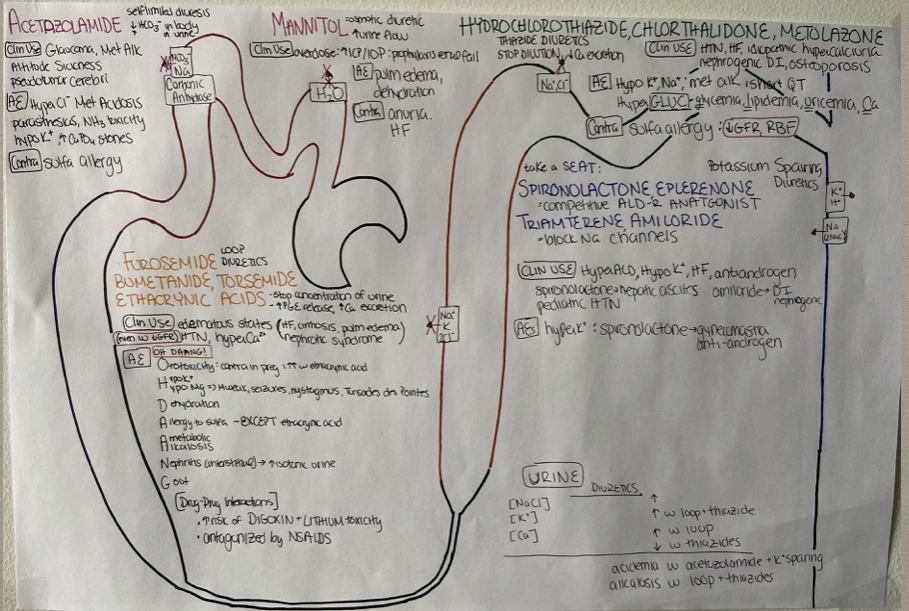
list which diuretics work at the different points of the renal tubules
what transporters are affected
mannitol: inhibit aquaporin in PT
acetazolamide: inhibit carbonic anhydrase (HCO3/Na) in PT
Furosemide, ethcrynic acids, numetanide, torsemide= Na-K-2Cl transporter
hydrochlorothiazide, chlorthalidone, metolazone= xNaCl in DT
spirinolactone, eplerenone,= ALD-R antagonist in CD
triamterene, amiloride= inhibit Na channels [resorb] (and the paired K/H channel [excrete K]) in CD
MAFTSA
Make -mannitol (P)
America= acetatzolamide (P)
For = Furosemide (LoH)
T= thiazides (DT)
S= spironolactone (CD)
Again= amiloride (CD)
fanconi syndrome
- where in the tubule is the defect and what is it
- what are the causes, be specific
- what are the main electrolyte effects
- presents similar to what? trx?
- PT- generalized reabsorption defect in PCT –> excretion of all substances
- hereditary (wilson ds, glycogen storage ds), ischemia, multiple myeloma, nephrotoxins=isofamide, cislatin, lead, expired tetracycines
- metabolic acidosis, hypophosphatemia, osteopenia
- IS RTA type II
bartter syndrome
- where in the tubule is the defect and what is it
- what are the causes, be specific
- what are the main electrolyte effects
- presents similar to what? trx?
- resorptive defet in TAL = xNa/K/2Cl
***bartter for as many electrolytes as possible, so hit the channel w 3 ions**
- AR inherit
- met alk, hypoK, hypercalciuria
- present siilar to chronic loop diuretic use
Gitelman syndrome
- where in the tubule is the defect and what is it
- what are the causes, be specific
- what are the main electrolyte effects
- presents similar to what? trx?
- xNaCl in DT= no resorb Na
2. AR inherit
3. met alk, hypoMg, hypoK, hypocalciuria - AR inherit
- present ~ lifelong thiazide use
Liddle syndrome
- where in the tubule is the defect and what is it
- what are the causes, be specific
- what are the main electrolyte effects
- presents similar to what? trx?
-GoF in CT –> inc Na resorp
**gain a liddle**
- AD inherit
- met alk, hypoK, HTN, dec ALD
- v similar to hyperALD BUT the ALD is not detectable
- trx w amiloride (ALD inhibitor)
SAME: syndrome of apparent mineralcorticoid excess
- where in the tubule is the defect and what is it
- what are the causes, be specific
- what are the main electrolyte effects
- presents similar to what? trx?
- inc ALD receptor acitivty in CD: deficiency in 11β hydroxysteroid dehydrogenase –> excess corticol –> inc mineralcorticoid receptor activity
- AR inh OR acquired from glycerrhetinic (licorice)
- trx w K-sparing diuretics, or corticosteroids (to stop endogenous creation)
how do low and high serum concentrations of Na present
low: nausea and malaise, stupor, coma, seizures
high: irritability, stupor, coma
what are the causes of inc Na serum levels
be specific
water loss: inc ADH or inc Uosm
diabetes Insipidus (can be caused by lithium or amphotericin) = ~~relative~~”inc” levels
- central= dec ADH activity
- nephorgenic= dec renal response to
*amphotericin can cause RTA T11= x NaCl = inc Uosm
how do low and high serum concentrations of K present
low: U waves and flat T waves on ECG : arrhythmias : M cramps : spasms: wkness
**low key= flat tones w “yoU” **
high: wide QRS and peaked T waves : arrhythmias : M wknss
*high K= “up to here” (at the peak), w a “big Qs” (wide QRS) ****
how do low and high serum concentrations of Ca present
low Ca= tetany seizures, QT prolonged, Chvostek’s sign (twitching) and Troussau sign (BBP spasm)
**low Care =prolong the TasQ**
high: stones, bones (pain), groans (abd pain), thrones (inc urinary requency), psychiatric overtones (anxiety, AMS)
**high on California–> LA devotee vibes**
how do low and high serum concentrations of Mg present
low: tetany, Torsades des pointes, hypoK+hypoCa
**low status w Magneto –> causes the TdP when he pulls the iron in your blood**, he don’t care if he kill you
high: dec DTRs, lethargy, bradycardia, hypotension, cardiac arrest, hypoCa
**up high w Magneto –> bad guy, gotta diminish that deep reflex to care for people: stop your heart from Caring; ignoring ethics for your self gain is the lazy thing to do”
how do low and high serum concentrations of PO4 present
low: bone loss –> osteomalacia (adult), rickets (kids)
high: serum hypoCa, renal stones, metastatic calcification
**once bones are saturated?? just depo the Ca everywhere else??**
***to meet your (phos)FATE, you need strong bones****
**phosphate–> Ca depo into bones**
outline the causes of hypoNa + ↑ serum osmolality
-hypoglycemia
mannitol use
(both are powerful osmoles themselves)
outline the causes of hypoNa w n osmolality
= hyperlipidemia,
=hyperproteinemia (i.e multiple myeloma)
outline causes of hypoNa w ↓osmolality
= ADH does NOT bring in Na, it translocates aquaporins to the membrane (vs ALD)
1) HF and cirrhosis = states of hyervolemia that the body perceives as hypoV so is constantly trying to retain H20 –> non-osmotic release of ADH
- 2° to low C.O in HF, low vasc resistance in cirrhosis
2) kidney ineffective
- advance renale failure= even w low ADH, the min Uosm will rise bc the urine can’t dilute
- diuretics : thiazides >> diuretics
3) inc ADH
= 2° to vomiting, diarrhea, adrenal insuficiencty (x corticol inhibition of ADH)
=1° –> dec ADL, inc ADH
= SIADH:
- 2° small cell LC, strokes, brain bleed/tumor, pulm ds
- drug induced: carbamezapine, cyclophosphamide)
causes of respiratory acidosis?
explain the physiology if applicable
(CO2> 44= less exhales per min)= hypoventilation
- airway obstruction, acute lung ds, chronic lung ds
- opioids, sedatives,
- weakening of respiratory Ms (i.e. MG, ALS, Guillan Barre, M dystrophy)
causes of metabolic acidosis?
(HCO3<24)
NAGMA
- H= hyperalimentation (i.e. IV nutrients)
- A=acetozolamide
- R= RTA
- D= diarrhea (so much poop, butt b hard)
- A= Addison’s Ds
- S= spironolactone
- S= saline infusion
HAGMA
- M= methanol
- U= uremia
- D= DKA
- P= proponyl glycene
- I= INH(isoniazid)/ iron
- L= lactic acidosis
- E= ethylene glycol
- S= salicylates(late) (hardass would not be late)
causes of respiratory alkalosis
how can it be treated?
CO2<36= most exhales/min= hyperventilate
- panic attack
- hypoxemia (high altitude) **MAX height= MAX brthe= MAX amount CO2 blown out**
- salicylates(early)
- tumor
- pulmonary embolism ***like coughing it out, but breathing it out????***
-trx w acetazolamide (augment the compensatory NAGMA)
how does an ASA affect the pH balance of the body
acute: medullary stimulation –> resp alk (hyperventilate)
hrs later: HAGMA via x(citric acid cycle)
= a mixed disease, w CO2 dec more than expected for just a compensation mechanism, and HCO3 dec over time
causes of metabolic alkalosis
=HCO3>28 / H+ loss
- loop diuretics and thiazides : volume contraction and inc H+ lost in urine
- vomiting (lose acid)
- antacid use
- hyperALD
- hypoK (K into cells, H out of cells–>alk)
contraction alkalosis –> inc RAAS –> H loss in PT(ATII) and CD(ALD), inc HCO3 resop in PT
hyperaldosteronism
- causes?
- presentation?
-inc adrenal production
=adrenal hyperplasia
=Conn’s Syndrome (adrenal adenoma)
-present w inc K/H+ secretion
:suspicious triad: hypoK + resistant HTN!!
- often no edema via ALD escape (inc ALD but then ANP will cause the excretion of Na/H2oO)
- inc urinary Cl- (dilute the medulla–> dec LoH action–> less K excrete (^^ lost later in CD) + less Cl- resrob)
renal tubular acidosis is a __anion gap MA, w __ Cl- serum levels
NAGMA
inc Cl-
RTA Type 1
–where is it
–what is the defect
–urine pH
– serum K levels
–causes
–associations
RTA ~ D.P.A
- distal tubule (HCO3 oftn <10)
- inability of α-intercalated cells to acidify urine: xsecrete H+ –> met acid
- UpH> 5.5 (no able to acidify)
- dec K: secrete K to maintain charge balance
- caused by AMPHOTERICIN B TOXICITY, analgesic nephropathy, obstruction of urinary tract, autoimmune (Sjogren &RA>SLE)
6- inc, oft bilat, Ca-PO4 nephrolithiasis (inc urine pH+inc bone turnover) : rickets +growth failure in children
RTA Type 2
–where is it
–what is the defect
–urine pH
– serum K levels
–causes
–associations
–trx
RTA ~ D.P.A
- defect in PT (HCO3~ 12-20)
- xHCO3 reabsorp = inc excreted in urine, overwhelm the DT/CD ability to acidify the urine
- pH < 5.5 (still able to acidify)
- hypoK:
- causes: Fanconi syndrome (lost everything in urine), multiple myeloma, carbonic anhydrase inhibitors
- inc risk hypoPhosphatemia = bone wasting
- trx= sodium bicarb




