Accurate estimate of unpaid claims are important to:
- Internal management: estimates are used to make business decisions in pricing and UW as well as strategic and financial decisions
- inaccurately high could lead to decisions such as raising rates, tightening UW guidelines. Exiting LOB or territory, or purchasing add. reinsurance - Investors: estimates impact profitability of insurer and thus returns paid to investors
- inaccurately high would lower insurer’s profit, making it appear worse investment to potential investors - Regulators: estimates are used to monitor solvency of insurer
- inaccurately high resulting in lower profit might cause regulator to restrict insurer’s ability to write new business
Assumptions of Chain Ladder
2 main assumptions
- Development of future claims will be similar to development in prior periods
- Claims observed for an immature period tell you something about claims yet to be observed
Other assumptions:
- consistent claims processing
- stable mix of types of claims
- stable policy limits and deductibles
- stable reinsurance limits
Chain Ladder works best when
- no material changes in insurer’s operations
- presence or absence of large claims doesn’t greatly distort data
- sufficient volume of credible data
- LOB has high freq low severity with stable and timely reporting
Impacts of changes on CL estimates:
Speedups in settlement rates
Speedups in settlement rates
- Paid: overestimate because applying historical LDFs based on slower settlement rates to higher paid amounts
- Reported: no effect because moving money from ending case reserve bucket to cumulative paid loss but total reported remains unchanged
Impacts of changes on CL estimates:
Increase in case reserve adequacy
Increase in case reserve adequacy
- Paid: unaffected because would no impact paid triangle
- Reported: overestimate because applying historical LDFs based on lower case reserve adequacy to higher reported amounts
Impacts of changes on CL estimates:
Changes in LRs, frequency, or severity
Changes in LRs, frequency, or severity
-changing LR does not imply change to either paid or reported loss development -> LDFs are same for each year even though numbers are higher for deteriorating LR assuming prem is constant
Impacts of changes on CL estimates:
Exposure Growth
Exposure Growth
- no impact if no change to average accident date within each period
- avg accident date will usually be later more recent AYs than in older AYs for growing BOB
- this means claims in more recent AYs will have had less time to develop so applying historical LDFs would cause you to underestimate Ultimate losses -> true for paid and reported
- way to deal with this is to use quarterly or monthly triangles since avg accident date will be more stable
Impacts of changes on CL estimates:
Changing product mix
Changing product mix
- when you having changing MOB, both paid and reported development patterns can be impacted if segments of business that are changing have different development patterns
- if both segments are grow @ same rate, combined development is fine
- underestimate ultimates using combined LDFs if segment that is growing at larger rate is longer tailed (aka larger LDFs)
Expected Claims Method and Assumptions
-estimates ultimate as ratio * exposure base
Ult claims=ELR*EP
Ult claims=EPP*EE
Assumptions
- ultimate claims for exposure period can be better estimated based on a priori estimate than using experience observed to date for that exposure period
- AKA claims reported to date for that exposure period tell you no useful info about your ultimate claims for that exposure period
- reasonable expected claims ratio can be obtained
Expected Claims Method:
Works best for
Works best for
- when entering new LOB aka insufficient data to obtain historical LDFs
- when operational or environmental changes make historical data irrelevant for projecting ultimate claims
- when estimating ultimates @ early maturities for long-tailed LOBs where early CDFs are highly leveraged
- when data is unavailable
Expected Claims Method
Advantages/Disadvantages
Adv = providing stable estimate of ultimate
Dis = unresponsive to recent experience
Expected Claims Method
2 challenges
2 challenges
- determining appropriate exposure base
- estimating claims relative to that exposure base
Calculating the expected claims ratio
can calc based on historical data
-intentionally exclude any data for that exposure period for which we are estimating ultimate claims
Steps:
- develop claims to ultimate for each year -> CL
- calc ultimate claim ratio for each year of historical experience
- adjust historical claim ratios to be on same rate, tort reform, loss trend, premium trend, and exposure trend levels as they year you are estimating claims
- selected expected claims ratio based on adj historical claims ratios
- if no pattern, select straight average
Impact of changes on EC estimates:
Speedups in settlement rates
Speedups in settlement rates
- unaffected to extent ECR is not impacted by this change
- if speedup started in most recent AY, estimate produced will be unaffected and accurate
- if started in earlier year, error will be in same direction as CL but to lesser extent if using CL to get ECR
- ECR only potentially impacted if calc based on paid data
Impact of changes on EC estimates:
Increase in case reserve adequacy
Increase in case reserve adequacy
- unaffected to extent ECR is not impacted by this change
- if strengthening started in most recent AY, estimate produced will be unaffected and accurate
- if started in earlier year, error will be in same direction as CL but to lesser extent if using CL to get ECR
- ECR only potentially impacted if calc based on reported data
Impact of changes on EC estimates:
Changes in LRs, frequency, or severity
Changes in LRs, frequency, or severity
-does not react to any changes in most recent AY because not responsive to these changes -> accurate in these situations
Impact of changes on EC estimates:
Exposure Growth
Exposure Growth
- unaffected by exposure growth on its own
- not impacted if avg acc date change only started in most recent year
- if avg acc dates have changed for several years then ECR will be impacted if using CL to estimate, error produced will be in same direction as CL but to lesser extent (underestimated)
Impact of changes on EC estimates:
Changing product mix
Changing product mix
- impacted if segments that are changing have different ECRs
- impacted if segments that are changing have same ECRs but have different development patterns and this causes the estimate of ECR from historical data using CL to be inaccurate
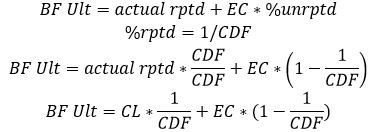
Bornhuetter-Ferguson
credibility weighed average of CL and expected claims technique
- credibility weighting with Z=1/CDF
- as given year matures, CDF will lower which mean more credibility given to CL i.e. actual data
Benktander
- second iteration of BF technique where BF Ult is used instead of EC
- credibility weighted average of CL and BF
- Benktander gives more weight to CL and thus actual data
- if you continue to iterate, more and more weight given to CL and thus approaches CL estimate

Assumptions of B-F
- unreported claims will develop based on expected claims
- AKA claims reported to date for that exposure period tell you no useful info about your IBNR for that exposure period
- reasonable expected claim ratio can be obtained
B-F: works best for
- there are random fluctuations or large claims at early maturities
- entering a new LOB
- estimating ultimates @ early maturities for long-tailed LOBs where early CDFs are high leveraged
Advantages/disadvantages of B-F and Benktander
Adv=providing more stable estimates than CL and more responsive than EC
Benk Adv=even more responsibe than BF while being more stable than CL (but not as stable as BF)
B-F/Benk: 2 Challenges
- Estimating expected claims
- Estimating expected % unreported


-
Reserving - basics41
-
Reserving - other techniques39
-
Reserving - ALAE6
-
Reserving - ULAE18
-
other reserving8
-
Data, Profit, and Background23
-
Addressing an Imbalanced Fund Ins Eqn16
-
one time and continuous changes25
-
development and expenses20
-
CMP & risk classification17
-
univariate and multivariate25
-
special classifications32
-
credibility16
-
individual risk rating17
-
implementation19
-
errata27



