Respiratory System Flashcards

(56 cards)

1
Q

The upper respiratory system consists of the…?

A

nose

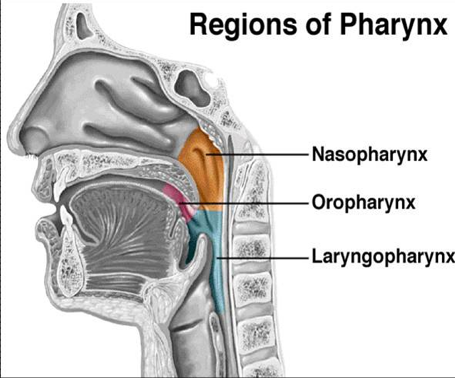
nasopharynx

oropharynx

2
Q

The lower respiratory consists of…?

It begin to form during which week of development?

A
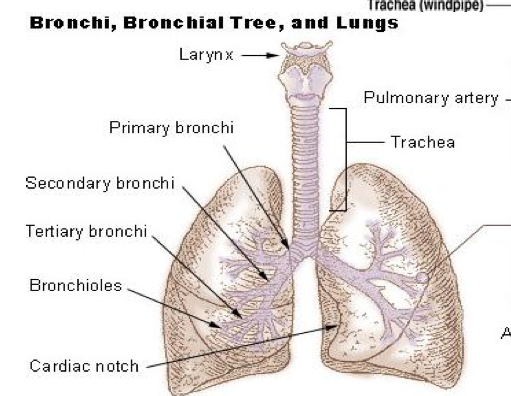
  • larynx
  • trachea
  • bronchi
  • lungs

week 4

3
Q

What is the first sign of development in the lower respiratory tract?

When and where does this form?

A

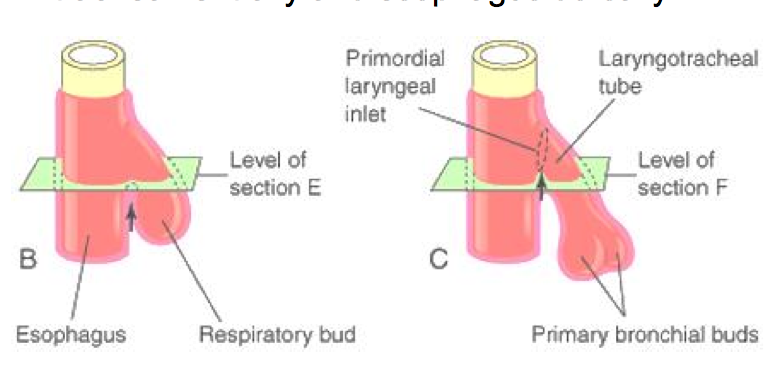
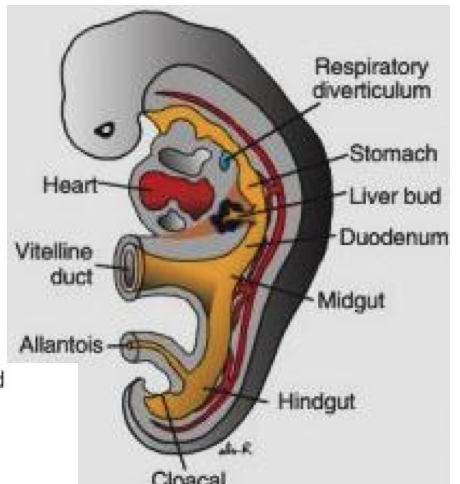
formation of the respiratory diverticulum

- ventral wall of the primitive foregut during week 4
4
Q

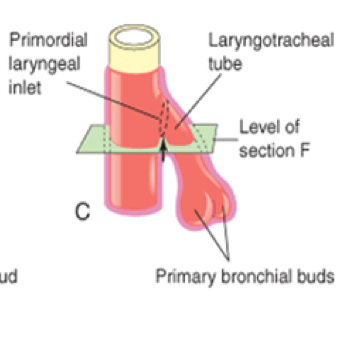
The distal end of the respiratory diverticulum enlarges to form what primordial structure?

A

the lung bud

5
Q

Initially the respiratory diverticulum is in open communication with the foregut.

What eventually separates these structures?

A

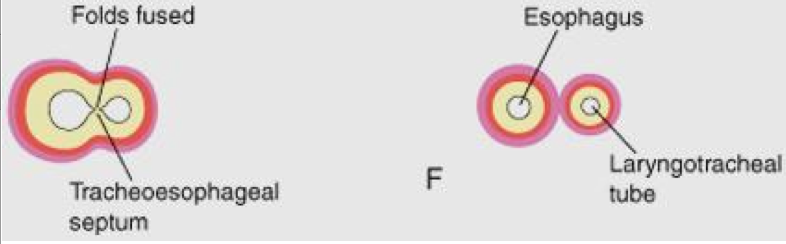
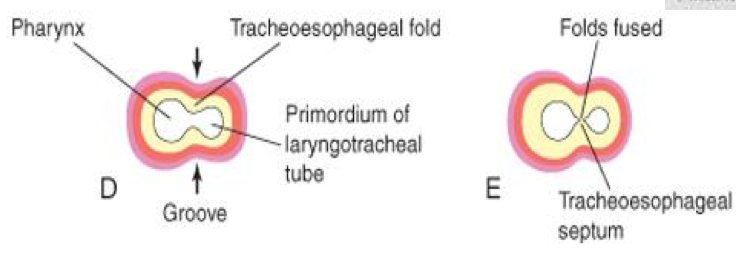
tracheoesophageal folds = indentations of mesoderm
6
Q

When the tracheoesophageal folds fuse in the midline to form what structure?

A

the tracheoesophageal septum

7
Q

The tracheoesophageal septum divides the foregut into what dorsal and ventral structures?

A

ventral = trachea

dorsal = esophagus

8
Q

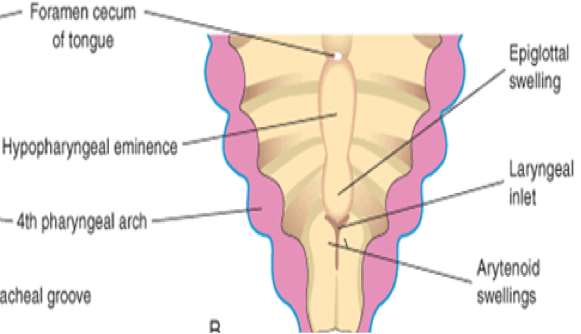
The opening of the respiratory diverticulum into the foregut becomes what inlet?

A

the laryngeal inlet (or orifice)

9
Q

The laryngeal epithelium and glands derive from what type of tissue?

A

endoderm

10
Q

The laryngeal muscles derive from what type of tissue & from what pharyngeal arches?

What nerve innervates them?

A

somitomeric mesoderm

  • pharyngeal arches 4 + 6
  • innervated by branches of the vagus nerve (CN X)
11
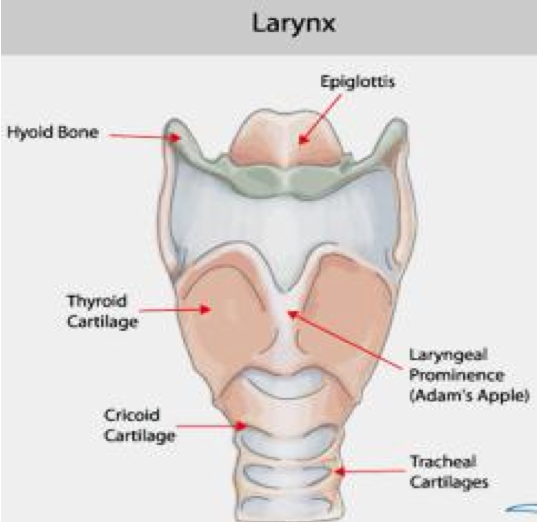
Q

What are the 5 laryngeal cartilages?

What typ of tissue are they derived from?

What pharyngeal arches did they originate from?

A
  • thyroid
  • cricoid
  • arytenoid
  • corniculate
  • cuneiform

somitomeric mesoderm

  • pharyngeal arches 4 + 6
12
Q

Laryngeal Atresia

A
  • failure of recanalization (removal of cells) of the larynx (apoptosis)
  • causing obstruction of the upper fetal airway

= CHAOS*

- distal to atresia or stenosis (narrowing) the airway dilates, the lungs enlarge and fill with fluid, the diaphragm flattenes or inverts, and there is fetal ascites and/or hydrops fetalis

13
Q

fetal ascites

A

accumulation of fluid in the peritoneal cavity

14
Q

hydrops fetalis

A

accumulation of serous fluid in the intracellular spaces
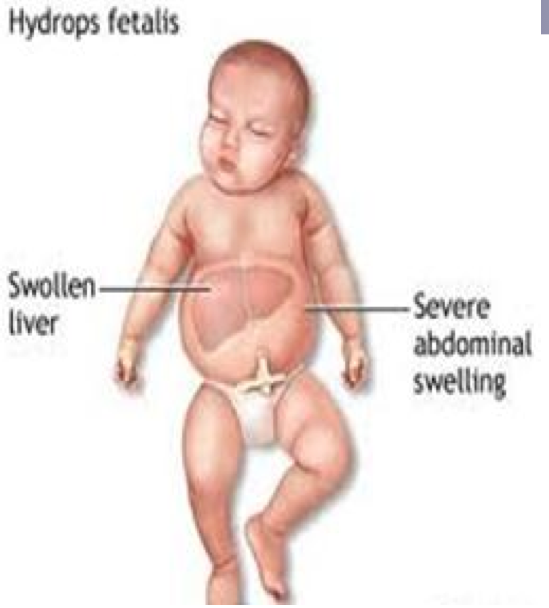
= severe edema

15
Q

CHAOS

A

congenital high airway obstruction syndrome

  • obstruction of the upper fetal airway
16
Q

The endodermal lining of the laryngotracheal tube differentiates into epithelium of what 2 areas?

A

epithelium + glands of the trachea

pulmonary epithelium
17
Q

The splanchnic mesenchyme around the laryngotracheal tube give rise to what 3 types of tissue?

A
  • cartilage
  • connective tissue
  • muscles of the trachea
18
Q

Tracheoesophageal Fistula (TEF)

A
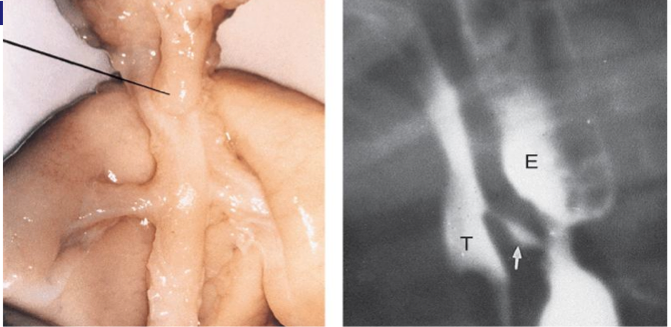
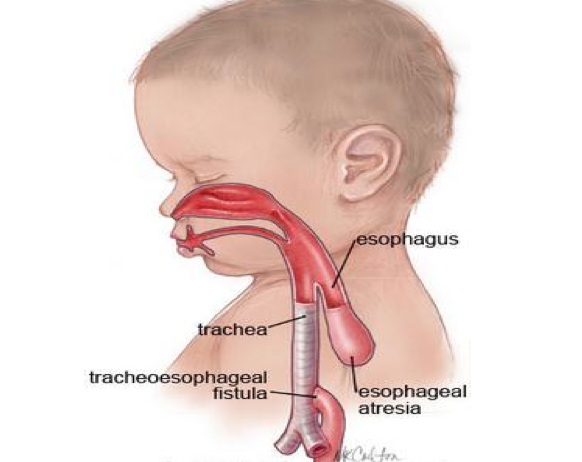
  • abnormal communication between the trachea and esophagus
  • improper division of foregut by the tracheoesophageal septum
19
Q

What is the most common anomaly of the lower respiratory tract?

What other anomalies are usually associated with this abnormality?

A

- Tracheoesophageal Fistula

  • associated with esophageal atresia + polyhydramnios
20
Q

What are the clinical features of a Tracheoesophageal Fistula?

A
  • excessive accumulation of saliva or mucus in nose + mouth
  • episodes of gagging + cyanosis after swallowing milk
  • abdominal distention after crying (air in stomach)
  • reflux of gastric contents into lungs = pneumonitis
  • *cyanosis = a bluish discoloration of skin from poor circulation or inadequate oxygenation of the blood**
21
Q

pneumonitis

A

inflammation of the walls of the alveoli in the lungs

22
Q

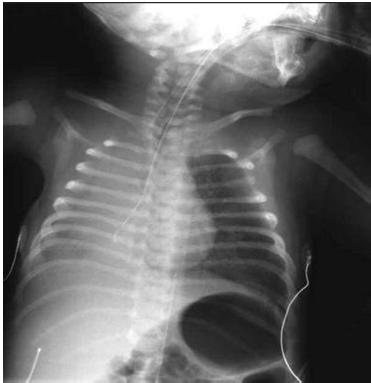
What are some diagnostic features of a tracheoesophageal fistula?

A
  • inability to pass a catheter into the infant’s stomach
  • radiographs demonstrating air in the stomach
23
Q

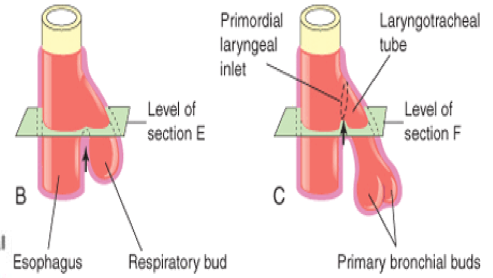
The lung bud divides into two ___________.

In week 5 of development, these enlarge to form ______________?

A

- bronchial buds

- main (primary) bronchi
24
Q

The main bronchi subdivide into what?

How many are on the right side, and how many are on the left side?

A

lobar (secondary) bronchi

right = 3; left = 2

(corresponds w. lobes of adult lungs)
25
Which main bronchus is larger and more vertically oriented than the other? What *misadventures* does this lead to?
Right main bronchus = larger, more vertical - **foreign bodies enter more frequently**
26
As the bronchi develop, they expand in which directions?
**laterally** and **caudally**
27
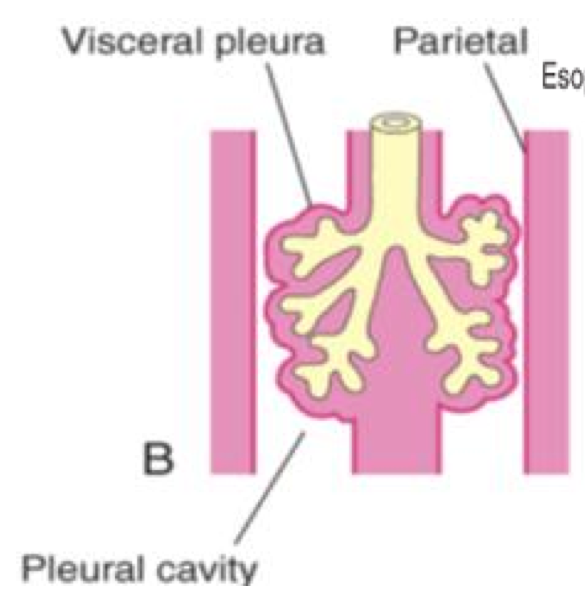
*Visceral mesoderm* covering the bronchi develops into \_\_\_\_\_\_\_\_\_\_\_\_? *Somatic mesoderm* covering the inside of the body wall develops into\_\_\_\_\_\_\_\_\_\_\_? The space between these 2 layers is called \_\_\_\_\_\_\_\_\_\_\_\_?
- visceral pleura - parietal pleura - pleural cavity
28
The lobar bronchi subdivide into \_\_\_\_\_\_\_\_\_\_\_\_\_\_\_\_\_, which also subdivide into\_\_\_\_\_\_\_\_\_\_\_\_\_\_?
- segmental (tertiary) bronchi - subsegmental bronchi
29
The segmental bronchi are primordia of what structures? ## Footnote
the **bronchopulmonary segments** (morphologically + functionally separate respiratory units of the lung)
30
Congenital Lobar Emphysema (CLE)
**progressive overdistention of the pulmonary lobes with air** \**"emphysema" is a misnomer because there is no destruction of the alveolar walls\** **- etiology is unknown** (possible failure of bronchial cartilage formation = air inspired but not expired)
31
**Congenital Lobar Emphysema (CLE):** During the first few days of life, what is trapped in the lobe? This produces what?
- fluid is trapped - produces opaque, enlarged hemithorax
32
**Congenital Lobar Emphysema (CLE):** Later, the fluid in the lobe is resorbed. What appearance will be shown in the radiograph?
an **emphysematous lobe** with generalized radiolucency (hyperlucent) *\*emphysematous lobe = as seen in emphysema\**
33
What are the **four stages of maturation** in the lungs?
Pseudoglandular stage Canalicular stage Terminal sac stage Alveolar stage
34
Pseudoglandular Stage | (6 to 16 weeks)
- histologically, lungs resemble exocrine glands - by 16 weeks all major elements of the lungs have formed **except those involved with gas exchange** ***fetus born during this time are unable to survive\*\****
35
Canalicular Stage | (16 to 26 weeks)
- lung tissue becomes highly vascular - by 24 weeks, each terminal bronchiole gives rise to two or more respiratory bronchioles (each divides giving rise to the primordial alveolar ducts) - terminal bronchioles, respiratory bronchioles, + alveolar ducts are lined by simple cuboidal epithelium ***\* Fetuses born at the end of this stage may survive with appropriate care\****
36
Terminal Sac Stage | (26 Weeks to Birth)
- more terminal sacs develop + their epithelium becomes very thin - capillaries bulge into the developing alveoli - contact between epithelial + endothelial cells establishes blood-air barrier = adequate gas exchange - terminal sacs lined by squamous epithelial cells of endodermal origin differentiate into *type I* and *II pneumocytes*
37
Pneumocytes type I cells
= gas exchange
38
Pneumocyte type II cells
= secrete pulmonary surfactant
39
What type of network** **proliferates fast in the mesenchyme around the alveoli? There is active development of __________ capillaries?
capillary network lymphatic capillaries
40
Surfactant production begins at what week? It reaches adequate levels by what week?
- begins by **20 weeks** - adequate levels by **26 to 28 weeks**
41
The development of an adequate vasculature and sufficient surfactant is critical to what? ## Footnote
survival + neurodevelopment of premature infants
42
Survival of infants born at 24 to 26 weeks has improved with the use of what treatments?
- antenatal **corticosteroids** (induces surfactant production) - surfactant replacement therapy
43
Alveolar stage | (32 weeks to 8 years)
- terminal sacs are partitioned by secondary septa to form adult alveoli - mechanism for the increase in number of alveoli is formation of secondary septa that partition existing alveoli
44
After birth, what is the increase in the size of the lung is due to?
increase in the **number of respiratory bronchioles**
45
**Aeration at birth**
replacement of lung liquid with air in the newborn's lungs - At birth, lung liquid is eliminated by a **reduction in lung liquid secretion** and **resorption into pulmonary capillaries and lymphatics**
46
In the fetal state, the functional residual capacity (FRC) of the lung...
...is filled with liquid secreted by lung epithelium
47
How can the lungs be use to determin if a baby was stillborn?
when placed in water the lungs will sink because they contain fluid rather than air (if the baby has never breathes, lung liquid has never been exchanged for air)
48
Respiratory Distress Syndrome (RDS) ia also know as...
... "hyaline membrane disease (HMD)"
49
Respiratory Distress Syndrome (RDS)
**caused by absence deficiency of surfactant** (coats the inside of alveoli to maintain alveolar patency) - lungs are underinflated; alveoli contain a fluid with a high protein content - prevalent in *premature infants* (50%-70% of deaths), *infants of diabetic mothers*, *hypoxic fetuses* and *multiple birth infants*
50
What other condition is related to RDS?
** germinal matrix hemorrhage (GMH)**
51
** germinal matrix hemorrhage (GMH) **
- germinal matrix is the site of proliferation of neuronal and glial precursors in the brain - premature infants have increased arterial blood pressure, leading to rupture and hemorrhage into the germinal matrix - child might present neurologic sequelae, including *cerebral palsy*, *mental retardation*, and *seizures*.
52
Clinical signs of RDS (Respiratory Distress Syndrome):
- dyspnea (difficulty breathing) - tachypnea (increased respiratory rate) - inspiratory retractions of chest wall - expiratory grunting - cyanosis - nasal flaring
53
Treatment of RDS (Respiratory Distress Syndrome):
- administration of betamethasone (corticosteroid) to the mother for several days before delivery (increases surfactant production) - postnatal administration of artificial surfactant solution, and high-frequency ventilation
54
Pulmonary Agenesis
**Absence of the lungs due to failure of the respiratory bud to develop** - agenesis of one lung = more common than bilateral agenesis - both conditions are rare - Unilateral pulmonary agenesis = compatible with life - heart + other mediastinal structures shifted to affected side *- Bilateral pulmonary ageneis = not compatable with life*
55
Pulmonary Hypoplasia (PH)
lung is unable to develop normally because it's *compressed by the abnormally positioned abdominal viscera* **- associated w. congenital diaphragmatic hernia** - hypertrophy of the smooth muscle in pulmonary arteries = pulmonary hypertension
56
**Bilateral renal agenesis** can also cause what pathology?
PH - pulmonary hypoplasia (insufficient amount of amniotic fluid - *oligohydramnios = *increases pressure on the fetal thorax)