Retroviruses: Group Definition
- Many different viruses that infect insects>>fish>>man
- Acquire host cells sequences - oncogenes
- Insert into host cells chromosome - can activate or inactivate genes >> cancer
- Rapid genome evolution - acquire mutation through replication and recombination
Infection consequences:
- No ill effects
- Tumors - rapid onset or long latency
- Wasting diseases, neurological disorders
- Immune deficiencies - HIV
Difficulty with standard classification
Historically based on pathogenicity or shape, but this classification system does not reflect evolutionary relationships observed in sequence comparisons: Alternative Retrovirus Classification System
Virion Structure and Composition
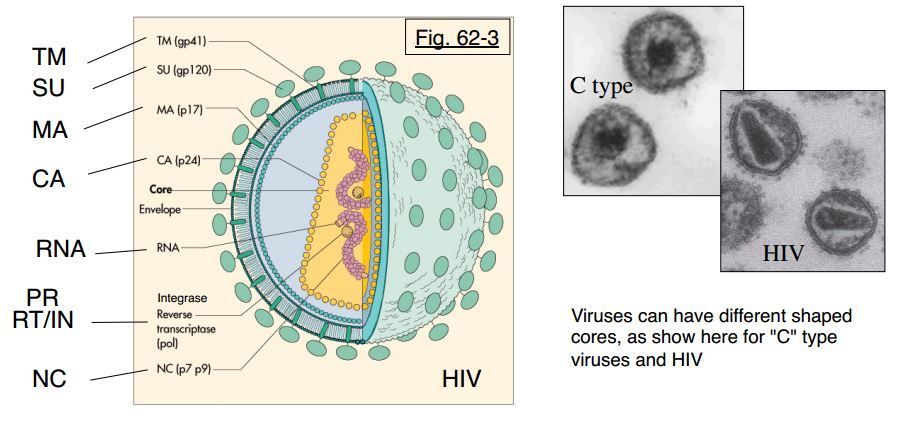
- Enveloped viruses, env protein embedded in membrane, matrix protein under lipid bilayer
- Capsid core made up of structural proteins - MAtrix CApsid NucleoCapsid, PRotease
- 2 copies of a + ssRNA genome - the only virus that is “diploid” and accounts for recombination potential
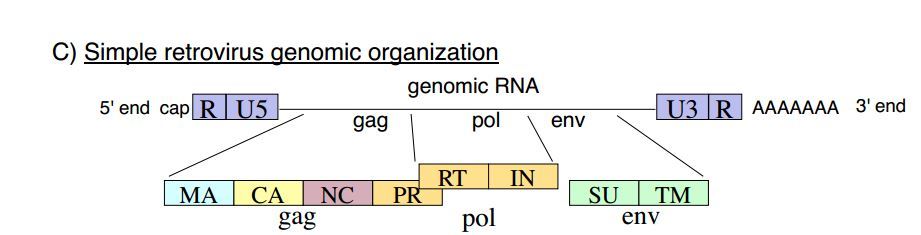
Simple retrovirus genomic organization
R:
U5:
The gag gene:
The polymerase gene:
The envelope gene:
U3:
R: “repeat” - it is repeated at both ends
U5: Stands for “unique to 5’ end”
The gag gene: encodes the gag proteins MA, CA, NC, and PR - the proteins are made as a polyprotein that then gets clipped
The polymerase gene: Encodes reverse transcriptase (RT) and integrase (IN) which are made as an extended polyprotein
The envelope gene: Encodes the env protein which is made as a precursor and then gets clipped into the surface (SU) and transmembrane (TM) domains
U3: Unique to 3’ end
Complex Retrovirus Gene Organization
Organized similar to simple retroviruses except numerous additional genes/proteins
mRNAs for the additional genes called “accesory proteins” are generated by complex alternative splicing
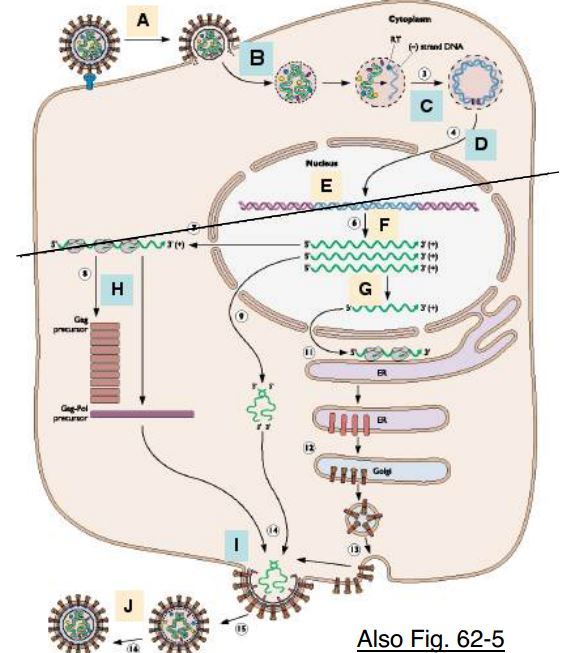
Points of Therapeutic Intervention/Replication Cycle
- Adsorption
- Penetration and uncoating
- Reverse Transcription
- Transit to the nucleus
- Integration into host DNA
- Viral RNA synthesis, host pol II
- RNA processing
- Virion protein synthesis
- Assembly and budding
- Capsid maturation (proteolysis)
Adsorption
Virus binds cell via the env protein and a host cell receptor. HIV receptor is CD4/CCR5
Penetration and uncoating
Penetration and Uncoating: Viral envelope fuses with cell membrane either at cell surface or in endosomes after endocytosis
Two antivirals to complete this step
Genomic RNA is only partially uncoated - remains in protein particle in the cytoplasm
- RT, IN and some of the gag proteins remain associated with incoming genomic RNA - convert the ssRNA genome to dsDNA, cause nuclear import, and integration
Reverse Transcription
- The process of converting ssRNA to dsDNA
- Integrated DNA is longer than the template RNA and has U3 and U5 duplicated at the ends to form the long terminal repeat or “LTR”
- Reverse transcription is accomplished in the cytoplasm by the viral enzyme, reverse transcriptase (RT) which has two polymerase functions
- An RNA dependent DNA polymerase
- A DNA dependent DNA polymerase
How does Reverse Transcriptase allow drug resistance
It is an ‘error prone’ polymerase - 5 errors made per genome, which accounts for rapid evolution and drug resistance
Integration
- Carried out by integrase (IN) protein which enters cell with virus and remains associated with dsDNA
- Requires that dsDNA have access to host DNA: HIV can cross nuclear envelope
- Integrase recognizes U3 and U5
- Once integration occurs, virus is a PERMANENT resident of the host cell’s DNA
- Good target for intervention
Proviral Transcription and LTR
Major role of LTR is to direct synthesis of viral RNA
U3 contains binding sites for cellular transcription factors required for high level RNA synthesis
U3 has signals recognized by the cell’s transcription machinery, which directs transcription at the beginning of “R” region (only the 5’ end)
What determines the tissue/cells in which a retrovirus is active
Spectrum of proteins that bind U3
HIV LTR requires the transcription factor NFkB which is only expressed in activated T cells
RNA processing
As pol II transcripts, all viral RNAs are polyadenylated, some must be spliced to generate the env mRNA, but a large portion must remain full length to serve as gag-pol mRNA and as genome for progeny virions
Three fates of viral RNA
- Full length RNA ⇒ genomic RNA
- Full length RNA ⇒ gag-pol mRNA
- RNA splicing ⇒ All retroviruses make env RNA by splicing
Translation
- Most abundant protein is gag and gag-pol, made as a polyprotein from full length mRNA
- gag initiates at AUG start codon and ends at stop codon
- gag-pol made from same AUG start, but ribosomes ‘ignore’ or circument the gag stop codon and continue to end of pol
- Env protein is made form spliced mRNA on ER bound ribosomes, moves through ER-golgi and is inserted into plasma membrane
- env gp160 precursor cleaved into gp120 (SU) and gp41 (TM) by cellular protease
Virion assembly and budding
Packaging:
Budding:
Maturation:
Packaging: requires a signal , Psi (Ψ) contained in unspliced but not spliced RNA
Budding: Viral gag and gag-pol polyproteins recruit RNA and assemble under the cell surface. gag protein interacts with env, and budding occurs as the particle forms
Maturation: as mentioned above, proteolysis of gag and gag-pol by PR occurs after budding, causing rearrangements and the core to become dense
Retroviral mediated oncogenesis: non-transforming retroviruses
Retroviruses were discovered as agents isolated from naturally occuring tumors
Non-acute or slow tumor viruses
- tumors take 6mo to 1 yr to appear
- do NOT transform cells in culture
- Viruses do not contain oncogenes
- Tumors are caused by the activation or inactivation of host genes
Retroviral mediated oncogenesis: Transforming Retroviruses
- Infections cause tumors within weeks
- Efficiently cause tissue culture cells to become transformed, or be cancer like
- Viruses harbor mutated copy of a cellular gene involved in growth control
- These viruses had a large impact on cancer biology
- Most oncogene containing viruses are defective because the oncogene replaces one or more viral genes

-
Intro to Virology30
-
Lytic Viruses27
-
Latent and Persistent Infections22
-
Host Defenses29
-
Viral Oncogenesis30
-
Retroviruses I20
-
Retroviruses II33
-
Respiratory Viruses38
-
Childhood Viruses36
-
HIV Diagnosis, Management and Prevention17
-
Emerging Viruses31
-
Neurotropic Viruses25
-
Lymphotropic Herpesviruses35
-
Hepatitis33
-
Viral Vaccine Development22
-
Viruses as Therapeutics24
-
Viral Infections in Transplant Patients18



