“Serious injuries”, 1993 NCCI definition
Fatal
Permanent Total
Major Permanent Partial
Non-serious injuries, 1993 NCCI definition
Minor permanent partial
Temporary total
Medical only
1993 NCCI hazard grouping
4 proposed hazard groups, linear combination of a few variables
L1 distance
Advantage: minimizes relative error in estimating excess premium
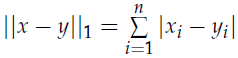
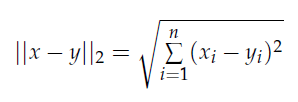
L2 distance
Euclidean distance; selected as analysis not sensitive to distance measure
Why NCCI did not use standardization
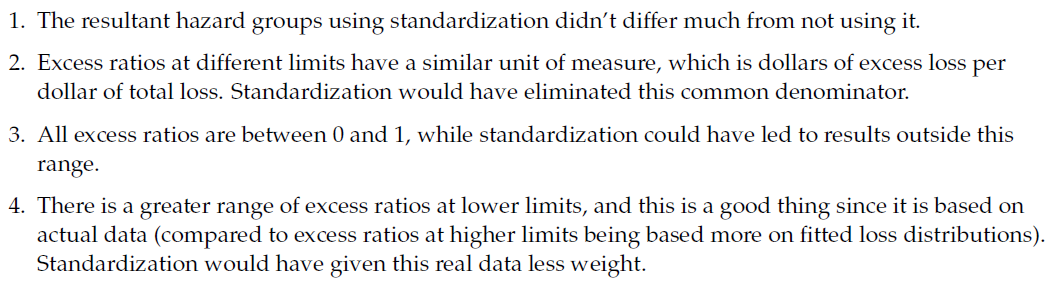
NCCI standardizing considerations

Non-hierarchical clustering
New hazard groups did not have to be subsets of existing hazard groups
k-means algorithm
- Decide on number of clusters k to target
- Start with initial arbitrary assignment into k clusters
- Compute centroid (mean) of cluster
- For each class, find closest centroid (L2 distance) and assign to that cluster
If there has been any movement, repeat step 3
Tests to determine number of hazard groups
Calinski and Harabasz
Cubic Clustering Criterion (CCC)
Calinski and Harabasz statistic
“Pseudo-F test”
Higher values, better # of clusters
Cubic Clustering Criterion
Compares amount of variance explained by a given set of clusters to that expected when clusters are formed at random; higher values better
Less reliable when data is highly correlated
Why NCCI strayed from CCC
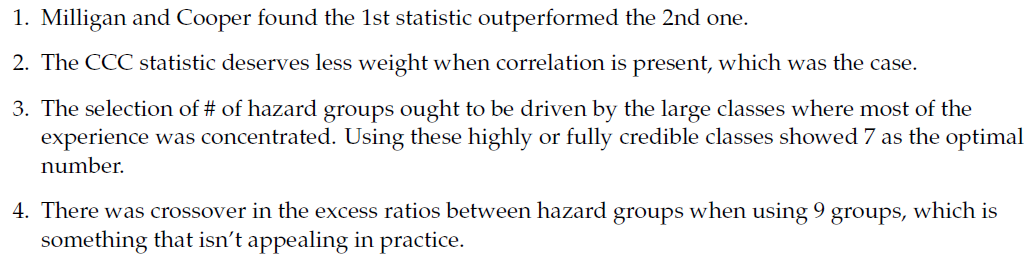
“Crossover”
Counterintuitive results (i.e. exceptions to rules)
Why NCCI went from 17 limits to 5 limits
ELFs at any pair of excess limits are highly correlated across classes
Limits below $100K were heavily represented
Wanted to cover range of limits commonly used for retro rating
5 limits in NCCI study (2007)
$100K
$250K
$500K
$1M
$5M
Credibility formula for NCCI Hazard Mapping
Z = min (1.5n / (n + k) , 1)
n = # of claims in the class
k = average # of claims per class
Other credibility options in NCCI Hazard Group Mapping
- Using median as k
- Excluding Med-Only claims
- Including only Serious claims
- Requiring minimum # of claims for classes used to calculate k
- Various square root rules
UW feedback on proposed hazard grouping
Similarity between class codes in different hazard groups
Degree of exposure to auto accidents in a given class
Extent heavy machinery is used in a given class
3 key ideas of remapping hazard groups
- Computing excess ratios by class
- Sorting classes based on excess ratios
- Cluster analysis

-
ASOP 12: Risk Classification14
-
GLMs71
-
Bailey and Simon14
-
Mahler17
-
Robertson20
-
Couret and Venter11
-
Bahnemann36
-
Experience Rating18
-
NCCI Experience Rating Plan11
-
CGL Experience Rating Plan15
-
Loss-Sensitive Rating Plans21
-
Aggregate Excess Loss Cost Estimation34
-
NCCI Retro Rating Plan9
-
Grossi42
-
Clark37
-
Bernegger10
-
Compare NCCI and ISO Experience Rating14



