Parental Attention
Types
Engagement
- Control: criticise & chastise
- Criticise: hijacks corrective learning
- Punish: hijacks threat system
- Validation & affection
Disengagement
- Ignore (withdraw validation & affection)
Early Childhood Needs
Safety
Connection
Autonomy
Self-appreciation
Self-expression
Status (Realistic Limits)
Safety - children need to be able to depend on a reliable adult
Connection to others - children need to be able to share their experiences, thoughts and feelings
Autonomy - children must have a safe, secure environment from where they can experience and learn about the world and eventually be able to stand on their own two feet
Self-appreciation - Children must be helped to appreciate themselves in order to develop good self esteem
Self-expression - children need to be able to express their opinions and feelings without being held back or restrained or punished
Realistic limits - children need to be helped to understand societal rules in order to be able to live in harmony with others; they also need to be helped to develop strategies for dealing with frustrations
Schema Modes
Fight
Flight
Freeze
Fight (my safety is here)
Overcompensation: Self-agrandiser - Perfectionistic
Flight (my safey is elsewhere)
Avoidance: introversion - escape
Freeze (overhwhelmed)
Compliance
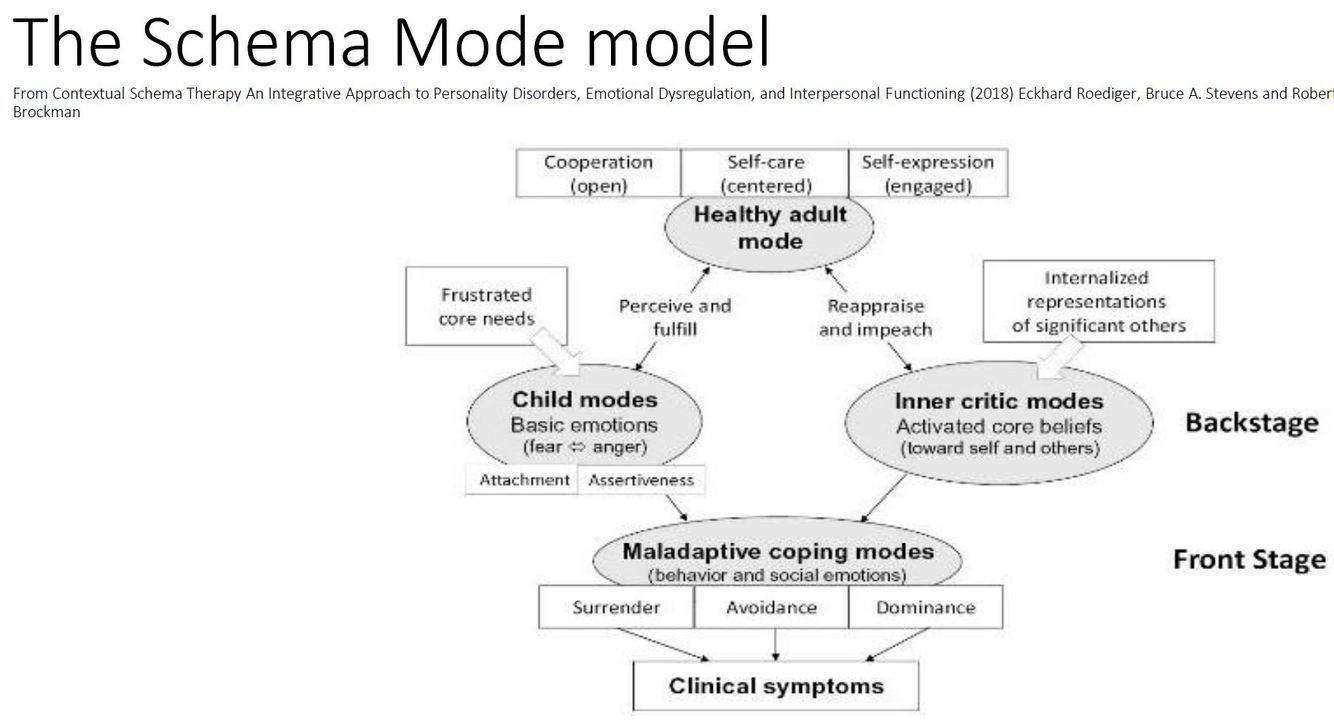
Self-Expression
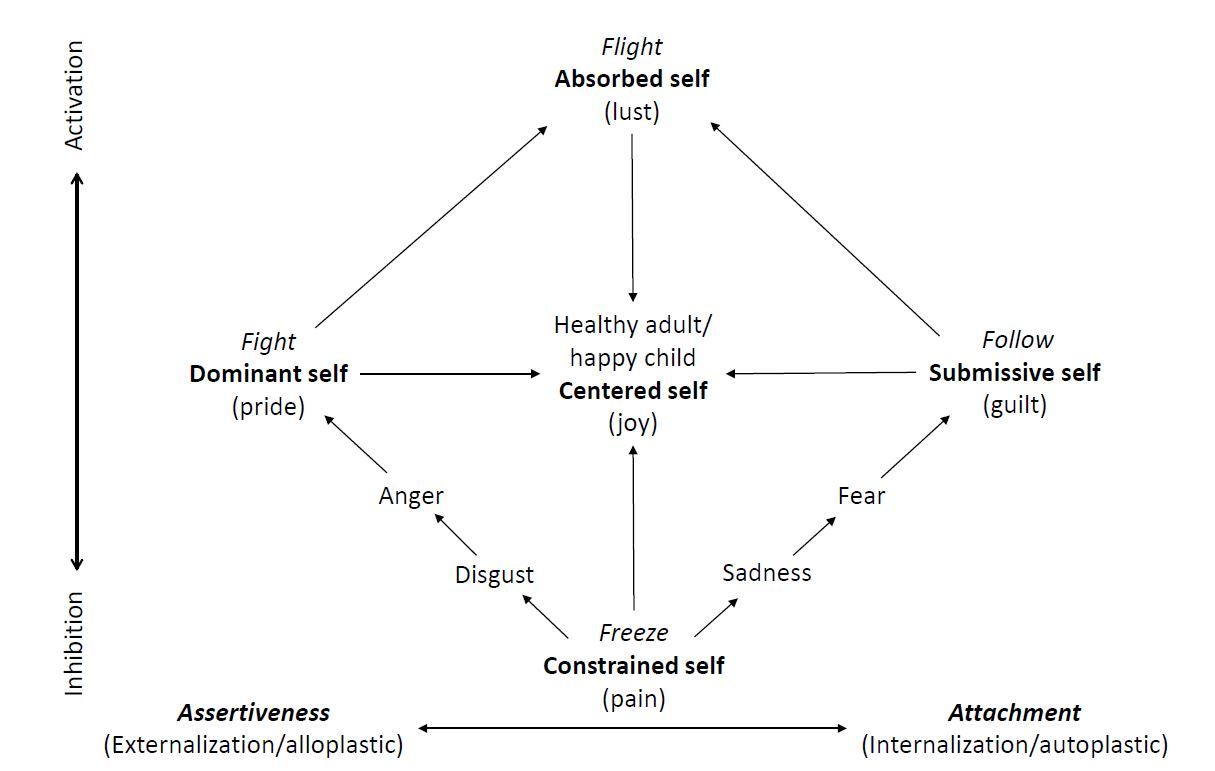
Assertive - Attatchment
Activation
I
Inhibition
Flight: Absorbed Self (lust) (drive)
Fight: Dominant Self (pride)
Follow: Submissive Self (guilt) (duty)
Freeze: Constrained Self (pain)
Centered: Healthy Self (joy)
Attachment Frustration
Schemas
Disconnection and rejection
Vulnerable or angry child
- *AB**andonment (instability)
- ‘all intimate relationships will eventually end.’**I have stable secure relationships
- *Mistrust-A**buse
- recurrent abuse is managed by mistrust.* I am safe and set protective boundaries.
- *E**motional Deprivation
- ‘my emotional needs will never be met’.* My emotions are genuine and are validated.
- *Defectiveness-S**hame
- shame resulting from feeling defective.* I am worthy and I accept myself.
- *S**ocial Isolation (alienation)
- ‘does not fit in anywhere’.* I feel I belong and know my tribe.
Assertiveness Frustration
Schemas
Impaired Autonomy
Vulnerable/Angry Child
- *Dependence-I**ncompetence
- lacks confidence / feels helpless.* I am capable and confident - I trust my judgement.
- *EnM**eshment (undeveloped self)
- fused relationship identity - caregiver (impotent).* I am an individual with my own choices, thoughts & values.
- *V**ulnerability to Harm or illness
- under threat with no protection.* The world is safe and I am healthy.
- *FA**ilure (to achieve)
- stuck due to an abiding conviction of failure.* I develop mastery and am OK with making mistakes.
Lack of self-control
Impaired limits & boundaries
Impulsive child
- *EnT**itlement-grandiosity
- exerts power and control over situations & others*
I respect and consider others in the actions I take.
- *I**nsufficient Self-control (or self-discipline)
- ‘snowflake’ - intolerant of frustration over goals*
I can tolerate distress and maintain my self-control
Assertiveness sacrificed for attachment
Submission (driven by inner critics)
Other directedness
- *SU**bjugation
- gives up will to avoid negative consequences.*
I express my truth inspite of the consequences.
- *Self-S**acrifice
- sacrifices for others needs, self comes last (guilt)*
My own needs are important and I set realistic boundaries.
- *A**pproval Seeking (recognition seeking)
- excessive desire for status and social approval.*
I am worthy of praise and acknowledgement of my efforts.
Sacrificing attachment & joy
Sacrificing spontaneity and play
Overvigilance & inhibition
Overcompensation or detachment
(driven by inner critics)
Avoids appearing incompetent or flawed
- *Negativity-P**essimism
- everything will go wrong eventually*. I am positive about my future and follow my dreams
- *E**motional Inhibition
- expressing emotions will hurt others.* I express my feelings and seek intimacy
- *UnR**elenting standards (hypercriticalness)
- I must try harder to avoid criticism.* I take care of my body, rest and manage my vitality.
- *PU**nitiveness
- mistakes should be punished without forgiveness.* I forgive myself and others and offer encouragement and support.
Compensation
Responses
Past Patterns (schemas)
Present reactions (modes)
Surrender
Avoidance
Compensation
Attunement
Resonance
Recount triggers
Attune to the triggers
Tune in to current feelings
Slow Down
Intensify attunement
Provide historical links to broaden the narrative
Use experiential techniques
Child Modes
Inner Critic Modes
Maladaptive Modes
Healthy Adult Modes
Global Workspace Theory
Frontstage: what is put out to the world
Backstage: hidden unconscious motivations
Healthy adult mode: backstage director
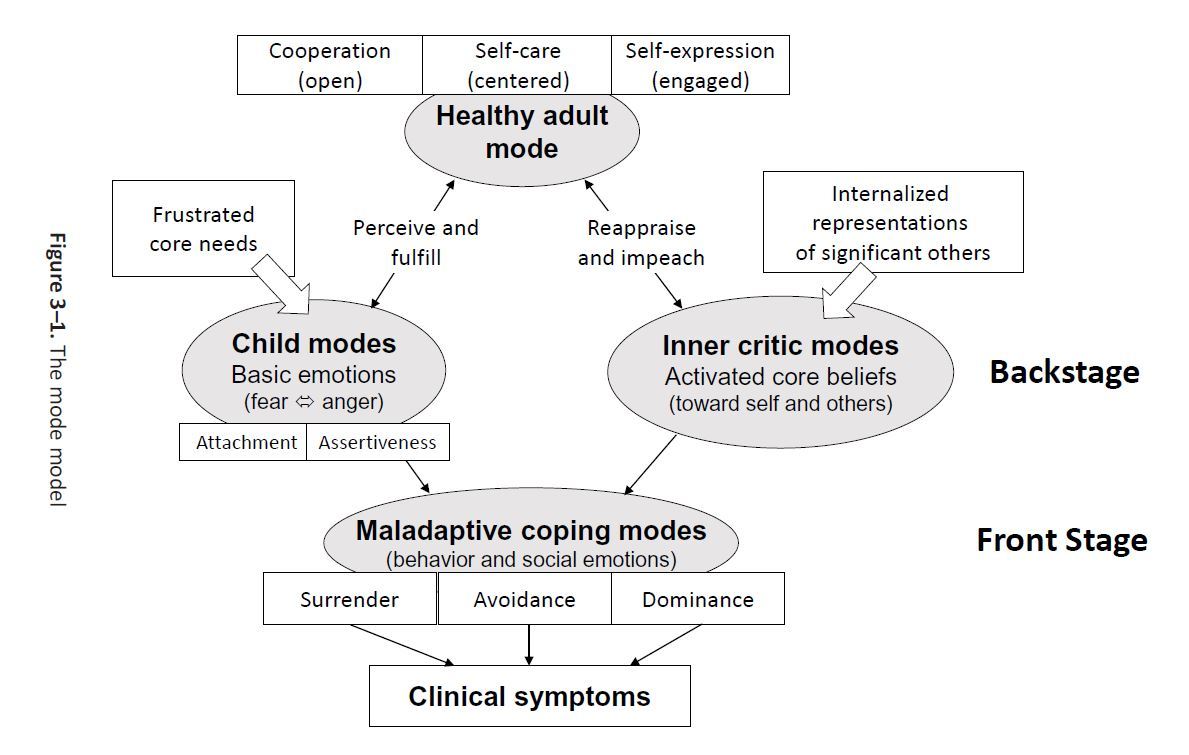
Child Modes
Inner Critic Modes
Maladaptive Modes
Healthy Adult Modes
Child: vulnerable, angry, enraged, impulsive, undisciplined, happy
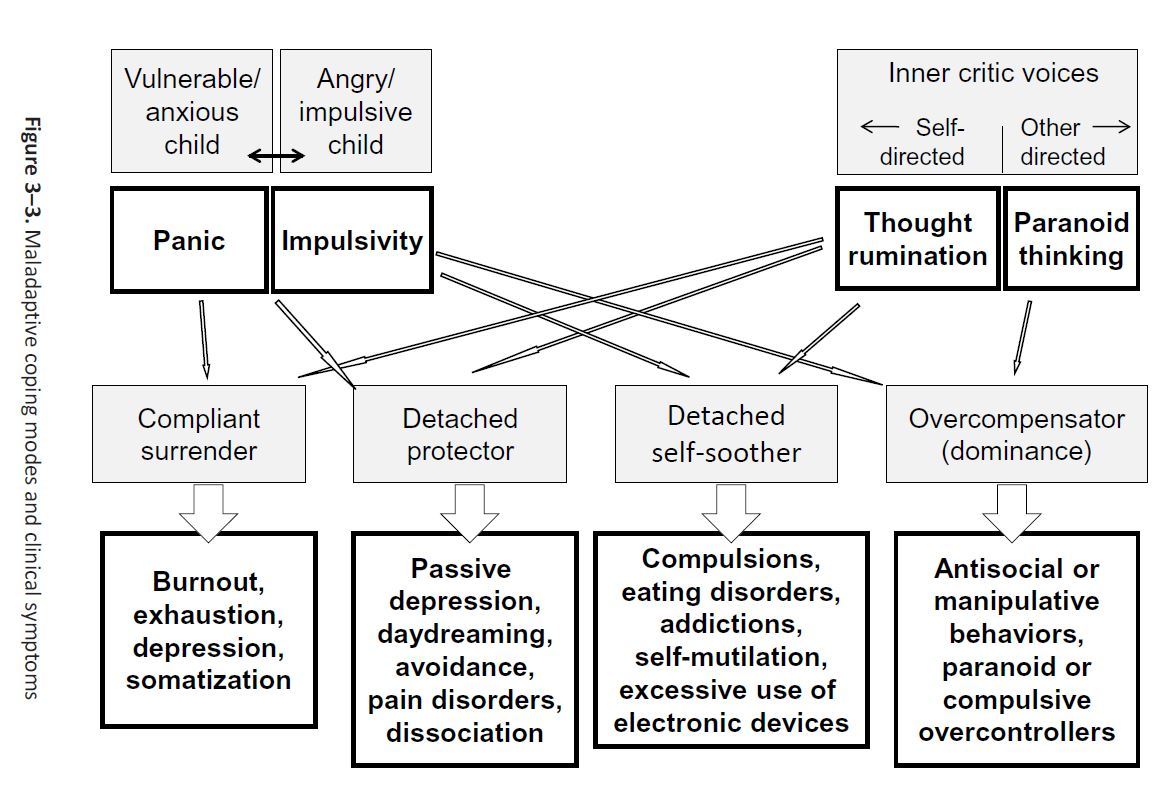
Maladaptive: compliant surrender, detatched self-soother, detatched protector, self-agrandiser, bully&attack.
Inner Critic: demanding, punative
Healthy: integrative
Vulnerability -panic - Compliance
Impulsive - Impulsive - Detachment
Inner critic - Rumination - Detachment
Critic - paranoia - Overcompensation
Complaint Surrender: burnout, exhaustion, depression, somatization
Detached protector: passive, depressive, avoidant, dissociated, pain disorders
Detached self-soother: compulsive, addictive, self-harm, digital media dependence
Overcompensator: anti-social, manipulative, paranoid, compulsive over-controllers
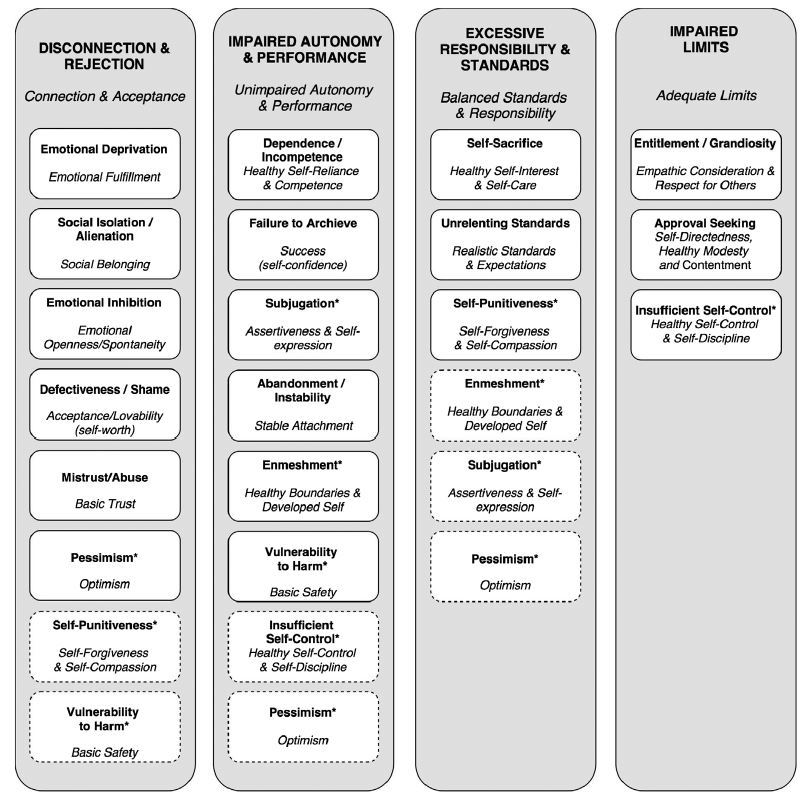
Schema Categories
Disconnection and Rejection
Impaired Autonomy & Performance
Excessive Responsiblity & Standards
Impaired Limits
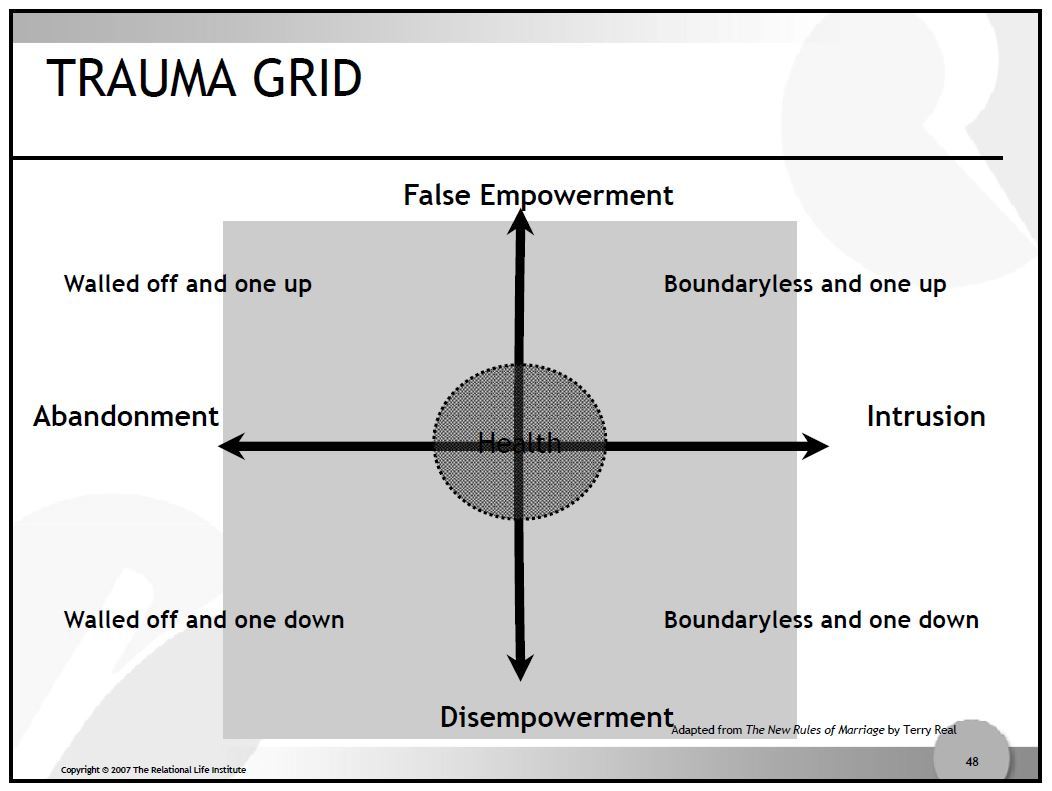
Trauma Grid
Terry Real
False Empowerment
Abandonment - Intrusion
Disempowerment
SCHEMA
- Abandonment/instability (AB)
CHILD NEED
For parent(s)/caregiver to provide stability and consistency in the home life and relationships
ADULT CHOICE
”| want to feel stable and secure in myself and my relationships”
- Mistrust/Abuse (MA)
For parent(s)/caregiver to protect the child from harm and honour the child’s boundaries and instil a sense oftrust and safety within close relationships
”| want to feel safe from harm and set boundaries to protect myself”
- Defectiveness/Shame (DS)
For parent(s)/caregiver to accept and love the child unconditionally and instil a sense of inherent worthiness
”| want to know my own worthiness and accept myself as | am”
I AM WORTHY
- Emotional Deprivation (ED)
For parent(s)/caregiver to care about the child’s emotions and validate their feelings as important
”| want to validate my own emotions and take them at face value”
I deserve ATTENTION
- Social lsolation/ Alienation (Sl)
For the peer group to provide a senseofinclusion and social connection for the child
”| want to feel like | belong and know who my tribe is”
I BELONG
- Dependence/incompetence (Dl)
For parent(s)/caregiver to encourage the child to take risks, problem solve, and develop competence and independent thinking through exposure to everyday situations
”| want to feel autonomous and capable of making decisions and trusting my own
judgment”
SCHEMA
- Vulnerability to harm or illness (VH)
CHILD NEED
For parent(s)/caregiver to contain their own fears and instill a sense of trust and safety within the world, in life and the future
ADULT CHOICE
”| want to trust that the world is a safe place and my body is capable of healing from illness”
I AM HEALTHY
- Enmeshment/Undeveloped self
(EM)
For parent(s)/caregiver to encourage individuality and celebrate the child’s unique personality, choices and preferences as separate to their own
”| want to experience my own unique individual self, including my preferences and choices as well as thoughts and values”
I HAVE AUTONOMY

-
Single Session Therapy12
-
Communication7
-
Narrative Therapy25
-
CBT IntInt25
-
Epigrams: Two to Tango17
-
Epigrams 3 - Psyche Logic26
-
Metaphors for Children22
-
Human Givens Needs & Resources25
-
Metaphors for Adults32
-
ACT13
-
Humour3
-
StoryTelling7
-
Andrew Bradford's Epigrams22
-
Famous Stories0
-
Human Givens Needs & Resources COPY20
-
Compassion Focused Therapy18
-
Motivational Interviewing57
-
Chair work19
-
Enneagram6
-
Schema Therapy44
-
Resource Therapy29
-
Rhymes & Riddles1
-
Memory Reconsolidation & New Rules1
-
Coherence Therapy14
-
Chairwork0
-
Attachment Theory4



