What is meant by psychosis?
Psychosis is a generic psychiatric term for a mental state often described as involving a ‘loss of contact with reality’. This could be present in other conditions as well. The ICD-10 classification of mental and behavioural disorders:
- ‘Psychotic’ simply indicates the presence of hallucinations, delusions, or a limited number of severe abnormalities of behaviour, such as gross excitement and overactivity, marked psychomotor retardation, and catatonic behaviour.
What are the symptom domains and symptoms of Schizophrenia?
- Positive symptoms (Hallucinations, Delusions)
- Negative symptoms (Anhedonia, Asociality, Avoilition, Affective flattening)
- Disorganisation (formal thought disorder)
- Dysphoria and Depression
- Disturbed Behaviour (thought disturbance, anti-social behaviour, depressed behaviour)
- Impaired social cognition (emotional processing, theory of mind, social relationship perception)
- Neurocognitive functioning (attention, memory, excecutuve functioning).
What symptoms of schizophrenia are primarily associated with disability and inability to work?
Negative symptoms (Aviolition, Asociality, Anhedonia and Affective flattening) and Neurocognitive effects (Attention, Memory and Excecutive functioning).
What are the classical subtypes of schizophrenia?
The classical schizophrenia subtypes include:
- Paranoid - characterised by persecutory/grandiose delusions, derogatory auditory hallucinations.
- Hebephrenic (Disorganisation syndrome) - formal thought disorder, affective flattening/incongruity and bizarre behaviour.
- Catatonic - multiple motor, volitional and behavioural disorders, stupor and excitement.
- Simple - insidious but progressive impoverishment of mental life, without development of florid symptoms.
Subtyping is criticised as being temporally unstable, overlapping phenomenologically and of questionable validity and clinical relevance.
Discuss the life expectancy of schizophrenic patients
Overall life expectancy is reduced by 20% for patients with schizophrenia. In fact their mortality is comparable to those who smoke heavily. Furthermore, this mortality gap between healthy and schizophrenics is widening, because of survival rates improving in the general population, more rapidly than those with schizophrenia. 60% of this excess in mortality is due to physical illness.
What are the reasons for the excess mortality in Schizophrenia?
- People with schizophrenia tend to have physical illness diagnosed later with inadequate treatment by physicians.
- Diabetes and schizophrenia have intrinsic disease links. Metabolic syndrome is one of the most common factors underlying this increased mortality in schizophrenic patients.
- Schizophrenics are more likely to have a poor diet, less exercise, more likely to smoke, medications can cause metabolic side effects and weight gain (olanzapine) increasing the risk of cardiac disease and diabetes.
- Some of the increased mortality may be due to suicide.
- ?Antipsychotics cause weight gain and dyslipidemia leading to metabolic syndrome.
Whar are other factors which contribute to the increased mortality and morbidity in people with SMI (Serious Mental Illness)
- Lack of access to and uptake of preventative care
- Suboptimal cardiac care (Mitchell & Lord - 2010)
- Physical illnesses underdiagnosed and undertreated ‘diagnostic shadowing’.
- Unhealthy lifestyle/physical inactivity
- Sleep and circadian disorders
- Social deprivation
- Poor diet: high in saturated fats and refined sugars, low in fruits and vegetables (Bly et al 2014)
- Poor compliance with medical treatment
- High levels of substance use (Olfson et al 2015)
Describe the onset of Schizophrenia
Vague symptoms such as a change in personality, a decrease in academic, social and interpersonal functioning often begin in middle-late adolescence. Other prodromal symptoms include suspiciousness, sleep disturbance, paranoid notions and emotional withdrawal. These precede a visit to the psychiatrist by about 1-2 years.
- First psychotic episode usually occurs between the late teenage years and mid 30s.
What is the sex disparity in Schizophrenia?
Affects males more than females 1.4:1. Men tend to present earlier, whereas more women present later on.
List the aetiological/risk factors for Schizophrenia
- Genes
- Advancing paternal age
- Cannabis use
- Chronic social advsesity
- Obstetric brain insults
Describe the influence of genetics to Schizophrenia development
Genetics is believed to play a role in the susceptibility to schizophrenia. The concordance for monozygotic twins is 48%, and for dizygotic twins is 12%. It is believed schizophrenia is highly polygenic, with a large heritable component but complex genetic architecture.
How may advancing paternal age contribute to Schizophrenia risk?
Advancing paternal age is also an independent risk factor for schizophrenia. This may be due to the accumulation of de-novo mutations in the paternal sperm that contributes to the risk. (Sipos et al 2004).
Describe the influence cannabis use may have on schizophrenia risk
- Heavy use at age 18 is associated with an increased risk of schizophrenia by six-fold.
- Cannabis use moderately increases risk of psychotic symptoms, but stronger in those predisposed.
- 40% increased risk of psychotic symptoms in anyone who has ever used cannabis.
- Findings were consistent with a dose-responsive effect.
How may cannabis use interact with genes to influence schizophrenia risk?
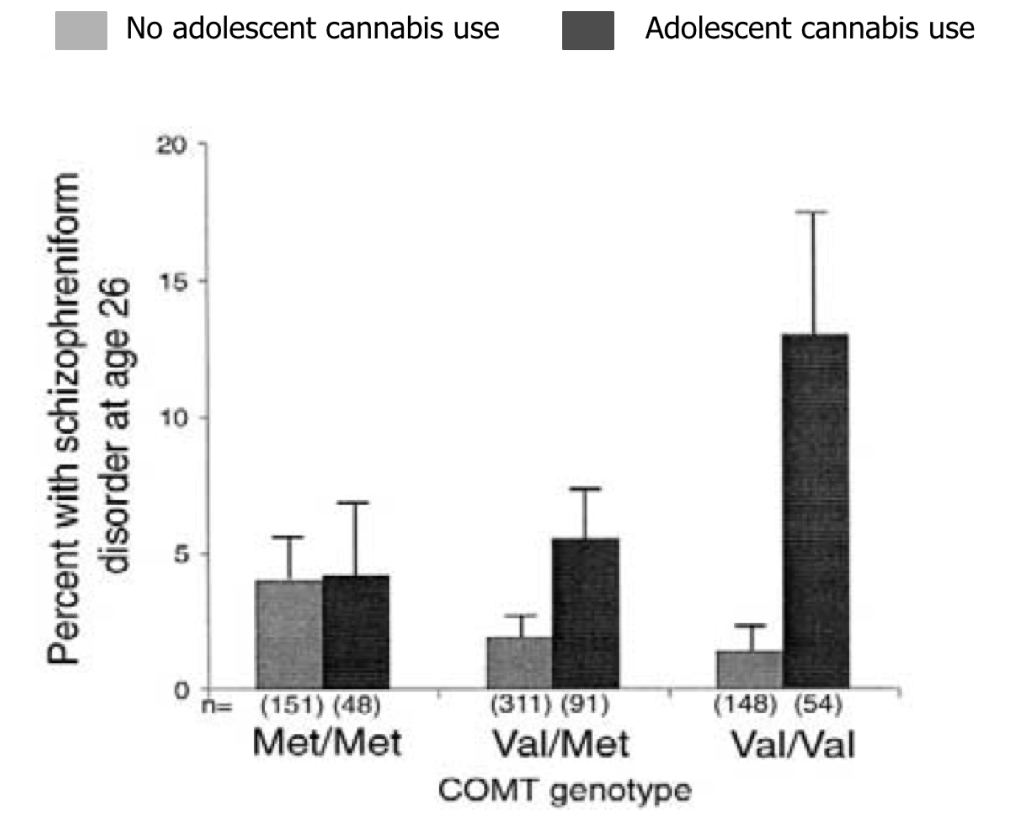
Evidence overall does suggest an aspect of causality. Perhaps cannabis use causes schizophrenia in genetically susceptible individuals. A potential loci for this genetic-environment interaction may be at COMT.
- COM-T is located on chromosome 22q11. It encodes catechol-O-methyltransferase, an enzyme involved in the metabolism of dopamine in the synapse.
- A common mutation is valine –> methionine substitution, producing a less active enzyme.
- Homozygosity for valine confers increased risk of developing schizophreniform disorder but only after adolescent cannabis use.
How do the aetiological factors produce the schizophrenia phenotype?
(neurodevelopmental hypothesis) Neurodevelopmental genes, neurotransmitter genes, environmental brain insults, substance use and chronic social adversity all contribute towards dopamine dysregulation which lead to the predisposition to developing psychosis.
This dopamine system dysregulation is reduced prefrontal dopamine activity coupled with increased mesolimbic dopamine transmission.
Describe how migration data suggests the role of chronic social adversity as an aetiological factor for schizophrenia
- Afrocarribeans have much higher incidence of diagnosed Schizophrenia in the UK. In Germany it tends to be the Turkish. This is thought to be related to immigration, with the chronic social adversity of being a 2nd or 3rd generation immigrant possibly accounting for the increased diagnoses of schizophrenia.
- First generation immigrants expect the social biases and xenophobia.
- 2nd or 3rd generation may not deal with antisocial experiences as well because they believe they are home.
What impact does the duration of the unreated psychosis (DUP) have?
The median time from onset of psychotic symptoms to treatment for psychosis is 1-2 years. This has an impact on patient outcomes:
- The longer the DUP, the poorer their response to treatment and poorer symptomatic and functional outcomes during the first several years of treatment (McGlashan et al 1996)
This may be due to:
- Antipsychotic medication slowing the active morbid process in the brain.
- Psychosocial effects of having an unchecked psychosis.
Describe the negative symptoms of Schziophrenia
- Alogia - Decrease in verbal output or verbal expressiveness
- Affective blunting/flattening - Diminished facial, emotional expression, poor eye contact, decreased spontaneous movement, lack of spontaneity.
- Avolition - Subjective reduction in interests, desires and goals, and a behavioural reduction of self-initiated and purposeful acts
- Anhedonia - Inability to experience pleasure from positive stimuli
- Asociality - Lack of self-initiated social interactions
What is the risk of suicide in schizophrenic patients, and what are the risk factors?
Schizophrenic patients are 12x more likely to commit suicide than the general population. This risk is particularly high in younger patients, with the risk decreasing over the decades however still remaining x4 more likely. Risk factors for suicide include:
- Male sex
- Young patients
- High level of education
- Fear of mental disintegration.
- Illness-related risk factors such as depression, active hallucinations, presence of insight.
Our only consistent protective factor is the delivery of and adherence to effective treatment.
What are the types of positive symptoms experienced in schizophrenia?
Positive symptoms can be categorised into either:
Perceptual disorders:
- Hallucinations - can involve all senses.
Thought disorders:
- Disorder of the form of thought - Formal thought disorder
- Disorder of the stream of thought - Thought blocking
- Disorder of the control of thought - Thought insertion, withdrawal or broadcasting
- Disorder of the thought content - Delusions.
Define halluication
A hallucination is the perception in the absence of an external sensory stimulus.
Describe the nature of hallucinations in schizophrenia
Auditory is the most common form (40-80%), where people frequently hear voices and other sounds. It may be described as emanating from inside the head or a specific external location. Can also be in third person and may be a running commentary on what the person is doing. They can be thought echoes or even command hallucinations.
Visual hallucinations (15%) are often unformed such as glowing orbs, or flashes of colour.
Somatic/tactile hallucinations (5%) can include the feeling of being touched, of sexual intercourse or pain.
Olfactory and gustatory hallucinations are rare, but possible.
Define delusion
A false, unshakeable belief which is out of keeping with the patient’s cultural and educational background.
What are the common delusional themes in schizophrenia?
Common delusional themes: It is about them and their status in society and the way people are responding to them. Common delusions are:
- Grandiose: belief person has some special significance or power.
- Paranoid: belief one is being harmed or persecuted by particular person of group. Common and clinically important because they may prevent the individual from cooperating with evaluation or treatment.
- Nihilistic: uncommon, bizarre belief that one is dead or one’s body is breaking down or does not exist.
- Erotomanic: person erroneously believes that he/she has a special relationship with someone.





