DVT management
- Prompt anticoagulant therapy is indicated to minimize thrombus extension and its vascular complications, as well as to prevent PE.
- Treatment options for initial therapy include IV or SC unfractionated heparin (UFH), SC low molecular weight heparin (LMWH), or SC fondaparinux.
- Warfarin is generally initiated within 24 to 48 h of starting heparin. Warfarin is the drug of choice for long-term anticoagulation for all patients except pregnant women (who should continue to take heparin) and patients who have had new or worsening venous thromboembolism during warfarin treatment (who may be candidates for an inferior vena cava filter (IVC)).
- The long elimination half-life of warfarin and the long elimination half-lives of clotting factors II and X necessitate a prolonged period of overlap between warfarin and heparin. Heparin is, therefore, continued for ≥5 days and until the INR is >2 and stable.
Heparin MOA
Heparin’s anticoagulant effect is a consequence of binding to antithrombin III. Antithrombin III is an α-globulin. It inhibits clotting factor proteases, especially thrombin, IXa and Xa. In the absence of heparin, these reactions are slow. The binding of heparin to antithrombin III leads to a substantial acceleration in the inhibition of the proteases. A critical sequence of five carbohydrate residues in heparin is required for binding to antithrombin III. Heparin functions as a cofactor for the antithrombin-protease reaction without being consumed. Once the antithrombin-protease complex is formed, heparin is released intact.
Compare and contrast UFH and LMWH
- LMWH inhibit activated factor X but have less effect on thrombin than UFH: UFH has an anti-factor Xa/anti-factor IIa ratio of 1:1. In contrast, LMWH have anti-factor Xa/anti-IIa ratios between 2:1 and 4:1.
- UFH also binds endothelial cells, platelet factor 4, and platelets, leading to rather unpredictable pharmacokinetic and pharmacodynamic properties. LMWH lack the nonspecific binding affinities of UFH, therefore they have more predictable pharmacokinetic and pharmacodynamic properties.
- LMWH have superior bioavailability, longer half-life, and less frequent dosing requirements (once or twice daily is sufficient) than UFH.
- LMWH are as effective as UFH.
- LMWH can be given on an outpatient basis.
- LMWH are cleared mainly by the renal route, and their half-life is prolonged in patients with renal failure. LMWH have a significant accumulative effect in patients with impaired renal function.
- UFH is cleared by renal and hepatic routes. UFH may be used instead of LMWH for hospitalized patients and for patients who have renal insufficiency or failure.
- LMWH have a predictable dose response, therefore usually their anticoagulant activity does not need to be monitored.
- The aPTT cannot be used to monitor LMWH activity, because LMWH do not significantly affect the aPTT. The anti-thrombin activity of LMWH is much less than its anti-factor Xa activity and prolongation of the aPTT is largely dependent on low thrombin activity.
- Anticoagulant activity of LMWH can be monitored by measuring factor Xa inhibition (anti-factor Xa activity).
- LMWH have replaced UFH for most clinical indications because (1) they can be administered SC, once daily, without laboratory monitoring; and (2) they are as effective as and safer than UFH.
Platelet count dropped by 50%, and blue discoloration of the toes was noted. What is the most likely diagnosis?
Heparin-induced thrombocytopenia (HIT) type II, a dangerous condition with a mortality rate of 50%.
HIT PFizz
- HIT type II is a systemic hypercoagulable state that occurs in 1 – 4% of individuals treated with UFH for a minimum of 7 days. It is caused by antibodies that recognize complexes of heparin and a platelet protein, Platelet Factor 4 (PF4). IgG binds to the PF4/heparin complex forming immune complexes. Then IgG binds to the Fc receptor on platelets. Fc activation leads to platelet degranulation & aggregation. The activated platelets release more PF4 and new immune complexes form. This can result in thrombocytopenia (due to platelet consumption) and thrombosis that range from mild to life-threatening. The result can be deep vein thrombosis, pulmonary embolism, or even a heart attack or stroke. Platelet counts can drop 50% or more.
- HIT must be suspected when a patient has a fall in thrombocyte count while receiving heparin—particularly if the fall is >50% of the baseline count.
- The risk of HIT is lower in individuals treated exclusively with LMWH.
What is the mechanism of action of argatroban and lepirudin? How is their effect monitored?
- They are direct thrombin inhibitors (DTIs). They exert their anticoagulant effect by directly binding to the active site of thrombin.
- Their effect is monitored with the aPTT.
What is the rationale of administering an anticoagulant when the patient has thrombocytopenia?
HIT is a clotting disorder, not a bleeding disorder. HIT is not associated with bleeding and, in fact, markedly increases the risk of thrombosis.
What other side effects of heparin?
- Hemorrhage
- Bleeding is the most common adverse effect associated with heparin.
- Osteoporosis
- The development of osteoporosis has been associated with administration of high-dose heparin for 6 months or longer. The underlying pathophysiology of this rare adverse effect remains unclear.
- Hyperkalemia
- Although rare, hyperkalemia has been attributed to heparin-induced inhibition of aldosterone synthesis. Patients with diabetes or renal failure may be at greatest risk.
- Other adverse effects
- Other rarely occurring adverse effects associated with heparin include generalized hypersensitivity reactions, such as urticaria, chills, fever, rash, rhinitis, conjunctivitis, asthma, and angioedema, as well as priapism and a reversible temporal alopecia.
What is the pharmacological therapy for prevention of deep vein thrombosis?
- UFH, the LMWHs, fondaparinux, and warfarin.
- LMWHs and fondaparinux provide superior protection against deep vein thrombosis when compared to UFH.
Three days after starting warfarin, an erythematous skin lesion, approximately 15 cm by 10 cm, was noted on D.J.’s right hip, and a similar one was noted on her left thigh; she reported intense localized pain bilaterally.
What is the diagnosis for her symptoms? What is the pathophysiology?
Warfarin induced skin necrosis (WISN), a rare, but serious adverse effect of warfarin therapy.
Patients present within 3 to 6 days of the initiation of warfarin therapy with painful discoloration of the breast, buttocks, thigh, or penis. The lesions progress to frank necrosis with blackening and eschar.
Skin necrosis appears to be the result of extensive microvascular thrombosis within subcutaneous fat.
Protein C has a shorter half-life than do other vitamin K-dependent coagulation factors (except factor VII), therefore its activity falls more rapidly in response to the initial dose of warfarin.
It has been proposed that the dermal necrosis is thus a consequence of a temporal imbalance between the anticoagulant protein C and one or more of the procoagulant factors, leading to initial hypercoagulability and thrombosis.
Skin necrosis has been associated with protein C or protein S deficiency. However, not all patients with heterozygous deficiency of protein C or protein S develop skin necrosis when treated with warfarin, and patients with normal activities of these proteins also can be affected. Morphologically similar lesions can occur in patients with vitamin K deficiency.
Adequate heparinization during initiation of warfarin can prevent the development of early hypercoagulability. However, as this case illustrates, warfarin-induced skin necrosis can occur in DVT patients when oral anticoagulation is started, despite the heparin coverage.
What other possible adverse effects from warfarin therapy should be considered
Hemorrhage
- Bleeding is the most common adverse effect associated with warfarin.
Purple Toe Syndrome
Purple toe syndrome is a rare adverse effect that typically occurs 3 to 8 weeks after the initiation of warfarin therapy. Patients initially present with painful discoloration of the toes that blanches with pressure and fades with elevation. The pathophysiology of this syndrome has been related to cholesterol microembolization from atherosclerotic plaques, leading to arterial obstruction. Because cholesterol microembolization has been associated with renal failure and death, warfarin therapy should be discontinued in patients who develop purple toe syndrome.
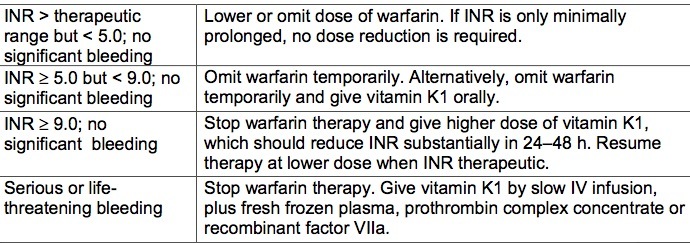
What is the recommended management of an elevated INR or bleeding in a patient receiving warfarin?
Note: INR>9 Stop Warfarin
What is the recommended initial management for Acute Coronary Syndrome (ACS)?
- Supplemental O2
- Aspirin
- Clopidogrel
- Nitrates
- Beta-blockers
- Morphine
- Anti-coagulation
- ACEi
- ARB
- Statins
When should patients receive fibrinolytic therapy instead of Percutaneous coronary intervention (PCI)/Angioplasty?
In situations in which early angiographic intervention is not possible fibrinolytic therapy should be used. Restoration of coronary blood flow in MI patients can be accomplished pharmacologically with the use of a fibrinolytic agent.
Absolute contraindications for fibrinolytic therapy in patients with STEMI include:
- Active internal bleeding
- Prior intracranial hemorrhage
- Structural vascular lesion
- Intracranial neoplasm
- Ischemic stroke within the past 3 months
- Suspected aortic dissection
- Closed head injury within the past 3 months
What fibrinolytics are recommended for reperfusion?
Streptokinase, alteplase (rt-PA), tenecteplase (TNK-tPA), and reteplase (rPA)
Describe the mechanism of action and the clinical effects of cocaine.
- Has multiple cardiovascular and hematologic effects
- Also associated with an increase in platelet activation, platelet hyperaggregability, premature coronary atherosclerosis, and thrombosis.
- Cause of MI via multiple mechanisms:
- Increasing myocardial oxygen demand by increasing heart rate, blood pressure, and contractility.
- Decreasing oxygen supply via vasoconstriction
- Inducing a prothrombotic state by stimulating platelet activation
- Accelerating atherosclerosis.
Patients with cocaine-associated chest pain, unstable angina, or MI should be treated similarly to those with traditional ACS, with some notable exceptions.
Pharmacotherapy includes aspirin and benzodiazepines. Unlike patients with ACS unrelated to cocaine use, cocaine users should be provided with IV benzodiazepines as early management. In the setting of cocaine use, benzodiazepines relieve chest pain and have beneficial cardiac hemodynamic effects.
Resolution of anxiety with a benzodiazepine will often lead to resolution of the hypertension and tachycardia. When sedation is not successful, hypertension can be managed with sodium nitroprusside, nitroglycerin, or intravenous phentolamine.
What agents should be avoided in Patients with cocaine-associated chest pain?
The use of β-adrenergic antagonists for the treatment of cocaine toxicity should be avoided in the acute setting. β-blockers result in unopposed α-adrenergic vasoconstriction, leading to further elevation in BP.
At discharge, β -blockers should be considered for patients with coronary artery disease or left ventricular dysfunction, in certain situations.
Can labetalol be used to manage cocaine-induced hypertension?
Labetalol is both an α-and β-blocker, but has substantially more β- than α- adrenergic antagonist effects. Labetalol does not reverse coronary artery vasoconstriction in humans. β-blockers and labetalol are contraindicated in the treatment of hypertension associated with cocaine toxicity.

-
Lecture 2 to 3: PD26
-
Lecture 4 to 5: PK24
-
Lecture 6 to 7: Clinical PK16
-
Lecture 8: Adverse effects18
-
Lecture 9: Drug development17
-
Lecture 11: Intro to autonomics21
-
Lecture 12: Cholinergic Drugs39
-
Lecture 13 to 14: Adrenergic drugs41
-
Lecture 15: Autacoids40
-
Lecture 16: Diuretics11
-
Lecture 17: Antihypertensives30
-
Lecture 18: CHF21
-
Lecture 19: Antiarrhythmic34
-
Lecture 20: antianginal drugs17
-
Lecture 21: antihyperlipidimics11
-
Lecture 22: Blood drugs26
-
Lecture 23: Anemia12
-
Lecture 24: Pharmacogenomics9
-
Lecture 25: Respiratory27
-
SG1: PK/PD5
-
SG2: Autonomics9
-
SG3: CVS18
-
Lecture 26: Contraceptives14
-
Lecture 27: Uterine drugs14
-
SG4: CVS219
-
GIT Drugs31
-
NSAIDS17
-
DMARD19
-
Opioids22
-
Gout10
-
Drugs for migraine12
-
Pain management17
-
Antimicrobials85
-
Clinical use of antimicrobials13
-
Antimicrobial therapy by pathogen36
-
Antimycobacterial drugs23
-
Antivirals27
-
Antiretrovirals45
-
Antiparasites34
-
Antifungals25
-
Anticancers61
-
SG 5: GIT & Pain management21
-
SG6: Infectious Disease21
-
Antimalarials21
-
Immunopharm27
-
SG7: HIV25
-
SG8: Diabetes26



