Define a hernia
Protrusion of part of whole of an organ or tissue through wall of a cavity that usually contains it
What is the most common type of hernia?
Inguinal hernia (abdominal cavity contents enter into inguinal canal)
Remind yourself of the two different types of inguinal hernia, include:
- Which is more common
- Path of each
- Why each occurs
- How and when can we reliably identify between the two?
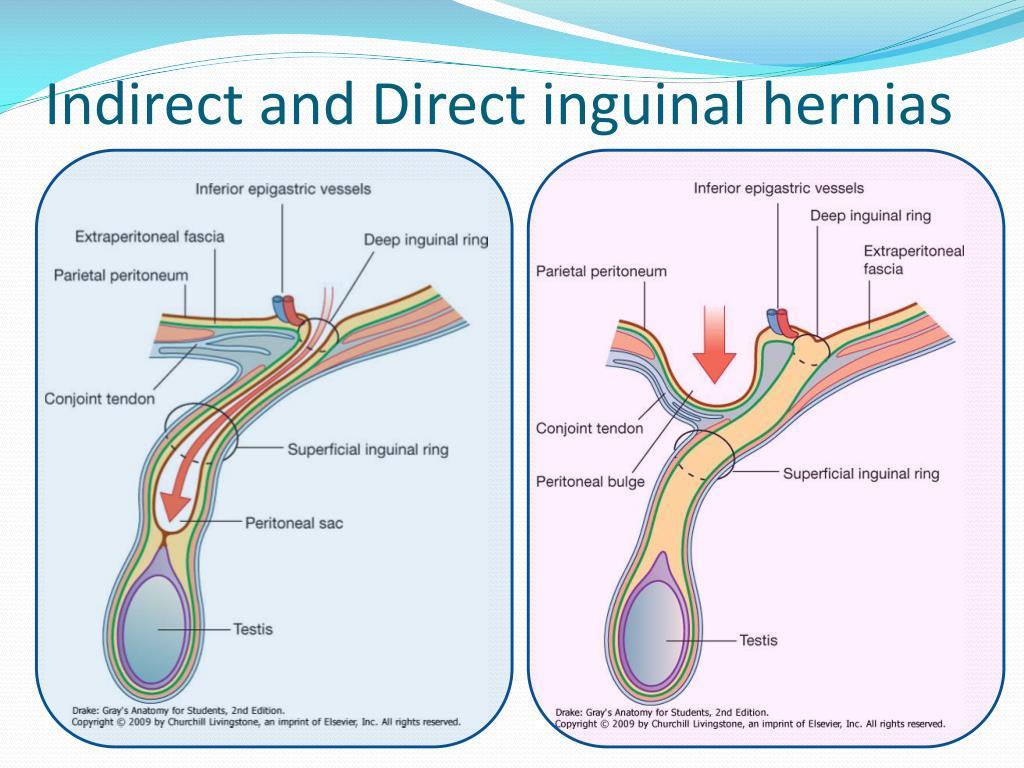
Indirect (80%)
- Enters inguinal canal via deep inguinal ring
- Arise from incomplete closure of processus vaginalis. Normally after testes descend to scrotum deep inguinal ring should close and processus vaginalis should be obliterated
Direct (20%)
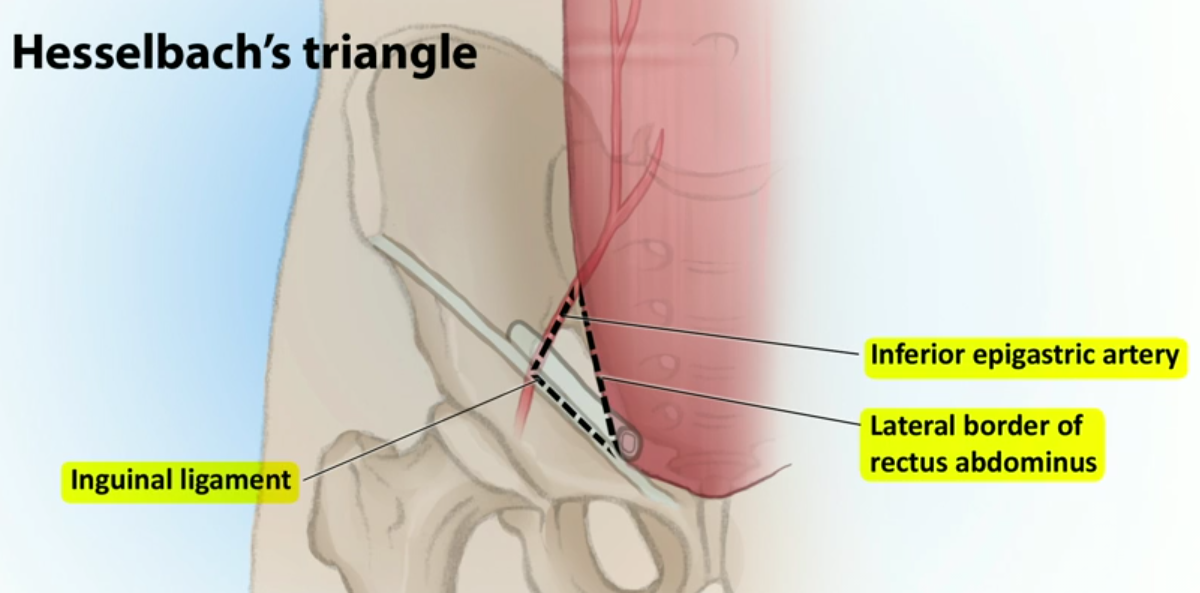
- Enters inguinal canal through weakness in posterior wall of inguinal canal; often it is Hesselbach’s triangle
- Commonly occur in older pts secondary to raised intra-abdominal pressure
Can only be reliably identified during surgery when look at relation to inferior epigastric vessels:
- Direct: medial
- Indirect: lateral
Remind yourself of borders of inguinal canal
- Posterior: transversalis fascia & conjoint tnedon medially
- Anterior: aponeurosis of external oblique reinforced by internal oblique muscle laterally
- Roof: transversalis fascia, internal oblique, transversus abdominis
- Inferior: inguinal ligament thickened medially by lacunar ligament
Remind yourself of the contents of inguinal canal
- Spermatic cord (MALES)
- Round ligament (FEMALES)
- Genital branch of genitofemoral nerve
- Ilioinguinal nerve
Remind yourself of borders of Hesselbach’s triangle
- Medial: lateral border of rectus abdominis
- Superior/lateral: Inferior epigastric vessles
- Inferior: inguinal ligament
State some risk factors for inguiinal hernias
- Male
- Age
- Rasied intra-abdominal pressure
- Chronic cough
- Heavy lifting
- Chronic constipation
- Obesity
Describe clinical features of inguinal hernia that is not incarcerated
- Soft lump in groin
- Disappear when lie down or with minimal pressure (if reducible)
- Protrude on coughing or standing
- Aching, pulling or dragging sensation
- Discomfort with activity or standing
Explain the difference between an incarcerated, strangulated and obstructed hernia
- Incarcerated= cannot be reduced
- Strangulated hernia= hernia is incarcerated and compression of hernia is compromising blood supply leading to ischaemic bowel.
- Obstructed= bowel that has herniated is obstructed leading to clinical features of bowel obstruction
Desribe clinical features of a strangulated hernia
- Lot of pain
- Tenderness at hernia site
- Hernia irreducible
What features should you look for when examining a groin lump?
- Cough impulse
- Location
- Reducible (on lying down +/- minimal pressure)
- Wide or narrow neck (wide neck=lower risk complications)
- If enters scrotum can you get above it/is it separate from testis
Describe how you can attempt to differentiate between direct and indirect hernias clinically
- Reduce hernia
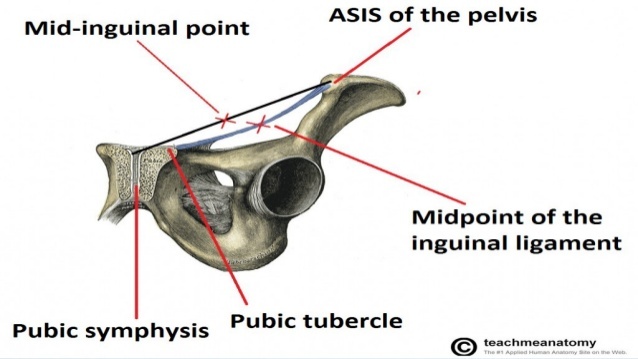
- Place pressure over deep inguinal ring (mid point inguinal ligament)
- Ask pt to cough
- If protrudes despite pressure on deep inguinal ring must be direct hernia
- *Often unreliable and can only truly differentiate at time of surgery*
- *Be sure you know difference mid inguinal point and midpoint inguinal ligament. Mid inguinal point= femoral artery*
Discuss whether any investigations are required for inguinal hernias
- Clincial diagnosis
- Only do imaging if diagnostic uncertinty or to exclude other pathology:
- First line= ultrasound in outpatient setting
- CT if features of obstruction or strangulation
Discuss the management (not specifics just general) of the following:
- Inguinal hernia no symptoms
- Symptomatic inguinal hernia
- Strangulated hernia
- Inguinal hernia no symptoms:
- Conservative
- Discussion about future surgical intervention and safety net strangulation
- Symptomatic inguinal hernia:
- Surgical intervention
- Strangulated hernia
- Immediate surgical exploration & intervetion

Discuss the different surgical interventions for inguinal hernias
- Tension free repair:
- Place mesh over defect
- Mesh is sutured to abdominal muscles & tissues
- Over time tissues grow into mesh to provide extra support
- Tension repair (rarely done):
- Suture muscle & tissue either side of defect back together
Repairs can be open or laparscopically. Often done open unless bilateral or recurrent (then do laparscopic)
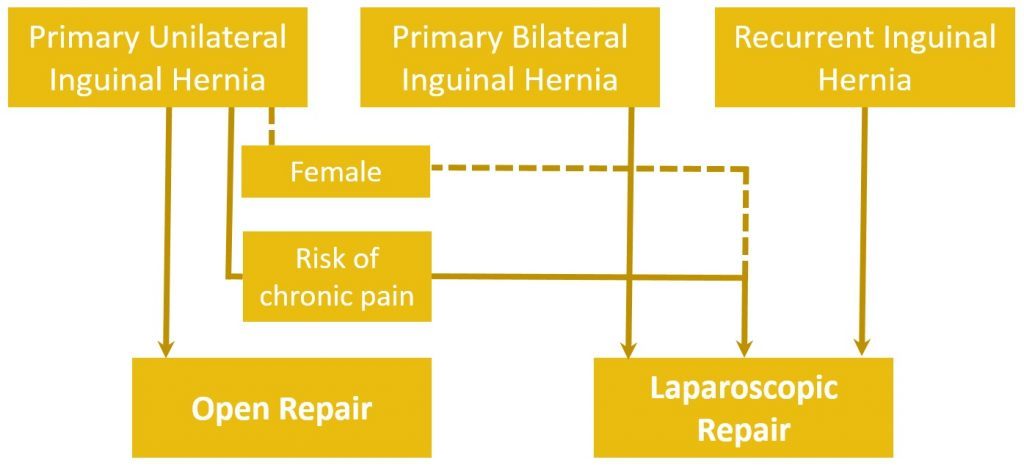
Why are open inguinal hernias done more often?
Why are laparascopic inguinal hernia repairs sometimes done?
- Open: cost effective
- Laparoscopic:
- Those at high risk of chronic pain
- In some females as higher risk of femoral hernia
State some potential complications of inguinal hernias
- Incarceration
- Strangulation
- Obstruction
State some potential complications of surgical repair of inguinal hernias
- Generic complications e.g infection, pain etc…
- Specific:
- Recurrence
- Chronic pain (persists >3 months)
- Subfertility (due to damage to vas deferens or testicular vessels which leads to ischaemic orchitis)
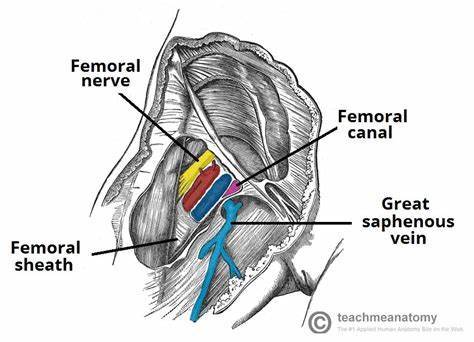
Remind yourself of the anatomy of the femoral canal
- Femoral ring= opening between peritoneal cavity and femoral canal
- Femoral canal boundaries:
- Medially: lacunar ligament
- Laterally: femoral vein
- Anteriorly: inguinal ligament
- Posteiror: pectineal ligament
What is a femoral hernia?
Abdominal contents pass through femoral ring into femoral canal
Which gender are femoral hernias more common in and why?
- Females
- Wider pelvis
What are femoral hernias at high risk of and why?
- Complicaions e.g. strangulation, obstruction, incarceration
- Narow neck/femoral canal only narrow opening
State some risk factors for femoral hernias
- Female
- Age
- Pregnancy
- Raised intra-abdominal pressure e.g. chronic constipation, heavy lifting
Describe clinical features of femoral hernias
- Small lump in groin
- Usually asymptomatic
- May present as emergency (obstruction or strangulation. ~30%)



