State the 8 planets in order of closest to furthest from the sun
Mercury
Venus
Earth
Mars
Jupiter
Saturn
Neptune
Uranus
Explain what the difference between a planet and a dwarf planet is.
To be a planet something must:
- Be large enough for its gravity to have cleared its own orbit of other debis
- Be large enough for its gravitational pull to have fomed it into a spherical shape
Dwarf planets are bodies orbiting the sun that have not managed to fulfil one or both of these criteria
What are the general differences between the orbit of a planet and the orbit of a dwarf planet?
- Dwarf planets orbits tend to be more eliptical than a planets (higher eccentricity)
- Dwarf planets orbits are inclined from the zodiacal plane but the orbits of planets are not.
What is an asteriod?
These are small rocky bodies orbiting the sun, mostly between the orbits of Mars and Jupiter
State 5 dwarf planets
Pluto
Ceres
Eris
Haumea
Makemake
What is a comet?
Where to comets originate?
A comet is a ball of ice and dust that is orbiting the sun in a very eliptical orbit
Short period comets originate in the kuiper belt, long period comets originate in the Oort cloud.
What is the life cycle of a star much larger than our sun
Include the elements that are created by the star at each stage
- A protostar forms within a nebula
- Fusion ignites in the protostar and it becomes a main sequence star, it remains here for most of its lifetime
Helium is fused to form hydrogen here
- The core of the star runs out of hydrogen to fuse and gravitational forces now overwhelm the thermodynamic pressure forces and the star collapses inwards. As it collapses it gets hotter and hotter until a layer of the star surrounding the core starts to undergo fusion. The outward pressure force increases and the star swells to become a red supergiant.
This star is hot enough to neuclei together to form all of the elements up to iron
- The Red supergiant runs out of fuel and collapes in on itself again. When it has collapsed enough to be hot enough to create fusion, the outer core undergoes a massive wave of fusing creating a massive explosion. This is a supernova.
All of the known elements are formed during this stage
- The inner part of the star then collapses again. If the mass of the core is less than 1.4x the entire mass of our sun it collapses to become an incredibly dense neutron star. If the mass of the core is greater than 1.4x the mass of our sun then the core collapses into a singularity - a black hole
Describe the life cycle of a small main sequence star, such as our sun
For each part of the life cycle state the elements created in the star
- A protostar forms within a nebula
- Fusion ignites in the protostar and it becomes a main sequence star, it remains here for most of its lifetime
Hydrogen is fused to form helium here
- The core of the star runs out of hydrogen to fuse and gravitational forces now overwhelm the thermodynamic pressure forces and the star collapses inwards. As it collapses it gets hotter and hotter until a layer of the star surrounding the core starts to undergo fusion. The outward pressure force increases and the star swells to become a red giant.
Hydrogen is fused to form helium
- the Red giant runs out of fuel and collapes in on itself again. When it has collapsed enough to be hot enough to create fusion, helium is fused into larger elements in one great and brief event that ejects the outer layers of the star to form a planetary nebula
Helium is fused to form heavier elements here
- The inner part of the star collapses to create a dense hot white dwarf star. This is very dense and no fusion occurs. it gives of light as it cools to become a red dwarf then a brown dwarf
What is a main sequence star?
what is the relationship between the mass of the star and how long it remains on the main sequence.
Describe the forces acting in a main sequence star
A main sequence star is a stable star. Stars will remain on the main sequence for the majority of their lifetime. The lower the mass of the star, the more slowly it uses up its fuel so the longer it remains on the main sequence.
Inside a main sequence star, the gravitational force trying to make the star collapse inwards are balanced by the radiation pressure from the fusing hydrogen neuclii which is exerting a force outwards.
Describe how stars are formed in a nebula
- Nebula are large clouds of hydrogen and helium gas, some areas of the nebula are more dense than others.
- The stronger gravitaitonal force of the more dense areas pulls the surrounding gas in the cloud towards it
- As the gas falls towards the denser area energy is transferred from the gravitational potential energy store to the kinetic energy store. The gas particles get faster and therefore hotter. This is now an object called a protostar
- As the protostar collapses in on itself it gets hotter and hotter. When it reaches 15 million kelvin it is hot enough for the hydrogen neucli to form into helium.
- When fusion ignites the outer layers of the protostar are ejected into orbit around the star, this material will eventually coalesce into planets.
Explain why neutron stars appear to give off pulses of radio waves (pulsars)
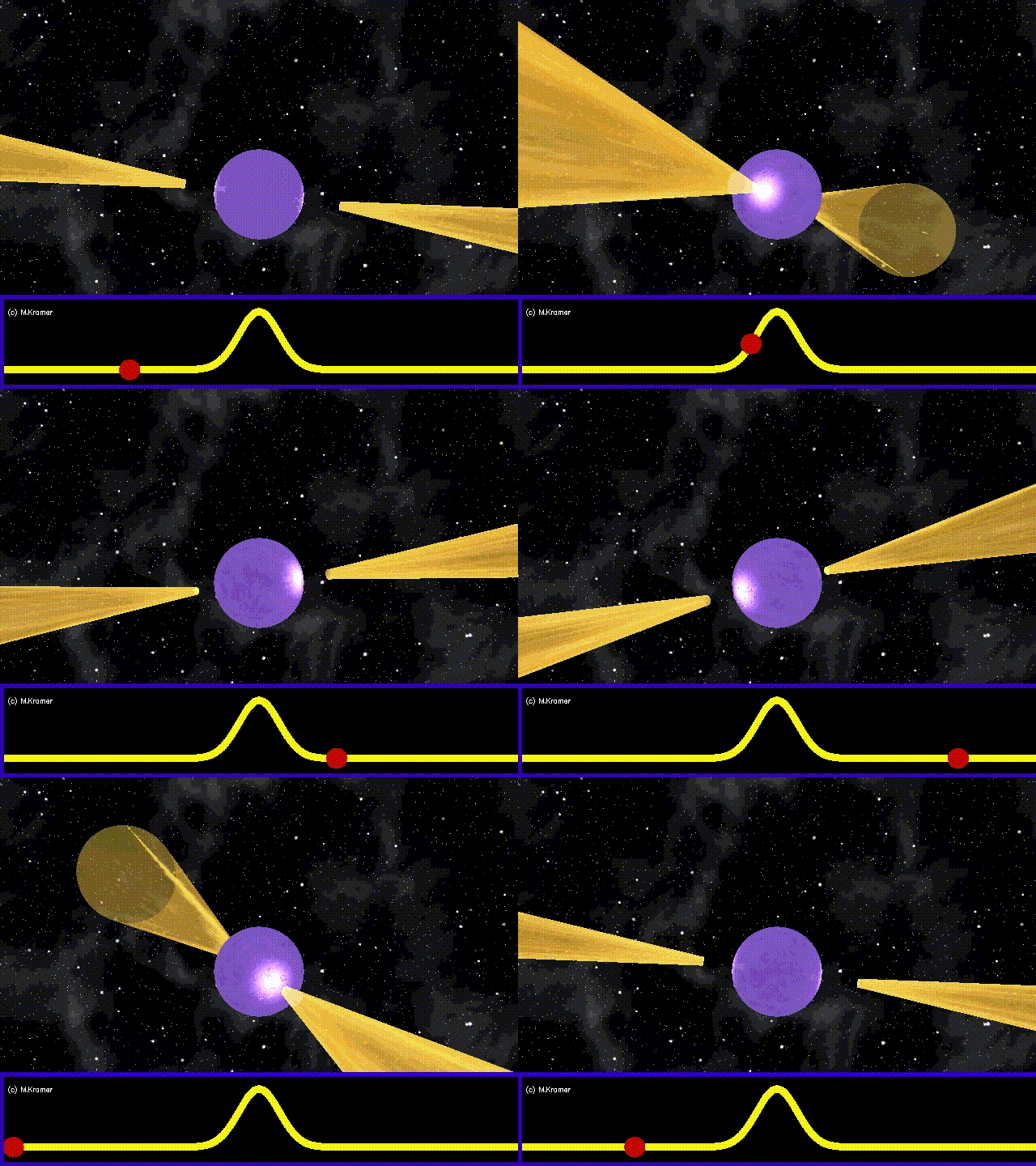
Neutron stars spin at an incredibly fast rate. As they spin they give off radio waves in beams from the magnetic north and south poles, which are in a different place to the pole around which it spins
This acts like a lighthouse beam, when the beam is pointing directly at us we experience a bright radio beam, then as it passes the radio wave intensity drops off to nothing again.
Explain why Neutron stars are incredibly dense
An entire neutron star is made of neutrons tightly packed together. This is means there are no spaces between the subatomic particles, like there are in atroms, so the entire star is as dense as the nucleus of an atom
Explain why black holes cannot be seen directly
How do we detect black holes?
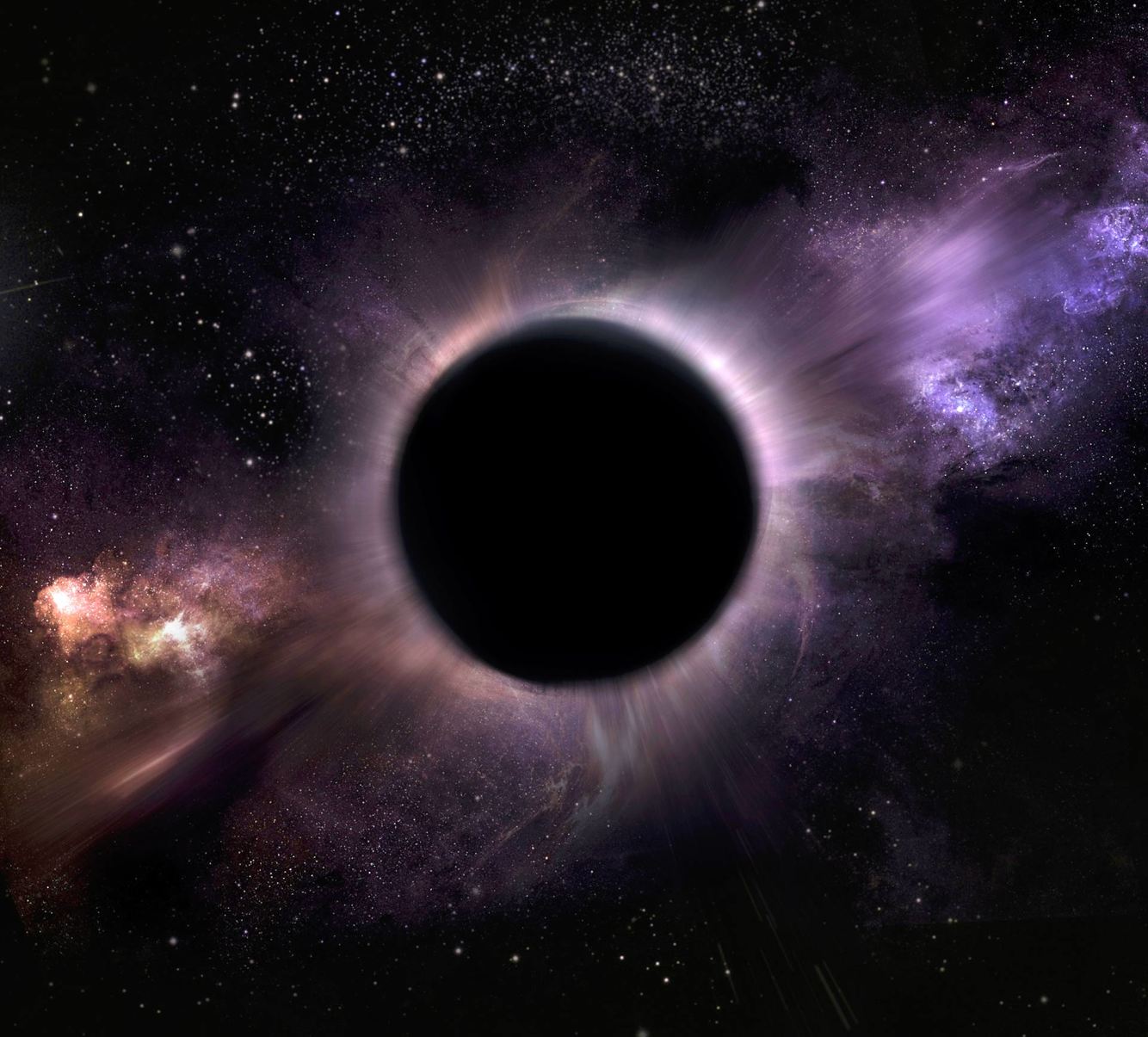
Black holes have a strong enough gravitational force that even light cannot escape its gravitational pull. This means that light cannot leave the black hole and get to the Earth, meaning that we cannot see it
As material falls into a black hole it gains energy and gets hotter. As it heats off it gives off light and infrared waves which reach the earth and can be detected
What is the Hertzsprung-Russell diagram?
Explain why this diagram is useful
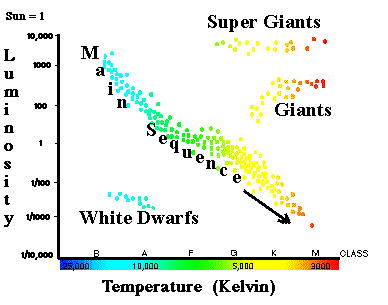
The Hertzsrpung-russel diagram is a chart that plots each star on a scale where its temperature is compared to its brightness.
It can be used to show which stars are on the main sequency and which ones are red giants, red supergiants and white dwarfs. This classification can then be used to predict what will happen to the star in the future and to infer some of its characteristics from similar stars.
What is the doppler effect?
Explain why red shift and blue shift occur
The doppler effect is the changing of the wavelength (and therefore colour) of the light emitted by an object when that object is moving towards or away from you.
Red shift is when the light moves towards the red end of the spectrum (the wavelength becomes longer) this happens when the galaxy is moving away from us
Blue shift is when the light oves towards the blue end of the spectrum (wavelength becomes shorter) this happens when a galaxy is moving towards us
Explain why the Andromeda galaxy is blue shifted
The andromeda galaxy is blue shifted becuase it is moving towards us. This is becuase the gravitaional force between Andromeda and The Milky Way is pulling the two galaxies towards each other at a rate that overcomes the expansion of the universe
What is a galaxy?
A massive collection of billions of stars bound together by gravity and all orbiting a common centre
Explain why galaxies moving away from us are red shifted
The galaxy is the sours of the waves. After the galaxy emits a wavefront of light it then moves in the opposite direction to the wave motion before emitting the next wave. This has the effect of lengthening the wavelength of the wave.
What is hubble’s law?
Explain how it can be used to find out how far away a galaxy is.
Hubble’s law states that the distance of a galaxy from the earth is proportional to the speed of recession of the galaxy.
v = Hd
v = speed of recession (km/s - kilometers per second)
H = Hubbles constant (km/sMpc)
d = the distance of the galaxy from the earth (Mpc - mega parsec)
To find the distance of a galaxy away from the earth first use the doppler shift to find the recession speed in km/s. Then rearrange the Hubbles law equation to give
d = v/H
Describe the motion of most galaxies relative to us
The galaxies are all moving away from us. The only galaxies that are not doing this are ones that are close enough to be affected strongly by the gravitational force of the milky way (e.g. Andromeda)
What is the relationship between the distance of a galaxy from us and the amount of red shift it experiences?
Explain why this is
The further away a galaxy is from us, the more red shifted the light that it emits. This is because galaxies that are further away from us are moving faster away than galaxies that are close by
Describe the big bang
The big bang is the theory that all of space, time and matter all started off in one place and exploded outwards. It is scientifically accepted as the most likely theory for the origin of the universe.
Describe 3 bits of evidence for the big bang
- Galactic red shifts - the further away a galaxy is the the more ded shifted the light is, meaning that it is travelling faster. This implies that all of the galaxies started in the same place.
- Cosmic microwave background radiation - During the big bang gamma rays were predicted to be released. As time and space has streched the waves have also stretched, so now the gamma rays are longer microwaves that can be detected coming from all directions at once
- Proportions of hydrogen (75%) and helium (25%) in the universe - the probotions of hydrogen and helium are the same as in the center of a star. This follows the theory that at the begining of the big bang the entire universe was one large fusing star (big bang nucleosynthesis)
Explain why the sun radiates visible light, ultraviolet and infraed radiation
In the core of the sun protons are fused together to create helium nuclei. This process has a mass defect (the mass of the helium is lower than the mass of the hydrogen that created it) and that mass is released as energy in the form of gamma rays.
The gamma rays emitted are transferred into thermal energy in the convetion zone of the sun, the convection zone heats up the phososphere which emits the energy as visible light, infrared and ultraviolet radiation.



-
Electricity Up to level 655
-
Electricity levels 7-910
-
old version Radioactivity75
-
Energy up to level 659
-
Energy levels 7-919
-
Particles up to level 634
-
Particles levels 7-98
-
Required practicals paper 112
-
Forces up to level 625
-
Forces levels 7-99
-
Additional Forces Seperate science16
-
Motion up to level 626
-
Motion levels 7-93
-
Forces and motion up to level 626
-
Forces and motion levels 7-99
-
Additional Forces and motion for separate science4
-
Pressure (separate science only)16
-
Wave properties up to level 621
-
Wave properties levels 7-95
-
Additional wave properties for separate science14
-
Electromagnetic waves up to level 622
-
Electromagnetic waves levels 7-94
-
Light and electromagnetic waves (separate science)39
-
Electromagnetism up to level 615
-
Electromagnetism level 7-95
-
Additional electromagnetism for separate science10
-
Space (separate science only)45
-
Required practicals paper 28
-
Radioactivity34
-
Radioactivity levels 7-99



