list in order of greatest to least the distribution of cardiac output
- heart
- brain
- skeletal muscle
- skin
- gi
- kidneys
- skeletal muscle
- skin
- gi
- heart
- kidney
what doe the coronary vessels (epicardial vessels) serve as?
low resistance distribution vessels
what factors regulate coronary blood flow?
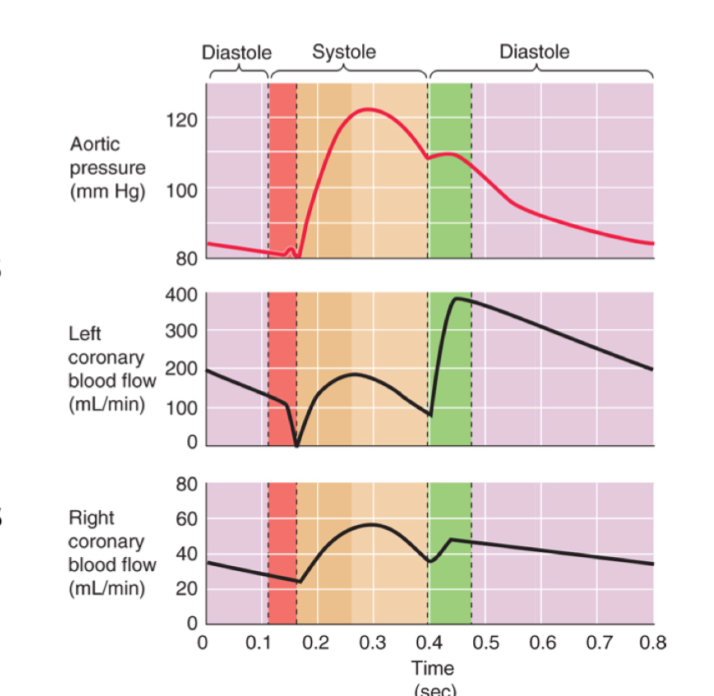
when does most blood flow in the coronary artery occur? when does it peak?
- hyperimic/metabolic- most important
- O2(decrease)->dilation via opening K channels of smooth muscles
- adenosine, NO,
- O2(decrease)->dilation via opening K channels of smooth muscles
- physical
- neural
most blood flow in the coronary artery occurs during diastole, when the myocardium relaxes. peaking early diastole and then falls passibely as the aortic pressure falls with the rest of distole
what sets the myocardial metabolic rate?
what response does the myocardial oxygen consumption lead to?
O2 demands
- amount and type of activity
- cardiac output
- stroke volume and heart rate
- healthy heart O2 demand =O2 delivery
MO2C
- increase heart rate
- chronotropy
- increase ionotropy
- increase afterload
- increase preload
ischemia reuls in
- accumulation of what intracellularly?
- affects the contractin of the heart how?
- accumulation of Na and Ca
- Ca leads to overload interference, interrupting myocardial contraction and cell death
what tis exhibeted in resting skeltal muscle? (think about capillaries)
what about active?
pre capillary arterioles exhibit asynchronous intermittent contraction and relaxation so that att any given time only a small fracttion of the muscle is perfused and total flow through the muscle is very low
active muscle excetes CO, as much as 80%, and is the primary determinant of systemic vascular resistance during exercise. increasing blood flow up to 20x’s
explain resting sympathetid tone and how it is overiden. what happens to flow during strong sustained muscular contraction
sympathetic innercvation produces vasoconstriction throuugh a1. at rest neural factos DOMINATE. during acttivity local factors overide neural vasoconstrictive reponse due to close coupling between O2 and blood flow(hyperimic)
flow can be significantly decreased by extravascular compression, via strong sustained contractions.
- how is the flow through the brain defined?
- how does the brain respond to ischemia?
- what regulates the cerebral circulation
- constant due to confinement imposed by the crainium
- least tolerant to ischemia, no longer than 5 seconds
- sympathetic is weak, hyperimic factor are strongest= CO2
- stimuli such as touch, pain, motino and problem solving affect blood flow
what is the function of splanchnic circulation?
what happens to caridac output and skeletal muscle?(this is tricky)
splanchnic circulation provides an additional blood reservor. containing 15% of total blood volume, majority in the liver.
during exercise, constiction of splanchnic resistance vessels decrease cardiac output to viscera by making more blood available for skeltal muscle contraction.
- what is the exclusive control over the GI vessels?
- how does parasympathetic vasodilation operate?
- what is functional hyperemia?
- exculively sympathetic. via a1 adrenergic receptors
- indirect, stimulating motility and secretion, increases activity of tissue, increasing hyperimic factors which manipulate blood flow regionally
- functional hyperemia is the the idea that food ingestion increases blood flow
- gi hormones: gastrin and cck
- undigested food = little effect on intestinal blood flow
- glucose and fatty acids increase mesenteric hyperemia
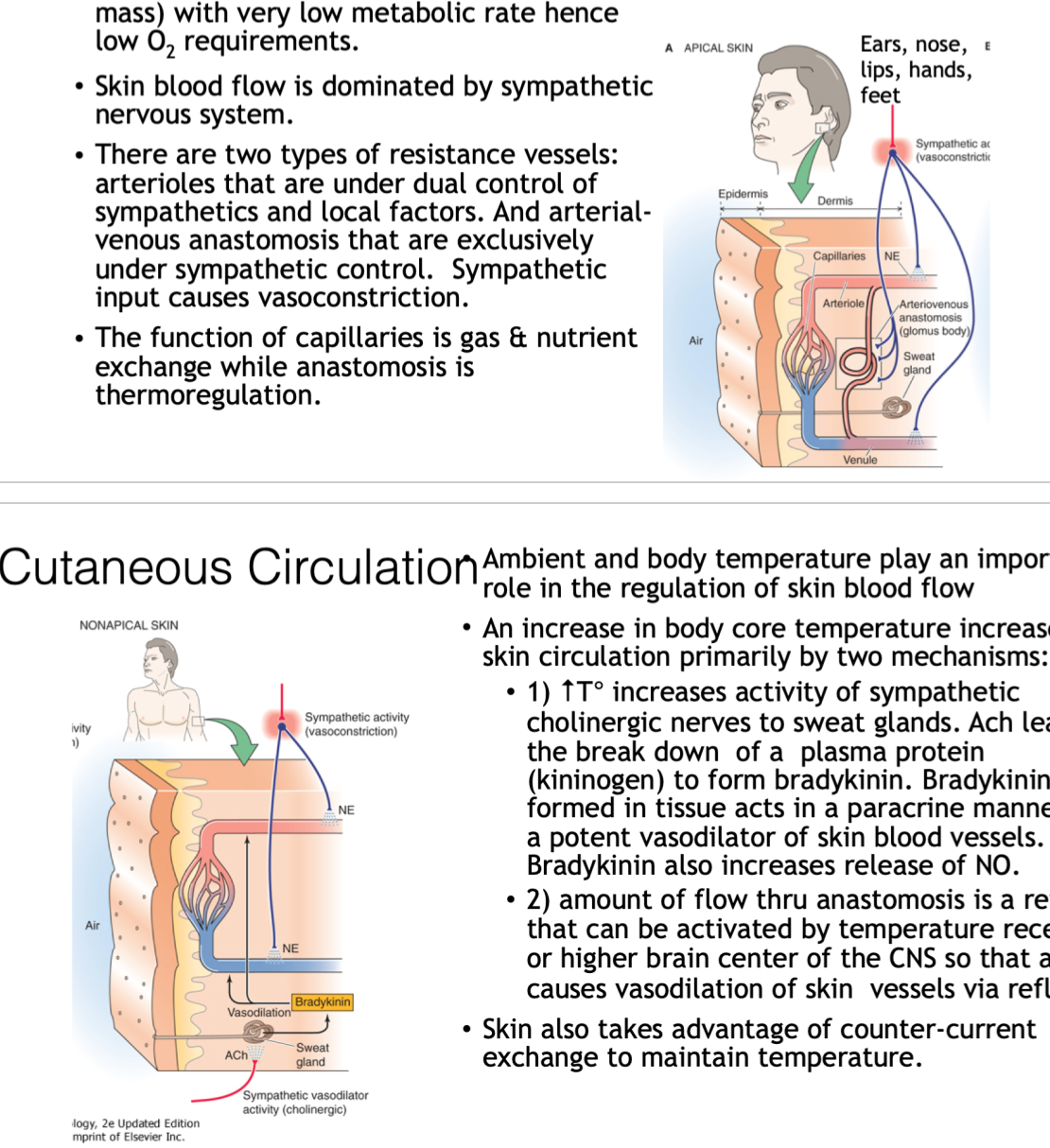
- what location has a very low metabolic rate and low o2 requirementts?
- which nervous system dominates this organ?
- describe the two types of resistance vessels, their control and function.
- skin
- sympathetic
- arterioles and anastomosis
- arterioles
- sympathetic and local factors
- nutrient exchange
- anastamosis
- exculsivley sympathetic
- thermoregulation
- arterioles
desdribe the function of thermoregulation in the skin.
increase in body core temp
- sympatheti stimulation of ACh leads to formation of bradykinin, which acts as a potent vasodilator. increasing NO
- this leads to blood flow through the anastomosis
- higher the NCS temp = higher the blood flow through the
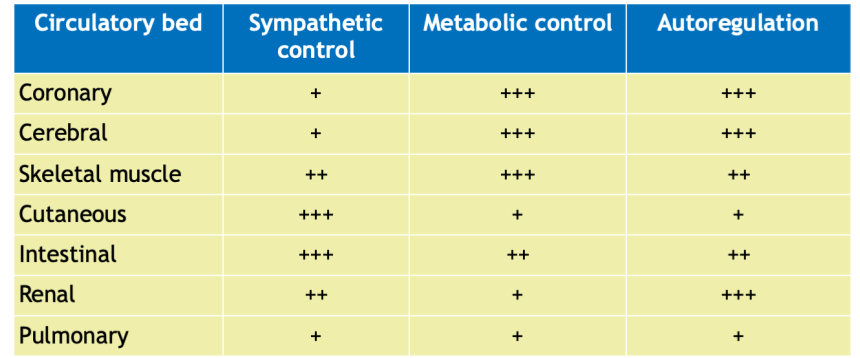
list the circulattory beds that corresond to vascular control mechanism
- sympathetic (2)
- metabolic control(3)
- autoregulation(3)
- sympathetic
- cuteaneous
- intestinal
- metabolic
- coronary
- cerebral
- skeletal muscle
- autoregulation
- coronary
- cerebral
- renal
not pulmonary has weak response to all three!