Michelson and Morley, and attempting to find the absolute speed of the Earth
- in the 19th century mosy physicists believed in absolute motion. Thye thought everything moved relative to a fixed background (called the ether)
- they tried to measure the absolute speed of the Earth through the ether using an interferometer
- the expected the motion of the earth to affect the speed of light they measured in certain directions
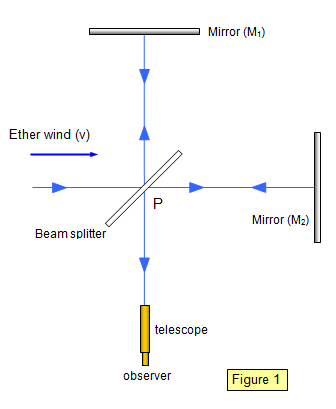
Michelson and Morley interferometer
- monochromatic light is sent towards the particle reflector
- light is split into 2 beams travelling at right angles to each other
- beams are reflected at M1 and M2
- when the reflected beams meet back at the partial reflector, they form an interference pattern
- this pattern is recorded by the observer
- the interferometer is then rotated by 90 degrees and the experiment is repeated
Michelson and Morley interferometer: expectations and results
Expected outcome: According to Newton’s laws, light moving parallel to the motion of the earth should take longer to travel to the mirror and back than light travelling at right angles to the motion. So rotating the apparatus should have changed the travel time for the 2 beams - tiny shift in the interference pattern
Results: There was no shift in the pattern, so newtons laws didn’t work here.
It was concluded that it was impossible to detect absolute motion (ether doesn’t exist), and that speed of light is the same for all observers
invariance of the speed of light
the speed of light is a speed measured to be the same in all reference frames by all observers
inertial frames of reference
An inertial reference frame is one in which NL1 is obeyed. Objects won’t accelerate unless they’re acted upon by an external force.
Rotating or accelerating references aren’t inertial frames.
References at constant velocities are inertial frames.
-To help understand this, imagine how a marble on a train table acts when the train is at rest, constant velocity, or accelerating
Einstein’s postulates of special relativity
This theory only works in inertial frames and is based on 2 postulates.
- physical laws have the same form in all inertial frames - if we do any physics experiment in any inertial frame we will get the same result
- speed of light in free space is invariant
time dilation
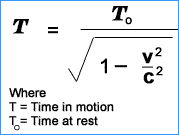
- a moving clock runs slower
- a stationary observer observes the interval between 2 events as t0, the proper time
- an observer moving at velocity, v will measure a longer interval of t
- this is called time dilation
- t > t0
proving time dilation from muon decay
Muons are particles created in the upper atmosphere that move towards the ground at speeds close to c. At rest, they have a half-life of less than 2µs.
- measure the speed of the muons, about 0.99c
- place a detector at a high altitude and measure the muon count rate
- use another detector to measure the count rate at ground level
- As we have 2 values for count rate and can find the time in between, we can calculate the half-life relative to the muons and the observer
length contraction
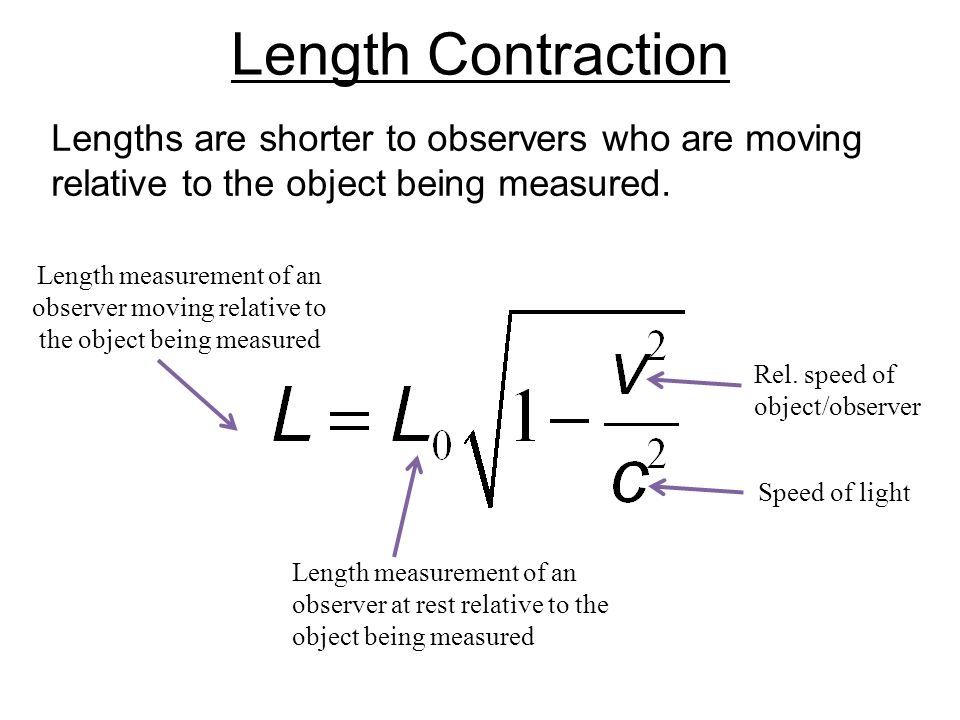
- a rod moving in the same direction as its length looks shorter to an observer
- L < L0
relativistic mass and energy
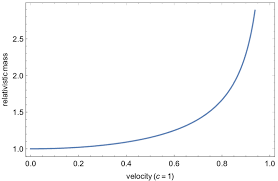
- the faster an object moves the more massive it gets, the formula is in the booklet and m0 represents the rest mass, and m the relativistic mass
- as the relative speed of an object approaches c, the mass approaches infinity. So in practice, no massive object can accelerate to a speed equal to or greater than the speed of light
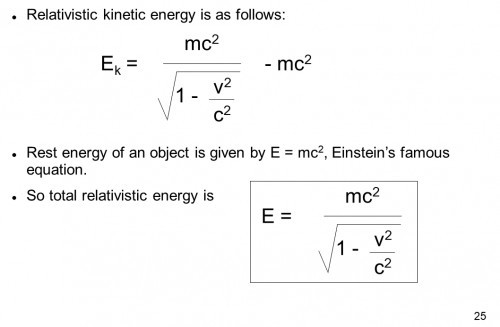
relativistic energy
-E = mc2
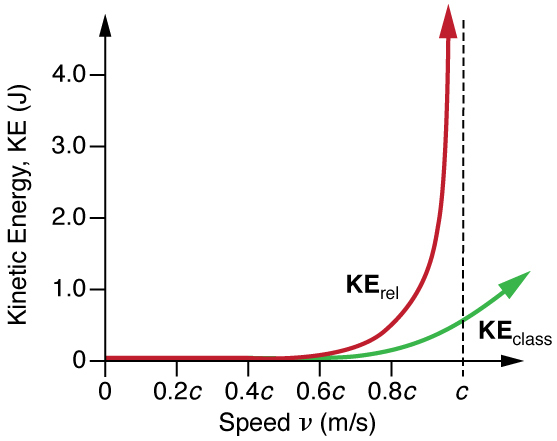
Bertozzi demonstrated that mass increase with speed
- Bertozzi used linear particle accelerators to accelerate pulses of electrons at different energies into an aluminum disc
- the time taken was measured so the speeds could be calculated. As energy increases speed doesn’t increase as you would expect from E = 1/2 mv2, So mass must also be increasing.
- Bertozzi used heat generated by the particle collisions to calculate the KE of the particles immediately before impact
- By plotting a graph of KE against speed he found it closely matched Einsteins predictions (from his formula), this was the first direct evidence for special relativity