corpuscular theory
- Newton suggested light was made of tiny particles which he called ‘corpuscles’
- one argument was that light was known to travel in straight lines, while waves would diffract. At the time it was only known that light could reflect and refract, not diffract too.
- the theory was based on his laws of motion, that all particles will travel in straight lines
- Newton thought that reflection occurred because of the normal reaction, e.g. bouncing a ball etc..
- Newton though refraction occurred because corpuscles travelled faster in a denser medium
wave theory
- Huygens thought light was a wave and developed Huygens principle
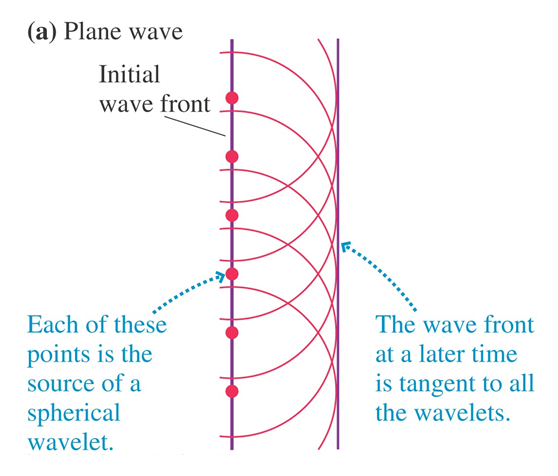
Huygens principle: Every point on a wavefront may be considered to be a point source of secondary wavelets that spread out in the forward direction at the speed of the wave. The new wavefront is the surface that is tangential to all of these secondary wavelets.
- by applying this theory to light he could easily explain refraction and reflection, but contrasting to Newton he predicted light would slow in a denser medium.
- he also predicted that light should diffract and 2 coherent light sources should interfere.
- for the photoelectric effect, this doesn’t work as energy is proportional to the intensity of the beam among other things
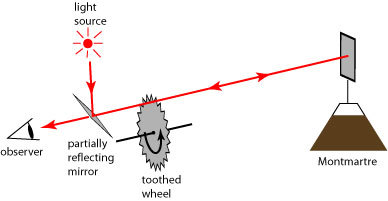
How did Fizeau measure the speed of light?
He passed a beam of light through the gap between 2 cog teeth to a reflector about 9 km away. The cog was rotated at exactly the right speed so that when the light returned it would travel through the next gap in the cog teeth.
Using the frequency of rotation and number of teeth Fizeau could calculate the time period for the light to travel to the reflector and back
As the distance was set, Fizeau had values for time and distance so he could calculate the speed of light.
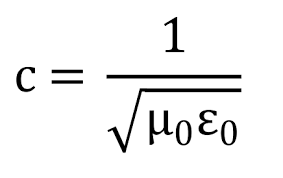
Maxwell’s prediction of EM waves and their speed
- Maxwell created a mathematical model of magnetic and electric fields, the model said that a change to these fields would create an EM wave, radiating out from the source of the disturbance.
- He predicted there would be a spectrum of EM waves travelling at the same speed but at different frequencies
- showed that theoretically, all EM wave should travel at the same speed in a vacuum
- the value for c was very close to Fizeau’s and as such was strong evidence that light was an EM wave
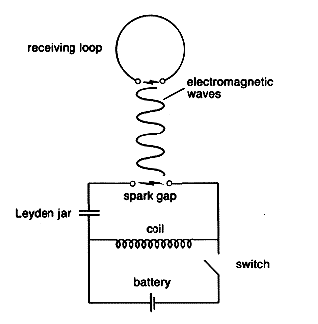
Hertz discovering radio waves
- Hertz produced and detected radio waves when a high voltage from an induction coil caused sparks to jump across a gap of air
- he detected the radio waves by watching for sparks between a gap in a loop of wire
- the fact that PD was induced in the loop showed the waves had a magnetic component
- He went on to show that radio waves could be reflected, refracted, polarised and show interference
Hertz measuring the speed of radiowaves
- he used a setup with a radio wave transmitter and a reflecting sheet to create a stationary wave at a fixed resonant frequency, the by moving a detector he could find where the nodes were and as such could calculate the wavelength
- then using frequency he could calculate the wave speed
- wave speed was the same as maxwells value, helping to confirm that radiowaves are electromagnetic waves.
black body radiation
Pure black surfaces emit radiation strongly and in a well-defined way. This is called black body radiation
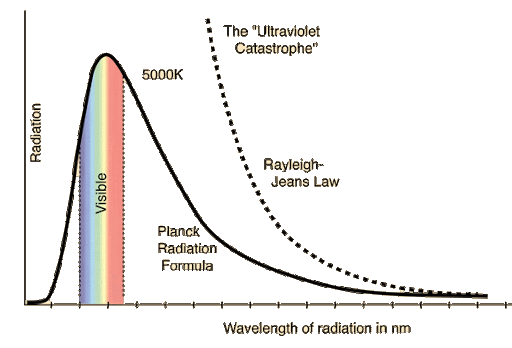
A black body: defined as a body that absorbs all wavelengths of EM radiation and can emit all wavelengths of EM radiation
the ultraviolet catastrophe
wave theory can explain the slope of the black body radiation graph at long wavelengths, but predicted an infinitely high peak towards the UV region - ultraviolet catastrophe
-the photon model of light can explain it
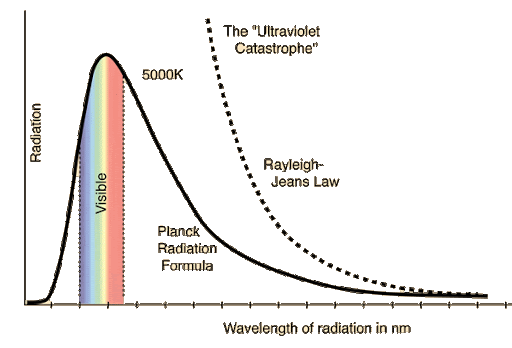
the photon model of light
- when Planck was investigating black body radiation he suggested EM waves can only be released in discrete packets or quanta
e=hf=hc/wavelength
- Einstein went further and said EM waves could only exist in discrete packets and he called these wave packets photons
- he saw them as having a one on one interaction with an electron in a metal surface, and this model would explain the photoelectric effect including threshold frequency and max. KE
wave-particle duality
-DeBroglie came up with the wave-particle duality theory.
If ‘wave-like’ light showed particle properties, ‘particle’ like electrons should be expected to show wave-like properties
p (momentum) = h/ wavelength
- the De Broglie wave of a particle can be interpreted as a “probability wave”. The probability of finding a wave at a point is directly proportional to the square of the wave’s amplitude at that point.
electron diffraction
- this shows the wave nature of electrons
- diffraction patterns were observed when accelerated electrons in a vacuum tube interacted with the spaces in a graphite crystal
- if velocity is higher the wavelength is shorter and the ad of the lines is shorter
- in general wavelength for electrons accelerated in a vacuum tube is about the same as the wavelength for EM waves in the x-ray part of the spectrum
electron microscopes
they use electrons instead of light
- a stream of electrons is accelerated towards the sample using an electron gun
- to resolve detail around the size of an atom, the electron wavelength needs to be similar to the diameter of an atom (0.1nm) or smaller. This means an anode voltage of at least 150V
- the stream of electrons from the electron gun is confined into a thin beam using a magnetic (or electric) field
- the beam is focused onto the sample and interactions are transformed into an image
transmission electron microscope (TEM)
A very thin specimen is used and the parts of the beam that pass through the specimen are projected onto a screen to form an image
scanning tunneling microscope (STM)
- a fine probe is moved over the surface of the sample and a voltage is applied between the probe and surface
- electrons “tunnel” from the probe to the surface, resulting in a weak current
- as the distance between the probe and surface increases, the current decreases
- by scanning the probe over the surface and measuring the current, you can produce an image of the surface of the sample




