Coke properties (uality and composition)
- Moisture
- Dry quenching 0,1-0,2%
- Wet quenching 2-5%
- Ash 11-12%
- Volatile matter 0,5-0,6 %
- Mean diameter 50mm
- H2 46-52%
- CH4 27-35%
- CO 6-10%
- HC 3-4%
- CO2 2-3%
- N2 3-5%
Name Typical iron ores
- Magnetite Fe3O4 –approx.72 % iron
- Hematite Fe2O3 – approx. 70 % iron
Decribe Production of raw iron
- Raw iron is produced from iron ores in blast furnace or by means of direct reduction process.
- Iron ores are naturally occurring iron compounds, mostly oxides or carbonates. The iron content is between about 25% and 70%.
- The fabrication method (breaking, screening, washing, magnetic separation) in conjunction with the respective occurrence removes part of the impurities.
- Coarse ore pieces are reduced to small pieces and finer ores (dust) are formed to processable dimensions by means of briquetting or sintering (pellets).
Describe Blast furnace process
- The blast furnace is an oven coated with fire resistance stones.
- The raw materials for producing molten iron are iron ore, coking coal and fluxes (materials that help the chemical process) mainly limestone, sometimes also dolomite and others according to the ore used.
- Preheated air (“wind”) will simultaneously be blown into the bottom part of the blast furnace.
- Coke provides the necessary energy and carbon for the reduction of the iron oxides.
- The heat in the furnace melts the iron, and the resulting liquid iron (or hot metal as it is called in the industry) is transported to the steel furnace.
Describe Direct reduction process
- Direct reduction process is a method for the manufacturing of an iron sponge (Fe > 90%), used as a starting material for steel production.
- Pellets (ores sintered to balls under thermal treatment) with a high iron content (Fe > 80%) will be reduced to iron in solid state at 700° C to 900° C. The reduction means are coal or natural gas.
Describe Oxygen blowing
- Steel scrap (recycled goods made from steel which have reached the end of their useful life) is first charged into the vessel, followed by liquid iron from the blast furnace.
- When the raw iron is melted in converters, technically pure oxygen will be blown at high pressure from above on the liquid iron through a water cooled lance.
- The oxygen (O), through a process known as oxidation, combines with the carbon (C), and with other unwanted elements, separating them from the metal, leaving steel.
- A balance between the amounts of hot metal and scrap is maintained as a means to ensure that steel of the required specification is produced
Describe Electro-melting method
- In the electro-melting method the melting heat is provided by an electrical arc, which works between coal electrodes and the iron.
- Unlike the basic oxygen route, the electro- melting method does not use hot metal, but is charged with “cold” material. This is normally steel scrap; however other forms of raw material are available which have been produced from iron ore (e.g. reduced iron or iron carbide).
- Steel scrap (or other ferrous material) is tipped into the furnace, where it is melted by the heat generated when an electric current is passed through the electrodes to form an arc.
Describe Siemens-Martin method
- The Siemens-Martin method is similar to electro-melting method. However, the hearth or tub oven (flat tub, depth of the bath up to 40 cm) with gas- or oil-furnace is used to melt the iron.
- Depending on either P- or Si-content of the raw iron, basic or acidic coating is used.
- Charging (feeding) with liquid raw iron and any amount of scrap iron. Oxidation of the iron impurities by preheated air also with oxygen enrichment and therefore creation of temperatures up to 2000° C (duration of one batch: 2 to 8 hours).
Describe casting process
- After the molten steel is poured out, it either undergoes secondary steelmaking or is transported to the caster.
- A range of different processes of secondary steelmaking is available,such as stirring with argon, adding alloys, vacuum de-gassing or powder injection.
- The objective in all cases is to fine tune the chemical composition of the steel and/or to improve homogenization of temperature and remove impurities.
Describe hot rolling
- After casting, steel is hot rolled to reach the desired form and to improve its qualities (e.g.increase of strength by compaction).
- At a roughing stand a collection of steel rolls (or drums) applies pressure to squeeze the hot steel passing through them and arranged so as to form the steel into the required shape.
- Billets used to produce reinforcing steel are processed in long product mills.
- Leaving the roughing stand, the billets pass through a succession of stands which do not just reduce the size of the steel, but also change its shape.
- After hot rolling, many steel products undergo a further processing in the cold state (cold forming).
- Note that the treatment after hot rolling and the steel composition are the main factors influencing the quality of steel.
Steel production final products
- Beams
- Wood connectors
- Plates
- Circular tubes
- Square tubes
- Rebar
- Angles
Factors influencing the steel quality
- Composition of steel
- Production method of the steel
- Impurities
- Treatment after rolling
- Heat treatment
- Cold work treatment
Steel composition and micro structure
- Metals like steel are composed of a large number of crystals. In each crystal the atoms are positioned in a special way, in so-called lattices.
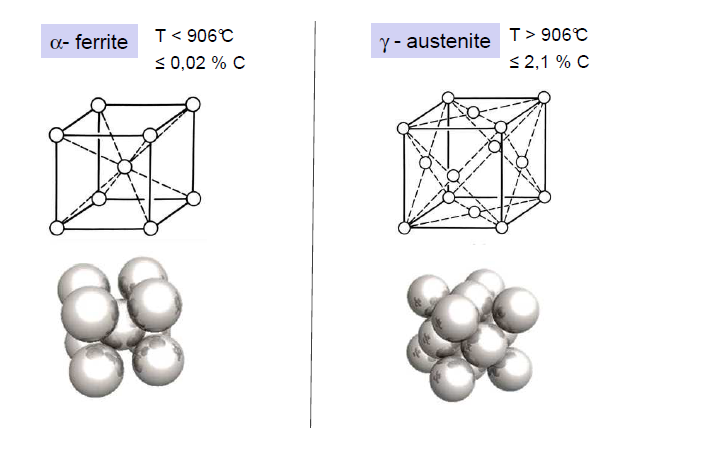
- For pure iron we distinguish mainly two different types of crystal structures which exist at different temperature ranges.
- α-iron: temperature range 0 - 906°C. Fe-atoms in the corners of a cube and the room diagonal relatively little space between the iron-atoms
- γ-iron: temperature range 906 - 1342°C. Fe-atoms in the corners of a cube and in the diagonals of the cube sides relatively much space between the iron-atoms
Describe the different steel phases
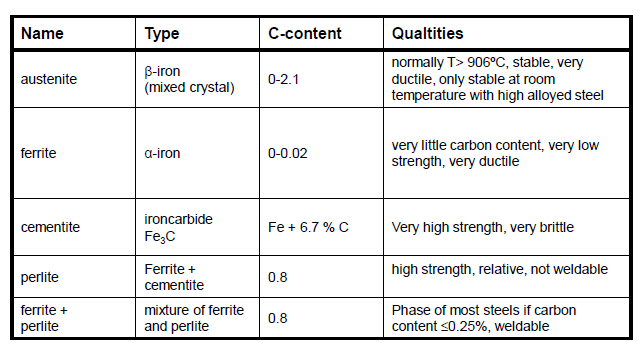
- Austenite and ferrite are two types of phases. Another type of phase is cementite.
- Cementite is iron carbide Fe3C (iron + 6.67% carbon). A mixture of ferrite and cementite is called perlite.
- The carbon content of perlite is 0.8%. Table 3-1 and Figure 3-3 gives the overview of different steel phases and their properties.
Stress – strain relationship of hot-rolled steel. Diagram and ranges.
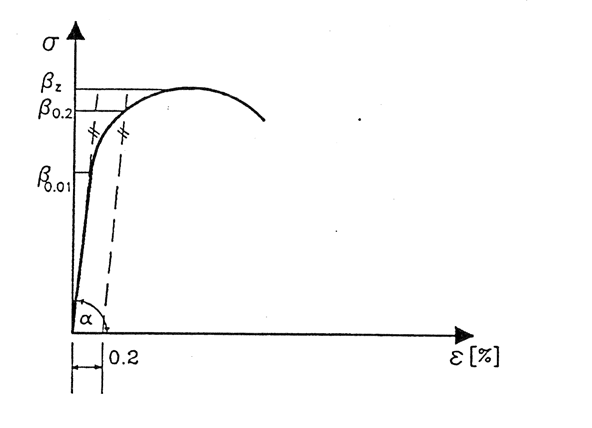
In a uniaxial tensile test the stress-strain diagram of a reinforcing steel can be obtained. The stress (σ) is normally obtained by dividing the load by the original section of the specimen at the beginning of the test. The stress-strain relationship is subdivided into different ranges, as indicated in Figure.
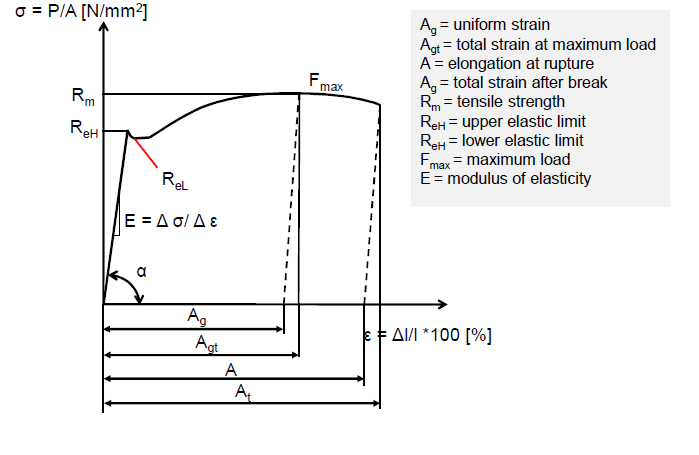
Stress-strain relationship for cold-worked steel. Diagram.
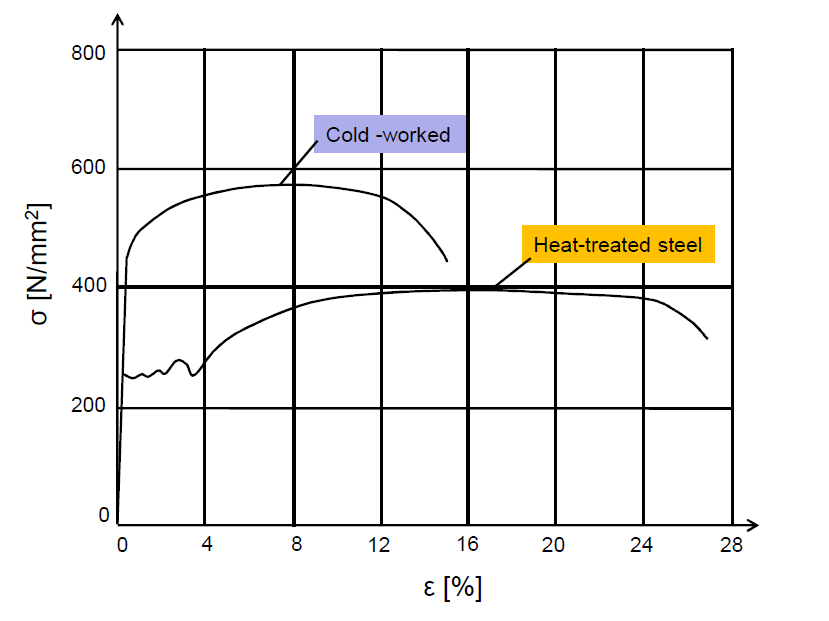
Stress-strain relationships of cold-worked and heat-treated stee
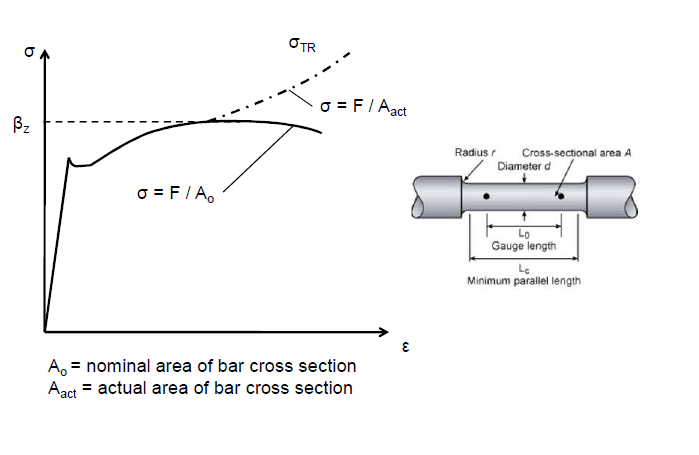
Stress – strain relationship of steel (calculated with nominal and actual cross-section area)
Strain hardening range:
In this region the load can be increased again. This is connected with an increase in plastic
deformations.
Distribution of elongations along the length
The rupture elongation δB is made up of the uniform elongation δG and the contraction elongation δE. The value of the rupture elongation depends on the measuring length.
and increases with decreasing measuring length. Therefore, when giving values for the rupture elongation, the measuring length must be stated as well.
Types of elongations
- uniform elongation δG: plastic elongation is a measure of the ductility of steel
- contraction elongation δE: a significant increase of the elongation in the region of the contraction after reaching the tensile strength
- rupture elongation δB: residual change of length Δ1 after failure of the specimen related to the original measuring length 10
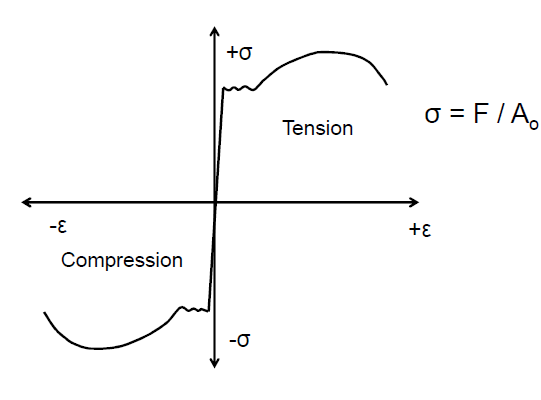
Stress-strain diagram of steel (under tension and compression)
The stress-strain relationship of most types of steel under compression is almost symmetrical to the relationship under tension
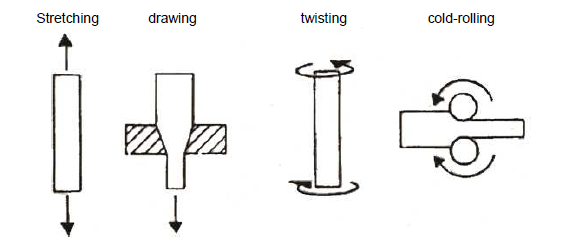
Types of cold working
- Stretching
- Drawing
- Twisting
- Cold-rolling
Describe the types of heat treatment and their benefits
- Hardening
T > 850 °C (austenite)
Fast cooling (martensite)
Increase in Strength, decrease in ductility - Hardening + Tempering
After Hardening, steel is heated up to 450°- 600°C,
cooled slowly
Increase in ductility, decrease in strength - Annealing
Reduction of internal stresses due to:
a. Cold working
b. Heat treatment (e.g. hardening)
c. Welding
Heat treatment at different temperatures
- Normalizing: T ≥ 700 °C and then slow cooling
- Re-Crystallisation: T = 500°-600°C reduction of cold working effects
- Stress-free annealing: T = 200°-300° reduction of induced stress (e.g. due to welding)
Influence of high temperatures on the behavior of steel
High temperatures:
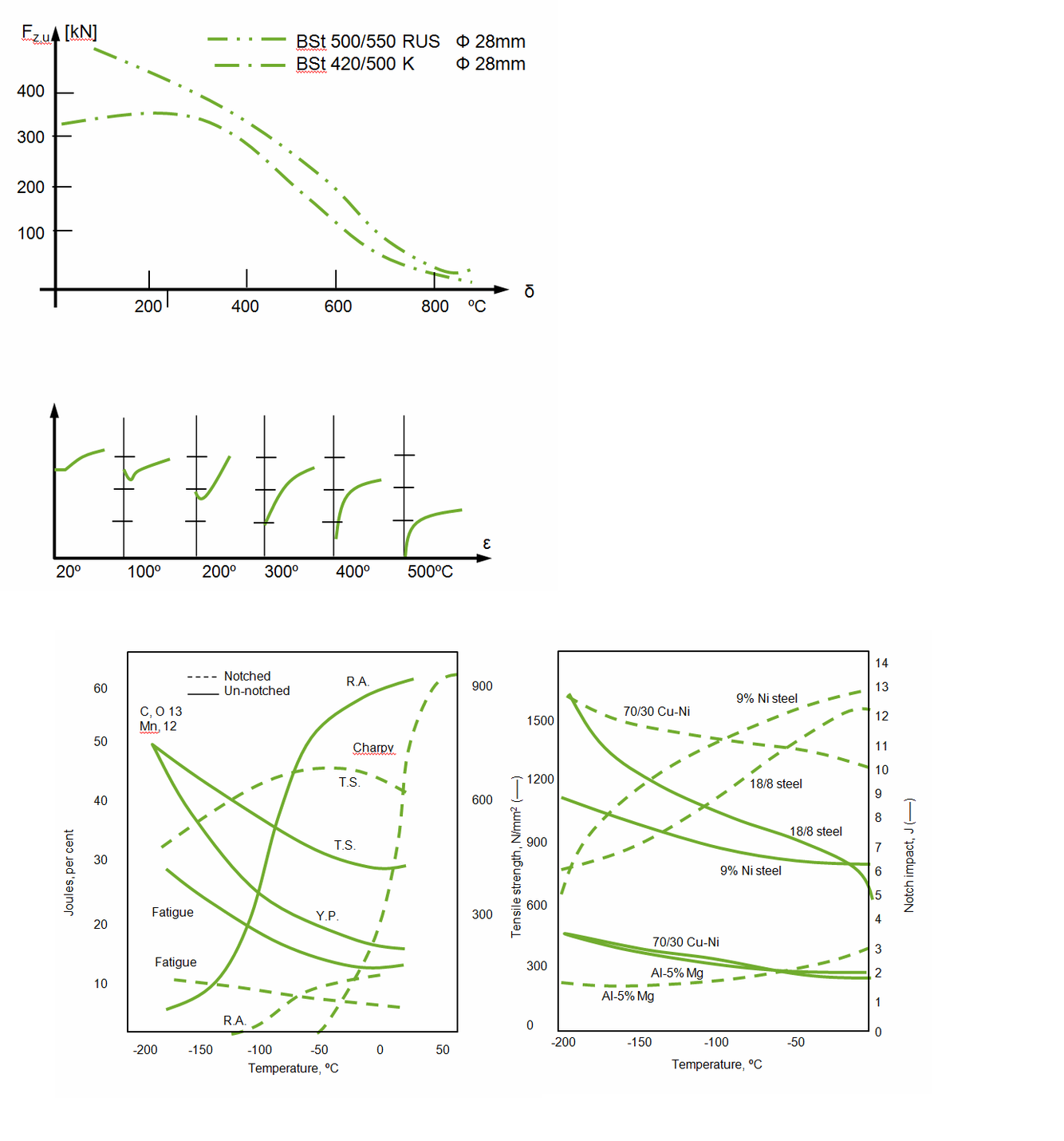
Under increased temperatures (for example fire) the stress-strain diagrams of steel change significantly (Fig. b). The characteristics are the decrease of the yield point (Fig. a) and the increase of the deformations at constant loads. Under service bad plastic deformations must be expected which under certain circumstances may lead to the collapse of the structure.
Under low temperatures (< 0° C) steel usually shows an increase of strength and after an
initial slight decrease an abrupt drop of the deformation capacity (Figure 4-9). However,
certain alloyed steels do not show this effect.