Production of Timber
- Felling (tronzado): Production of a Stem (tallo)
- Bucking (tala): Production of the log (smaller pieces).
- Sawing (aserrado): Production of green and rough lumber (madera)
- Drying: Production of dry and rough lumber
- planing and sorting: Production of graded finished lumber
Chemical composition of timber (component and element)
Components:
- C 48 - 50 % mass
- O 43 - 45 % mass
- H 5 - 6 % mass
- mineral substances 0,2-0,6 % mass
Elements:
- Cellulose 40- 50 weight%
- Hemicellulose 20-25 weight%
- Lignin 25-30 weight%
- Extractives 0-10 weight%
Timber types
- Softwood (Spruce, pine)
- Hardwood (Maple, birch, poplar, oak, beech)
How is defined Moisture content?
Moisture content M (expressed in percent) is defined as:
M = {(Wa – Wo) / Wo} • 100 [%]
Wo: oven-dry weight of wood sample
Wa: weight of sample prior to drying
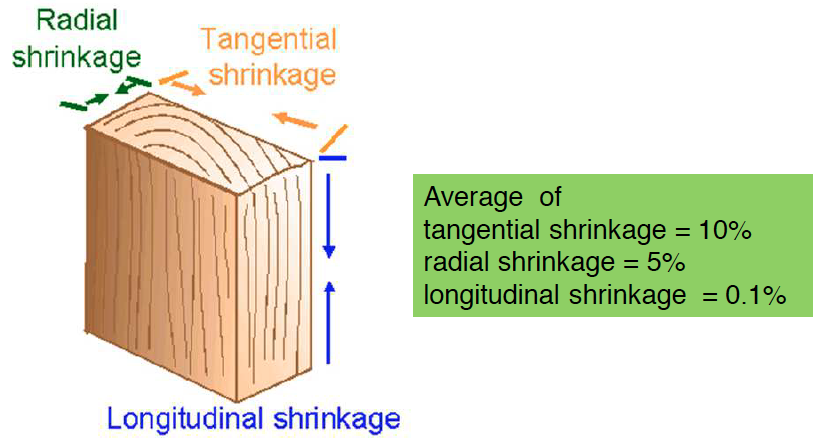
Which are the directions of the Shrinkage ?
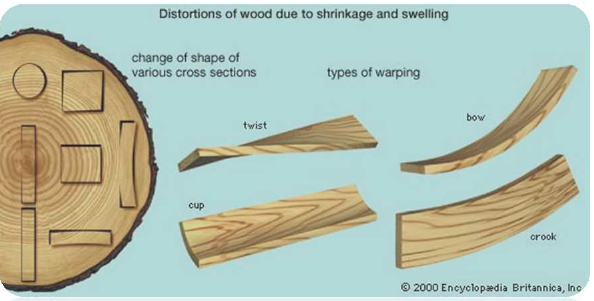
Possible distortion of various cut sections after drying
twist. bow, cup, crook
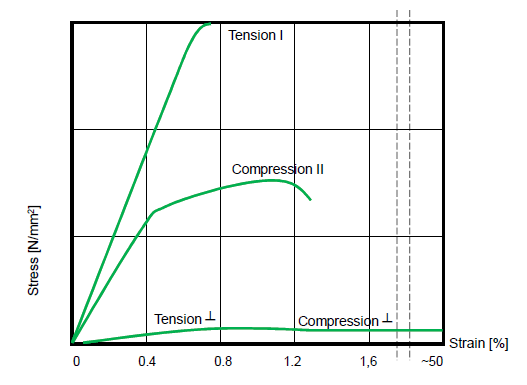
How are the stress-strain curves of pine wood under loads?
Parallel and perpendicular to the grains at a moisture content (u) of 15%
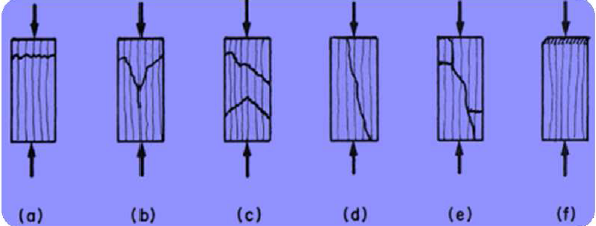
Failure modes of timber under compression parallel to grain
Failure types of non-buckling clear wood:
a) Crushing
b) Wedge splitting
c) Shearing
d) Splitting
e) Crushing and splitting
f) Brooming or end rolling
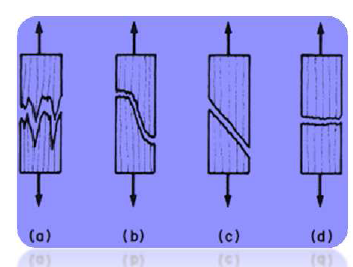
Failure modes of timber in tension parallel to grain
Failure types of clear wood:
a) Splintering tension
b) Combined tension and shear
c) Shear
d) Brittle tension
Failure modes of timber in bending with span parallel to grain
Failure types of clear wood:
a) Simple tension
b) Cross-grain tension
c) Splintering tension
d) Brash tension
e) Compression
f) Horizontal shear
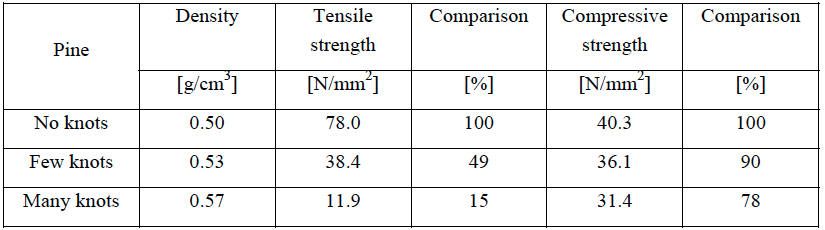
Influence of knots on the strength of pine timber loaded parallel to the grain.
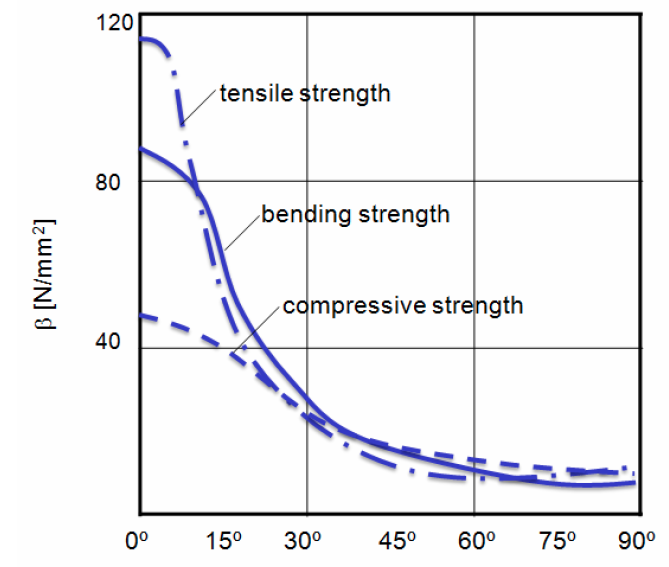
The relation of strength to loading angle (schematically)
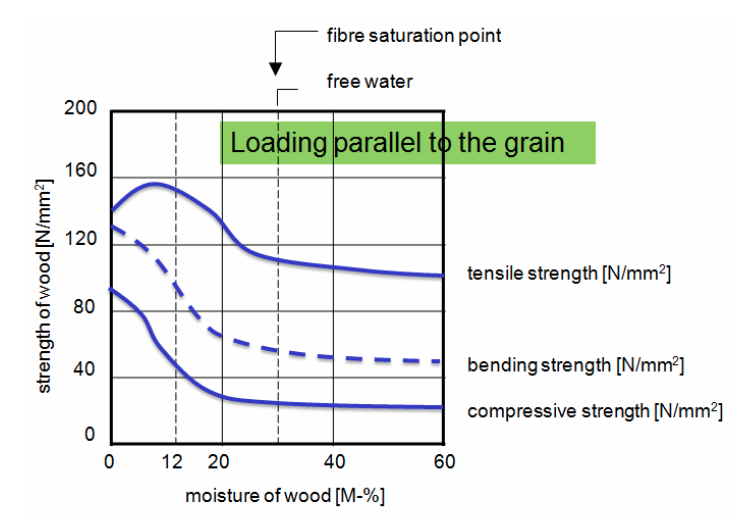
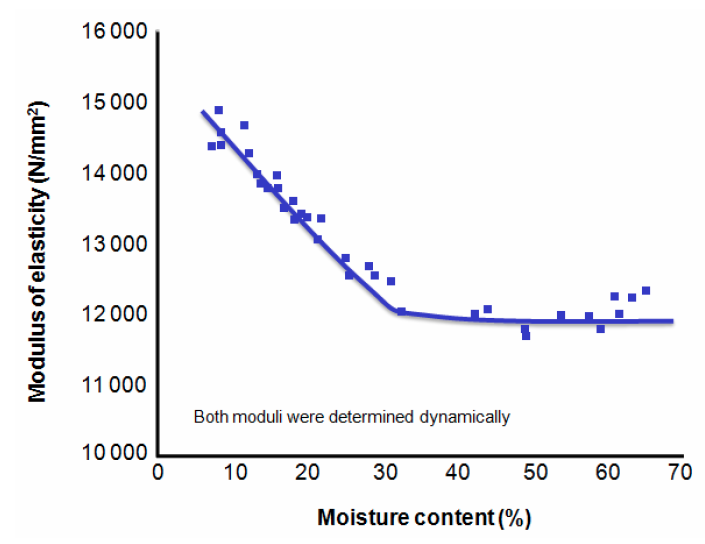
Influence of moisture content on the strength
Effect of moisture content on the rigidity in Sitka spruce
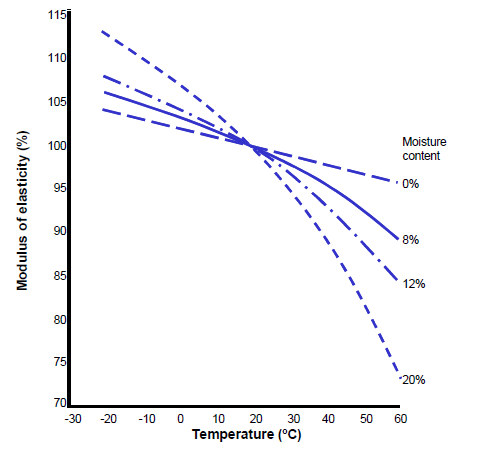
The interaction of temperature and moisture content on the modulus of elasticity.
Results are averaged for six species of timber and the modulus at 20°C and 0% moisture is taken as unity.
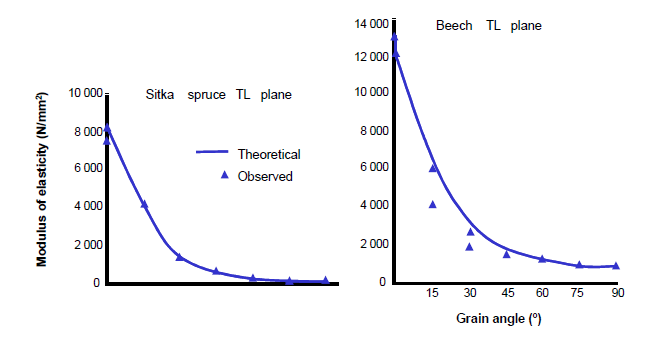
Effect of grain angle on the modulus of elasticity
The theoretical line has been calculated by transformation of the stresses and strains from the rotated to the principal
Quality classification parameters
Independently from the type of timber, the quality class is determined according to the following parameters:
• Knots
• Inclination of fibers (wane)
• Pith
• Cracks
• Resin pockets
• Bending
• Insects frass
Influence on Timber Durability
The timber durability can be negative influenced by:
- Fungi
- Insect infestation
- Fire
By moisture content equal to 0.0 % (dry) or to 100 % (water immersion) no attack by fungi or insect infestation is possible
With lower moisture content the degree of inflammability increases
Oxygen, Temperature and moisture are required for fungi and / or insect attack
Preventing fungi attack
- Good designed column base
- Correct design of a bedding of a timber beam into a masonry wall
Timber fire behavior
Glued beam section after exposure to fire of 30 and 60 minute
Timber carbonization, approx. 0.7-0.8 mm/min (EC 5)
Timber fire protection
- Light timber: Protection through fire resistance cladding materials.
- Heavy timber: Protection through proper design. Burning point of approx. 300 °C
- Outer burned layer looses strength, but act as insulating layer for the core
- The moisture evaporation leads to a slight loss of strength and stiffness of the core
Timber connections
- Screws for timber connections
- Connections with nailing strips
- Wooden connections with perforated plates and perforated form parts
- Timber truss connected with perforated plates
- Timber connected with steel angles
- Timber connection with steel dowels
- Timber connection with wooden dowels
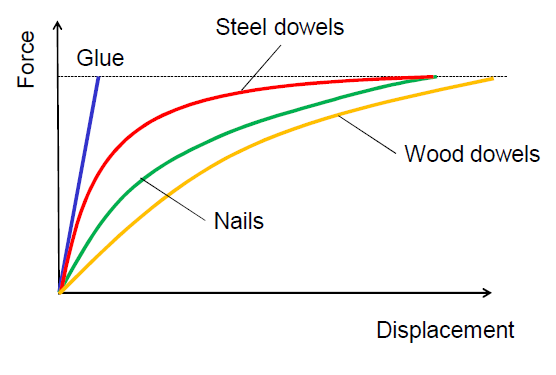
Stiffness of connections (graph)
Production of glued laminated timber
- Drying of the boards
- Strength grading - Visual and/or mechanical tests
- Cutting off knots and other wood-defects and repetition of strength grading
- Planning of the lamellas - Max thickness 45 mm
- The glue is applied on the broader edge of the lamella
- Pressing - At least three lamellas are stacked and pressed in an either straight or curved press
- Planning of the gluelam
- Factory assembly and further detailing




