Where are the cruciate ligaments?
Understand the basic anatomy
- Cranial cruciate ligament
- Arises from medial aspect of lateral femoral condyle
- Inserts on cranial aspect of the region between the condyles
- Caudal cruciate ligament
- Arises from lateral aspect of medial femoral condyle
- Inserts on caudal aspect of intercondylar region
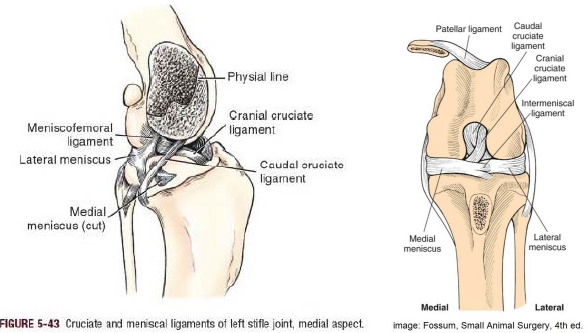
T/F: The cranial cruciate ligament is named so because the distal portion (insertion) sits cranially on the tibia relative to its proximal portion (the origin)
TRUE
What is the relationship of the cruciate ligaments to the synovial lining of the joint?
Why is it important?
- The cruciate ligaments have a thin lining of synovium over them
- They lie inside the joint capsule but are actually outside the synovial lining of the joint
- Important because the synovial lining is an effective barrier between the collagen of the ligament and the immunoresponsive mechanisms of the joint
- When the ligament is damaged, that barrier is disrupted
- Damaged cruciate ligament is a potent stimulus for ongoing inflammation–> DJD
What is the function of the cranial cruciate ligament?
- Prevents internal rotation, hyperextension, and tibial thrust
- Most important: preventing tibial thrust
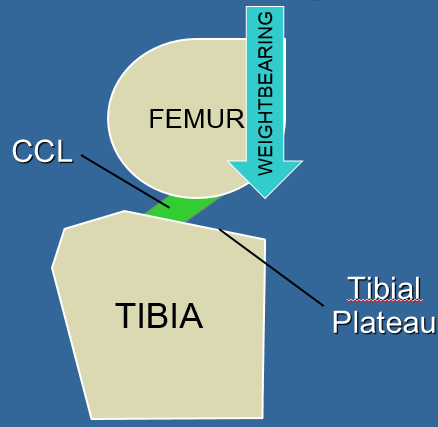
What is cranial tibial thrust?
When does it occur?
- Naturally occurs during weight-bearing
- Wt.-bearing creates compression across the joint
- Angle between compression and tibial plateau results in shear force–> tibia slides cranially relative to the femur
- CCL opposes shear
How does cranial tibial thrust relate to cruciate ligament rupture?
- If the force of tibial thrust > breaking strength of the cruciate ligament –> rupture
T/F: Most cruciate ruptures are a result of abnormally excessive tibial thrust forces
FALSE
Most cruciate ruptures are a result of normal tibial forces applied to an abnormally weak cruciate ligament
What is the etiology of acute cranial cruciate rupture?
- Usually traumatic
- Excessive torsion or extension on a normal, healthy CCL
- Least common in vet med
What is the etiology of chronic cranial cruciate ligament disease?
- Chronically weakened CCL
- Cannot withstand normal forces of wt.-bearing
- Disease = degenerative process in place before any clinical/radiographic findings
- Rupture is chronic, progressive process–ligament does not tear all at once
T/F: Chronic cranial cruciate disease is more common than acute cranial cruciate rupture
TRUE
What factors play a role in the pathogenesis of chronic cranical cruciate ligament disease?
- Degeneration occurs with age
- Tends to be worse in larger dogs (> 15kg)
- Obesity
- Poor fitness
- Conformation–straight stifle joint
- Excessive plateau angle
What is the risk of contralateral disease with chronic cruciate ligament disease?
~50% bilateral disease within 1-2yrs
What is the typical signalment of a dog with CCL disease?
- Adult
- Large breeds
- Rottweiler, Newfie, Staffordshire terrier, lab, mastiff, St. bernard
- Female > male
- Neutered > intact (retrospective)
What is the typical history of chronic CCL disease?
- Variable
- Intermittent, progressive signs typical
- Slow degeneration of CCL leads to DJD
- Fraying of ligament
- Rupture may present acutely
- Rupture is acute, disease is chronic
- DJD on PE and rads confirm chronicity
- Response to NSAID dependent on DJD
- Difficulty rising, “bunny hopping”–bilateral
What are the expected PE findings on a dog with cruciate ligament disease?
- Effusion–infill of parapatellar “divot”
- Rounding of limb
- Effusion (acute)
- Fibrosis and effusion (chronic)
- Muscle atrophy (disuse)
- Medial buttress–firm medial fibrosis
- Crepitus–osteophyte formation
- Instability
- Not specific for CCL disease
What are the expected PE findings when testing instability in a patient with cruciate ligament disease?
- Cranial drawer test–passive constraint
- Tibial compression test
- Active constraint
- Generates tibial thrust
- AKA “tibial thrust test”
*
T/F: Sedation is only required for aggressive patients when using the cranial drawer test or the tibial compression test
FALSE
Sedation is required to definitively test either cranial drawer or tibial compression
What is the significance of “puppy drawer”?
- Puppies < 6mo
Why is it important to test for instability in both views when evaluating for cruciate ligament disease?
- Functional divisions in CCL
- Craniomedial–taut in flexion and extension
- Craniolateral–taut in extension only
- If only craniomedial band ruptures–> instability shows only in flexion
How does treatment of a partial tear differ from that of a complete tear?
It doesn’t
Dog still experiences discomfort–treat the same
What is the function of the menisci?
- Primarily act as shock absorbers
- Fibrocartilage–compressible–act as padding between femur and tibia
- Reduce stress on cartilage
What is the frequency of meniscal injury?
60-70% of dogs with cruciate rupture will have some amount of meniscal injury
Which meniscus is most commonly damaged?
Why?
- Medial meniscus is most commonly damaged
- Medial meniscus is attached to the tibia–when the CCL is ruptured and the tibia displaces cranially the meniscus moves with it
- This predisposes it to crushing injury when there is compression bewteen the tibia and femur
What are the PE/history findings in a patient with meniscal injury?
- Increased pain level over uncomplicated CCL disease
- History: sudden increase in lameness
- “Meniscal click”–distinct popping sensation as stifle is put through ROM, typically from full flexion to full extension
- Not completely reliable (present in ~25%)



-
Wound classification, infection and antimicrobial use40
-
Surgery of the kidney58
-
Surgery of the ureters35
-
Surgery of the bladder56
-
Surgery of the urethra48
-
Surgery of the ovaries and uterus68
-
Surgery of the vagina and vulva44
-
Mammary diseases49
-
Male reproductive tract59
-
Fractures--intro, internal & external fixators97
-
Fixation evaluation, fracture disease, and fracture healing25
-
Arthritis49
-
Osteochondrosis25
-
Shoulder disease67
-
Elbow disease42
-
Diseases of the carpus and tarsus58
-
Surgery of the stomach91
-
Surgery of the small intestine48
-
Surgery of the large intestine, rectum, and anus49
-
Surgery of the spleen and pancreas32
-
Hepatobiliary surgery31
-
PSS and oncology62
-
Hips54
-
Stifle81
-
Wound management14



