Stroke is the leading cause of ________________.
Long-term disability
85% of strokes are _____________.
Ischemic
A transient episode of neurological dysfunction caused by focal brain, spinal cord, or retinal ischemia without acute infarction is known as a(n) ______________________.
Transient Ischemic Attack (TIA)
During a stroke, 2 million __________ die each minute without blood flow or oxygen.
Neurons
During a stroke, 14 million __________ die each minute without blood flow or oxygen.
Synapses
What are common risk factors for stroke?
- Age
- Gender
- Hypertension (HTN)
- Diabetes (DM)
- Dyslipidemia
- Smoking
What is the primary standard of care for a patient undergoing a stroke?
Administration of tPA Stroke care in a specialized stroke unit
The three things to avoid when treating a stroke patient are:
- Avoid treating hypertension.
- The stroke has caused the body’s acute rise in BP.
- The BP will decrease on its own within a few days.
- Lowering the BP will damage the penumbra of the stroke patient.
- Avoid giving glucose.
- High glucose damages the penumbra and worsens the outcome
- Only give glucose if the patient is severely hypoglycemic (<50 mg/dL)
- Avoid causing aspiration pneumonia.
- Weak oropharyngeal muscles are common in stroke patients.
- Do elevate the head of the patient’s bed to 30°, keep medications NPO (not by mouth), and rotate patient for emesis (vomiting)
When material from the heart travels distally to form a clot in the neck or cranium, it is referred to as a(n) _________________.
Cardio embolism
An occlusion or embolism of a large vein or artery in the head or neck is referred to as __________________.
Large vessel disease
An occlusion of a smaller vein or artery in the head or neck, particularly the perforating arteries of the cerebrum, is referred to as ________________.
Small vessel disease
Some of the leading causes for cardio embolism are:
- Atrial fibrillation
- Atrial myxoma (tumor of the cardiac muscle)
- Endocarditis
- Valvular calcification
When diagnosing a stroke, what tests should be performed concerning brain tissue?
- CT
- MRI
When diagnosing a stroke, what tests should be performed concerning the blood?
- Hypercoaguability panel
- Platelet function assay (PFA)
When diagnosing a stroke, what tests should be performed concerning the cerebrospinal fluid?
Lumbar puncture (LP)
No tissue plasminogen activator (tPA) may be given to a patient if ____________ or ____________ is detected on a brain CT.
- Hemorrhage
- Subacute ischemia
- Lesion will appear dark on CT scan if it is subacute, suggesting the condition is more than 3 hours old.
If you suspect a patient of having a subarachnoid hemorrhage, but fail to detect it on a CT exam, what subsequent test should you perform?
Lumbar puncture (LP)
What is shown on the following CT scan? What would the treatment option be?
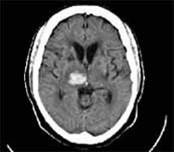
- Intracerebral hemorrhage
- Do not administer tPA in this case.
What is shown on the following CT scan? What would the treatment option be?
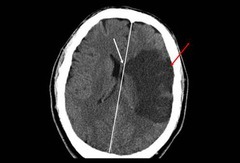
- Subacute ischemia. The condition is more than 3 hours old.
- Do not administer tPA in this case.
What is shown on the following CT scan?
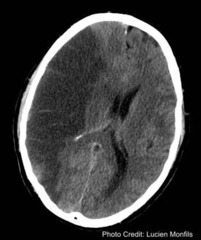
MCA subacute ischemia.
What is shown on the following CT scan?
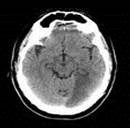
PCA subacute ischemia.
What is shown on the following CT scan?
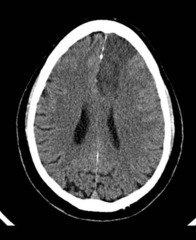
ACA subacute ischemia.

-
Neuroradiology28
-
Functional Neuroimaging30
-
CNS Neurotransmitters61
-
Anxiety45
-
Post Traumatic Stress Disorder23
-
Sedative Hypnotics16
-
Diencephalon59
-
Bipolar Disorder52
-
Depressive Disorder53
-
Antidepressants64
-
Circadian Rhythm14
-
Limbic System & Hypothalamus71
-
Pain32
-
Antipsychotics36
-
Schizophrenia37
-
Impulse44
-
Stroke22
-
CNS Neoplasms62
-
Vascularpathology44
-
Sleep Disorders45
-
Motor I, II, and III64
-
CNS Trauma14
-
Opiates44
-
Alcohol39
-
CNS Stimulants57
-
Toxic Metabolites16



