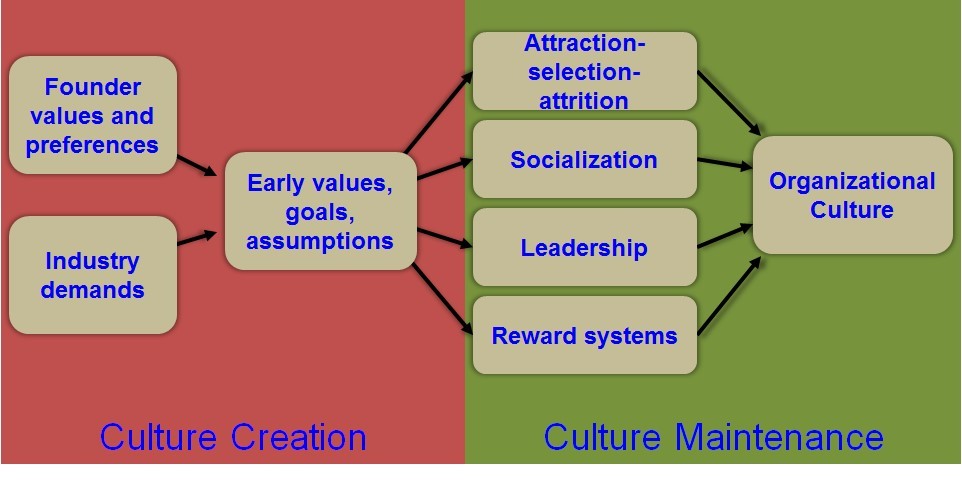
ASA Framework (culture creation and culture maintainence)
(see image)
Culture creation - these two things initially create the culture
- Founder values and preference
- Industry demands
Culture Maintenance: (4 things)
- attraction-selection-attrition
- attraction - different companies will attract different types of people
- Rewards will also attract (these could be the wrong talent, but they’re attracted because of rewards)
- Selection - find someone who fits the culture
- Attrition - even after selection, some employees may not fit in. Candidates who don’t fit in will naturally leave the company
- socialization - they learn the skills, attitudes, knowledges, etc., to function effectively within an organization
- leads to higher job satisfaction, stronger organizational commitment, and longer tenure
- leadership - Leaders are instrumental in creating and changing an organization’s culture. There is a direct correspondence between a leader’s style and an organization’s culture. For example, when leaders motivate employees through inspiration, corporate culture tends to be more supportive and people oriented.
- reward systems - the company culture is shaped by the type of reward systems used in the organization, and the kinds of behaviors and outcomes it chooses to reward and punish.
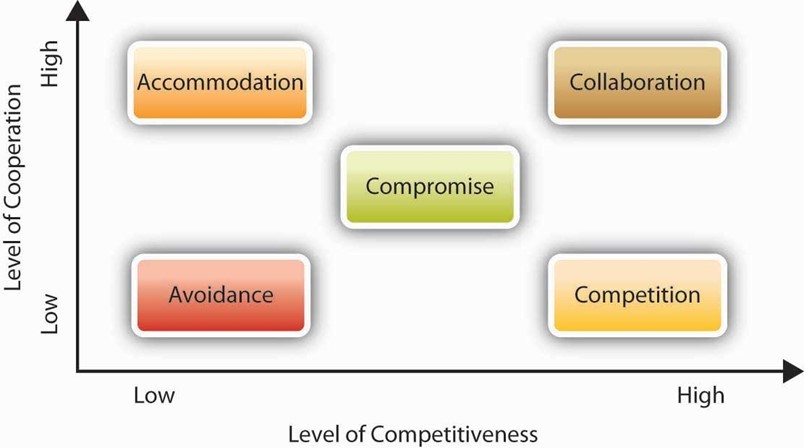
Conflict Management - 5 different styles to handle conflict situations
(see image)
- Avoidance - don’t care about relationship nor issue
- What is the downside here?
- You didn’t put any investment into it, and so the relationship goes down here cause they think you should care about it more
- What is the downside here?
- Collaboration (only WIN -WIN strategy), where you meet needs of both parties
- If this is the best, why isn’t it used more in business? The two T’s:
- Time - it takes longer to solve to get both parties what they want
- Trust - if I really want all my outcomes satisfied, we have to be willing to put ALL of our cards on the table; in most cases, that won’t happen
- If this is the best, why isn’t it used more in business? The two T’s:
- Compromise - each party is giving up something; you’re not maximizing outcomes
- **This one is used more often in business
- Competition
- aggressive competing - Jerry taking the bread from the old lady
- What’s wrong with this:
- affects other relationships / reputation
- ethics
- What’s wrong with this:
- aggressive competing - Jerry taking the bread from the old lady
- Accommodation - most relationships are more important than the outcom
For graph: If the level of cooperation is low, then you don’t care about the relationship
Performance Management (p. 222-227)
4 Fundamental Principles
Simple
- Performance reviews are typically long, with lots of paperwork. Great managers like the communication with employees = simple
- You don’t want managers and employees dreading this process
Frequent Interactions between manager and employee
- many companies are going to monthly check-ins
- 1 a year is NOT enough – at least have them quarterly minimum
- a yearly meeting misses many important details
- if only once a year, then you’ll drop on the weaknesses of the employee on them like a bomb
- 1 a year is NOT enough – at least have them quarterly minimum
The routine is focused on the future
- great managers spend most of the time on what we do moving forward. How will we hit goals? How can I better support you as a manager?
- First 10 minutes = review, rest of time is forward looking
As employees to keep track of own performance and learnings (Self-tracking/collaborative)
- Employees are keeping track of how performance is trending and how they will be analyzed
- This record isn’t evaluated, but it allows each employee to measure herself, her discoveries, and her successes
3 Types of Noise (don’t memorize subpoints) understand how the 3 are different from each other
- External
- distractions
- volume
- Info overload = emails, etc.
- Internal
- Perceptions
- Stress
- Lack of Focus - he’s focused on where the lecture is going, and not where the lecture is
- Semantic (what types of words/descriptions you use)
- jargon (including hot buttons) – happens in politics
- someone used this word, and that’s all you focus on while talking to them because it was negative
- Hot buttons = words that have a negative connotation
- ambiguity
- jargon (including hot buttons) – happens in politics
Three False Assumptions about Climbing the Ladder (p. 180-181)
- A little more training makes you fit for the next rung
- Competition brings the best fit for the next rung - by limiting prestige to the highest rung, every employee with try to climb to the top. Why not create heros in every role
- Varied experiences lead to the best fit for the next rung - (most devastating) - the employees try to gain good skills and the manager is the gatekeeper who is picking the attractive ones. In the great manager’s view, the hunt for marketable skills shouldn’t be the force driving the employee’s career.
Culbert article (deadly sins with performance reviews)
- tying the review to pay
- If we tell them that pay comes from the review, that will be all they care about
- Standardization
- ignoring individual differences in function or talent
- Example: BYU uses that same evaluation form, no matter if it’s a small class with 6 people or a class with 500 people
- You need some function specific questions — make sure the questions make sense for that role
- Disrupts Teamwork -
- “…the team play that’s most critical to ensuring that an organization runs effectively is the one-on-one relationship between a boss and…subordinates.”- Culbert
Goal-Setting Theory
if you set good goals, people will be more focused and be more persistent toward the goal outcome
SMART Goals
Specific, Measurable, Aggresive, Realistic, Time-Based
- You want goals that are accepted by employees (set them with employees)
- you use SMART framework to get past general goals (go from general to SMART)
- you want feedback
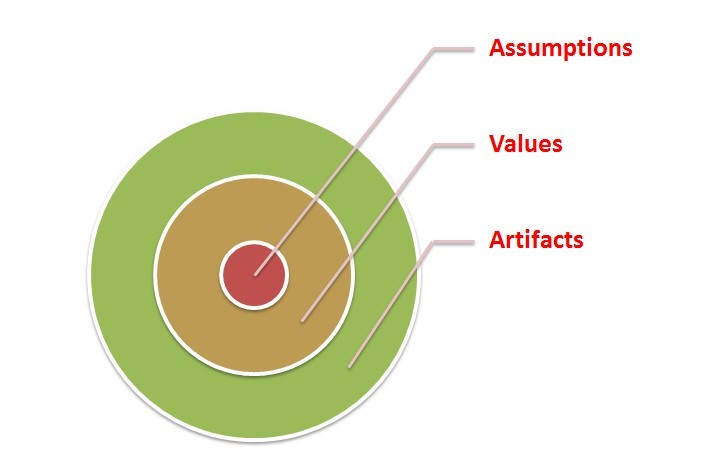
Organizational Culture
3 Components:::
- (1) Artifacts - we will pay attention to this first as OUTSIDERS. What do you first see, etc.? Then this leads
- Zappos = you see that everyone is valued for who they are, and their stairway of culture
- (2) Values (two types)
- Expressed: on their website
- Then you’ll see which of these are practices, and which matter the most?
- Expressed: on their website
- (3) Underlying Assumptions
Making Your First Year a Success (starting strong slide)
§ Clarify your boss’s expectations and obtain a clear understanding of her 2-3 top priorities
§ Demonstrate the utmost integrity, professionalism, and positive attitude
§ Perform exceptionally well those activities for which you have ownership (exceed the expectations of others)
§ Seek feedback from others concerning your job performance (ensure that formal performance review schedules are fulfilled—but do this in a tactful way)
§ Start internal networking by building bridges with your “internal customers.” (i.e., who else in the company depends on my work?)
§ Get one or multiple mentors inside your new organization (this will be covered in greater detail in Chapter 15)
§ Show up on time, be someone others can count on, and work really hard
What is the acronym to remeber the *Characteristics of High-Performance Teams
Common MASS, meaning
Common purpose, goals, and working approach
Mutual Accountability
complementary Skills
Size (typically small)
How to Change Culture
- Conduct a Culture Audit - you need to understand what EMPLOYEES are understanding as the culture (you can’t just view it from the leader’s chair)
- Employee surveys
- Focus groups/interviews
- Metaphors
- Identify “sacred cows”
- Come into the company, and identify what they are. Don’t try to change these!
- Follow Kotter’s Change Guidelines
3 questions to define the right outcomes
Whats right for the (order matters here)
- customers
- organization
- individual (employee)
Career Management (Nielson Chapters)
3 Key Principles
- Clarify your plan…and then execute it
- Have a 3-year plan
- Clarify expectations…and then exceed them
- Do something different
- Relationship building
- Integrity
- Clarify your brand…and then strengthen it
- What is your reputation? How do you distinguish yourself?
Who should drive the mentoring relationship?
The protege (mentee)
Define the Right Outcomes – Chapter 4
Rules of Thumb for When to Focus on Steps (not Autonomy for Employees) (3 points) and when to not (1 point)
Activities involving Accuracy and Safety - don’t break the bank
Following External Standards -
The Steps don’t obscure the Outcomes - don’t let the creed overshadow the message - Airlines letting on-time numbers overrule customer satisfaction.
Don’t try this with Customer Satisfaction
Socialization (aka onboarding) (2 steps orgs can take)
- 1 - formal orientation program
- learn culture, meet people
- these are good to learn, but computer-based orientations aren’t as effective
- 2 - Help employees adjust through organizational insiders (i.e., supervisors, coworkers, mentors)
Not sure if these are two steps – it’s what I got from the book?
Main Idea in culture of candor article (what is a culture of candor?)
- call for greater transparency, and leaders should carry that banner.
- New metric for corporate leaders? The Triple bottom line:
- economically, ethically, and socially sustainable
- ethically and socially are harder if you’re not transparent
Pros & Cons of a Strong Culture (Section 15.3)
Pros:
- For example, imagine a company with a culture that is strongly outcome oriented. If this value system matches the organizational environment, the company outperforms its competitors.
Cons:
- A strong culture may also be a liability during a merger. During mergers and acquisitions, companies inevitably experience a clash of cultures, as well as a clash of structures and operating systems. Culture clash becomes more problematic if both parties have unique and strong cultures.
- One limitation of a strong culture is the difficulty of changing established organizational behaviors. If an organization with widely shared beliefs decides to adopt a different set of values, unlearning the old values and learning the new ones will be a challenge, because employees will need to adopt new ways of thinking, behaving, and responding to critical events.
- a strong outcome-oriented culture coupled with unethical behaviors and an obsession with quantitative performance indicators may be detrimental to an organization’s effectiveness.
Employer Responsibilities
- Keep the Focus on Outcomes - companies are experts in the destination while employees can enjoy the journey
- Value World-Class Performance in Every Role - understand the company by looking at its heroes
- Study Your Best – set up an internal university of best practices, which will provide a forum for you best in everyone to show how they do what they do
- Teach the Language of Great Managers - language affects behaviors. Making it clear the distinction between talents and skills and what’s important to you
Peters article (Brand You)
Differentiating your brand:
- Identify differentiating qualities, skills, characteristics
- Questions you assist you:
- What do I do that I am most proud of?
- What have I accomplished that I can brag about?
- What do I want to be known for?
- 15-words-or-less Challenge
Name Kotter’s 8 steps to change
UNFREEZE
Urgency
Create coalition of supporters
CHANGING
Develop vision
communicate vision
empower others
plan and create short-term wins
REFREEZE
avoid premature celebration
anchor change in culture (e.g., rewards system, etc.)
Directions of Formal Communication
- KISS = focused on downward communication
- MBWA = more worried about upward communication
- Horizontal = jargon may be an issue at first – you need to get up to speed on the jargon of other functions
Interviewing for Talent (p. 215-221) - six things
- Stands alone interview - the talent interview should stand alone, apart from negotiating and renegotiating offers, etc.
- Open-ended questions
- They can see how you think
- Talent interviews should allow him to reveal himself by the choices he makes. Ask open-ended questions, and don’t lead the question one way
- Pause and remain silent; if he asks a clarifying question, then deflect the question.
- When he/she answers, BELIEVE HIM!
- Listen for specifics:
- Past behavior is predictive of future behavior
- But look for (1) top-of-mind and (2) specific responses = recurring behavior
- The cardinal sin is “probing” - probably suggestions that this isn’t a talent
- But look for (1) top-of-mind and (2) specific responses = recurring behavior
- Tell me about a time when… (you didn’t ask for a specific, but he will give you a specific in the answer)
- Behavioral-based questions
- Past behavior is predictive of future behavior
- Look for clues to talent
- (1) Rapid learning - ask what kinds of activities come quickly to her
- (2) Satisfactions - a person’s sources of satisfactions are clues to his talents
- “what do you find fulfilling” – answers will help you know what he can keep doing week after week after week
- Know what to listen for -
- Great managers ask only question where they know HOW top performers respond:
- “How do you feel when someone doubt’s what you have to say?”
- Great salesman hate it because great salesman are selling themselves
- Great teachers love this because a doubter is someone who is ready to learn
- “How do you feel when someone doubt’s what you have to say?”
- Great managers ask only question where they know HOW top performers respond:
- How to develop questions:
- 1 - try out questions on best employees and then other employees and see the differences
- 2 - ask all the new applicants, write down what they say, and see who did well answered in the same way






