Describe the structure of a capillary and a capillary bed
Capillaries are exchange vessels that act as the point of delivery for tissue nutrients, and the point of removal for tissue waste products. They have deveral properties that allow them to carry out this task:
- They have overally relatively smooth, non-pulsatile BP
- They have slow velocity
- They are thing,a nd a little leaky to enable exchange
A capillary is approximately 5-10 um and diameter and is composed of a basement membrane and endothelium (simple squamous). They may have intercellular cleft, vesicular channels and plasmalemmal vesicles.
Capillaries cumulatively have the biggest total cross-sectional area.
Describe how substances transverse the capillary wall.
Passive of substances through the capillary wall can occur via several routes:
- Diffusion: across the cell membrane - lipid soluble small molecules eg O2, CO2, cholesterol and some anaesthetic drugs.
- Filtration (paracellular pathway - between adjacent cells) e.g. water, ions, small molecules such as urea, glucose.
- Pinocytosis: move specific molecules across the cell membrane. Important in the brain - very tight intercellular junctions so paracellular pathway very restricted (blood-brain barrier).
*Remember large non-lipid solubel molecules don’t normally pass through the capillary wall, exceptions - sinusoidal capillaries or damaged capillary walls *
Define the Starling forces and how they relate to oedema.
Starling’s forces are forces that determine the net filtration pressure (NFP).
Outward forces (forces pushing fluid out of capillary into interstitium)
- Mean capillary hydrostatic pressure (PC)
- Interstitial fluid colloid osmotic pressure (πif)
Inward forces (forces pushing fluid in to capillary out of interstitium)
- Interstitial fluid pressure (Pif)
- Capillary colloid osmotic pressure (πC)
A balance between the fluid filtration across the capillaries and the lymphatic drainage is essentially in ensuring that oedema does not occur. An change in any of Starling’s forces can, inevitably, lead to oedema:
- High PC: increased capillary hydrostatic pressure
- Heart failure, venous obstruction, salt and fluid retention etc.
- High πif: increased interstitial osmotic pressure
- Similar to Kf, increased leakage of protein
- Low πc: decreased capillary osmotic pressure
- Low plasma protein in liver disease
- Low lymph flow = lymph blockage
- Tumor, surgical lymph node removal
- High Kf = increased capillary permeability
- Inflammation
Describe the structure and function of the lymph system.
Function
- The primary function of the lymphatic system is to redirect the residual fluid and protein from the interstitium back to the blood. Lymph vessels ultimately empty into the left and right subclavian veins. In this way, lymph is returned to the circulation.
- Lymph is an ultrafiltrate of plasma.
- Lymphatics also carries newly absorbed nutrients from the GIT.
- Lymphatics also has an immune role
Structure
Lymph vessels spontaneously contract when stretched with fluid. Combined with the valves, this pumps lymph towards the collecting ducts.
External compression (for example, muscle contraction) provides an external pump.
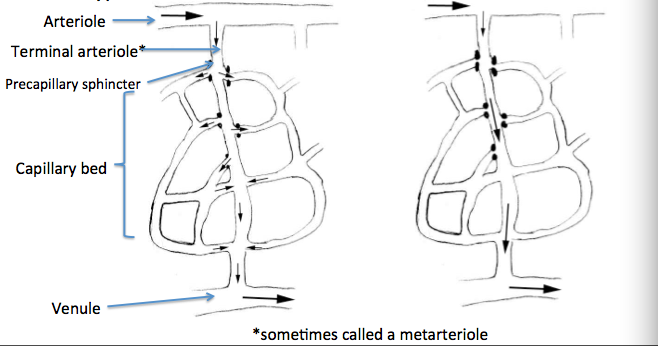
Appreciate how blood flow through capillaries is varied according to the metabolic needs of the tissues.
Blood flow into the capillar bed is regulated by the terminal arterioles and pre-capillary sphincters. These will relax (vasodilate) when tissue metabolism is high.
- Blood flow is regulated locally via O2 depletion or metabolite accumulation.
- In addition, the ANS systemically can adjust the tone of larger vessels (biger arterioles, small and large arteries and veins) to adjust upstream resistance and flow to tissues (mainly via SNS and circulating catecholamines).
- In vital structure (heart and brain) and in active skeletal muscle, the local metabolic factors are more powerful than the systemic neural influence.
The more metabolically active a tissue the more extensive the capillary bed. When the tissue has low metabolic demands the capillary bed can be bypassed.
Vasomotion
In addition to local control, capillary blood flow is also subject to rhythmic variations called vasomotion. This oscillation of vascular tone is seen in most vascular beds. This oscillation originates in the vessel wall, that is, it is not a consequence of the heart beat, respiration or neuronal input.
Tissue specific permeability
Pore width and pore numbers dictate the size and number of molecules that can diffuse through the capillary wall.
Variations in these can dramatically influence the permeability characteristics of tissue capillaries. Pore width is normally intermediate (large molecules diffuse poorly, water molecules diffuse easily).
There are three main classes of endothelial permeability:
- Continuous capillary: which was a continuous endothelial lining and complete basal lamina.
- Fenestrated capillary: has a complete basal lamina but fenestrated endothelial lining.
- Discontinuous capillary: has an incomplete basal lamina and a fenestrated endothelial lining.
Tissue permeability in the brain
The capillaries are continuous and the junctions are tight - only very small molecules can pass through.
Tissue permeability in the liver
Sinusoidal capillaries - the clefts are wide. ‘Almost’ everything, including plasma proteins, can pass through.
Tissue permeability in the kidney.
Fenestrated capillaries; numerous, fairly narrow indows through the endothelial cells called fenestrae. Large quantities of small molecules can pass, but large proteins are excluded.
Determinants of fluid filtration across capillaries
This depends on two things only:
- Balance of hydrostatic and osmotic pressure at work across the capillary. Net filtrayion pressure (NFP).
- The surface area and permeability of the capillary (expressed as Kf)
Filtration (mL/min) = Kf x NFP

-
Control of Breathing31
-
Respiratory Mechanisms19
-
Introduction to Gas Transport49
-
Pulmonary diffusion and blood flow30
-
V/Q Relationships/Mismatch17
-
Lung volumes and capacities24
-
Respiratory Failure6
-
Pulmonary Oedema15
-
Cardiac Muscle and Conducting Systems11
-
Cardiac Cycle and Basic Haemodynamics8
-
The Normal ECG8
-
The Microcirculation10
-
Control of CO (and blood flow)16
-
BP Homeostasis and Hypertension13
-
Cardiac Pressure-Volume Relationships12
-
Pathophysiology of Heart Failure22
-
Shock Syndromes22
-
VO2 and Specific Circulations13



