Describe the electrophysiological basis for impulse generation, conduction and the ECG.
Two adjacent cells with different charges creates a dipole. This dipole has a direction (ie. a vector) so the orientation of the dipole matters, as does the position of the electrodes.
Placing a lead with a reference end and a sensor end can read the direction and magnitude of this dipole.
The body is a good conductor. Depolarisation of the heart involves many more cells than just 2 adjacent myocytes. The spread of depolarisation involves many dipoles that are oriented in different directions simultaneously. The voltage that is detected at any instant results from the net dipole that = sum of all of these vectors.
Remember that the position (i.e. direction) of the electrodes matters.
- Depolarisation heading in the same direction as the orientation of a lead produces a positive voltage deflection.
- Depolarisation heading in the opposite direction as the orientation of a lead produces a negative voltage deflection.
- Depolarisation heading perpendicular to the orientation of a lead produces zero voltage deflection.* *
Describe the basic components of the ECG waveform and normal values of the major intervals.
P wave: atrial depolarisation.
QRS complex: collectively ventricular depolarisation
T wave: ventricular repolarisation
PR interval (0.12-0.2s)
- Start of atrial depolarisation to start of ventricular depolarisation
- Atrial contraction occurs here
- Also includes AV node delay
RR interval
- Time between successive ventricular depolarisations
- Used for measuring ventricular HR
QT interval (<0.44s men, <0.46s women)
- Start of ventricular depolarisation to start of ventricular repolarisation
- Ventricular contraction occurs here
QRS complex duration (<0.1s)
- Time taken to coplete ventricular depolarisation
ST segment
- Period during hich ventricle is fully depolarised
- Useful in detecting MI and infarction
Relate the orientation of the ECG leads to the electrical events that occur in the heart
We are able to superimpose the limb leads over the heart to give an axial reference system.
- The leads measure the same electical events simultaneously, but observe them from different angles.
- The axial reference system explains the differences in the ECG waveform for each of the leads.
- The chest leads look at the heart only in 2 dimensions
There are an extra 6 chest leads that allow us to look at the heart in three dimensions
Basic 3 lead ECG
Forms a triangle called Einthoven’s triangle.
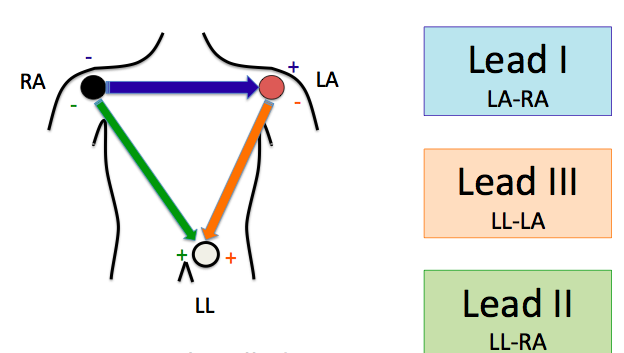
Augmented limb leads
- Lead aVF
- Lead aVR
- Lead aVL
Inferior leads
aVF, II and III
Lateral leads
I, aVL, V5 and V^
Anterior leads
V1-V4

-
Control of Breathing31
-
Respiratory Mechanisms19
-
Introduction to Gas Transport49
-
Pulmonary diffusion and blood flow30
-
V/Q Relationships/Mismatch17
-
Lung volumes and capacities24
-
Respiratory Failure6
-
Pulmonary Oedema15
-
Cardiac Muscle and Conducting Systems11
-
Cardiac Cycle and Basic Haemodynamics8
-
The Normal ECG8
-
The Microcirculation10
-
Control of CO (and blood flow)16
-
BP Homeostasis and Hypertension13
-
Cardiac Pressure-Volume Relationships12
-
Pathophysiology of Heart Failure22
-
Shock Syndromes22
-
VO2 and Specific Circulations13



