solitary thyroid nodules - proportion of benign and malignant
5% malignant
95% benign
benign solitary thyroid nodules
cyst
benign follicular adenoma
hyperplastic nodule
what are most malignant nodules
papillary thyroid carcinoma - 95%
how would one determine if the nodule was in the thyroid
if it moves upwards on swallowing
what fascia are the thyroid gland and thryoglossal duct invested in
pre tracheal fascia
pain?
uncommon feature
risk factors
- Previous irradiation
- E.g. MEN2 (medullary thyroid)
- Family history
- Low iodine diet
- note, smoking and lifestyle have no influence
determinants in history
previous neck irradiation predisposes one to thyroid cancer
FH
- there is no association with lifestyle factors, smoking or other malignancies
neck lymph node involvement on examination
papillary thyroid carcinoma until proven other wise - this spreads via the lymph nodes
hoarseness on examination
indication of recurrent laryngeal nerve palsy, as this supplies the vocal chords
investigations
- TSH for thyroid status
- Thyroid antibodies to exclude autoimmune aetiology
- US
- Delineate nodule and demonstrate whether they are cystic or solid
- Chest and thoracic X ray/CT
- Detect tracheal compression and large retrosternal extensions
- USS-FNA (US Guided Fine Needle Aspiration)
- Gives no indication of the morphology of the lump
- Radionuclide scan
what investigation is performed if recurrent laryngeal nerve palsy is suspected
pre operative laryngoscopy
radionuclide scan of thyroid
used to diagnose thyroid problems
- low uptake suggests thyroiditis
- high uptake suggests Grave’s
- uneven uptake suggests a nodule
- cold/hypofunctioning - malignant
- hot/hyperfunctioning - adenoma
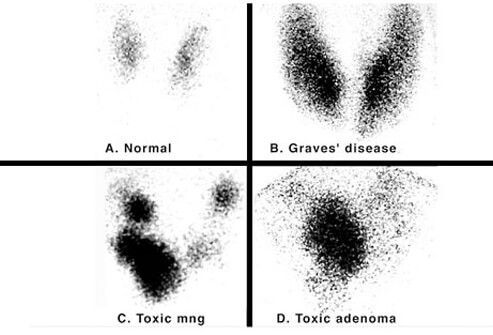
toxic adenoma
- produce thyroid hormones causing hyperthyroidism and suppressed TSH
- positive uptake on scan - hot nodule
what are the clinical predictors of malignancy
- new thyroid nodule aged <20 or >50
- male
- nodule increasing in size
- lesion >4cm in diameter
- history of head and neck irradiation
- vocal cord palsy
what are the FNA and USS stages used
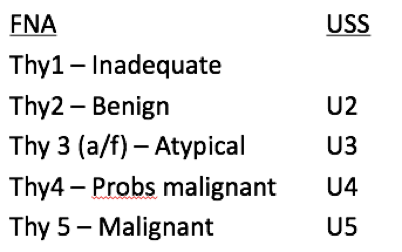
Thy1 on FNA
only blood aspirated, no cells
what percentage of Thy3 and U3 are malignant
30%
what does differentiated refer to
how much the histological appearance and physical characteristics of the tumour are like the normal tissue they came from
well differentiated will look and behave like normal cells (eg take up iodine and produce thyroglobulin - TSH driven) and spread more slowly
incidence of DTC
5% incidence in females, rates increase from 15-40 then plateau
in males there is a steady increase with age
the incidence is rising, but the mortality is falling
epidemiology of DTC
seen worldwide, lower incidence in Afro-Americans
strong association with exposure to radiation: medical or environmental
common presentation of DTC
majority present with palpable nodules
a small percentage are chance findings on a histological section of thyroidectomy tissue
5% present with local or disseminated metastases
what is used as a marker of tumour
- thyroglobulin - papillary and follicular cancers produce thyroglobulin, can be used as a marker and for follow up
- calcitonin for medullary cancers
papillary thyroid cancer
95% of thyroid carcinomas
are found in younger patients
spread via the lymph nodes mainly, less so by blood






