Straight Upper anterior forceps
only straight
easy access
3-3
single rooted
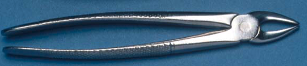
upper universal forceps
same single rooted tip as upper straight
but curved to allow slightly further back in oral cavity
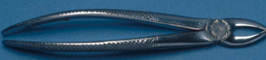
upper molar forceps
2 roots buccal and 1 palatal
- engage furcation on buccal side
- beak to cheek
separate ones for each side
- smooth single root
- point engage furcation
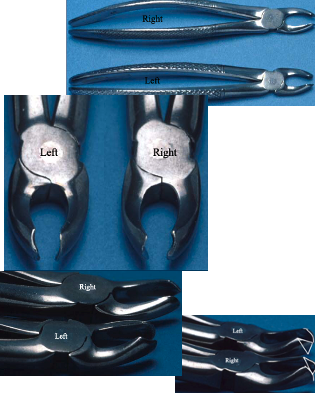
what forceps are these
upper universal forceps and then straight upper anterior forceps
- Straight upper anterior forceps Vs upper universal forceps
- Similar tips
- Curvature allows access to premolars
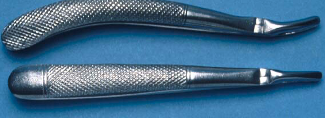
lower forceps
have 90o bend to allow reach in lower arch
root and universal narrower at tip - single rooted
molar has pointy beaks on both sides to engage both furcations
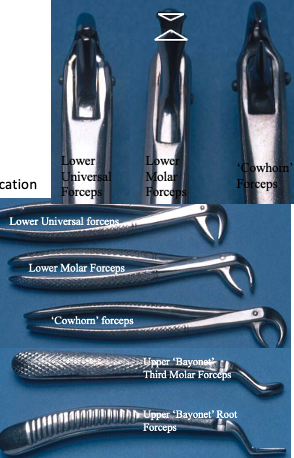
cowhorn forceps
engage furcation in mesial and distal roots
- Only really on younger individual – lifts tooth
- Need divergent roots
- No grip, just squeeze

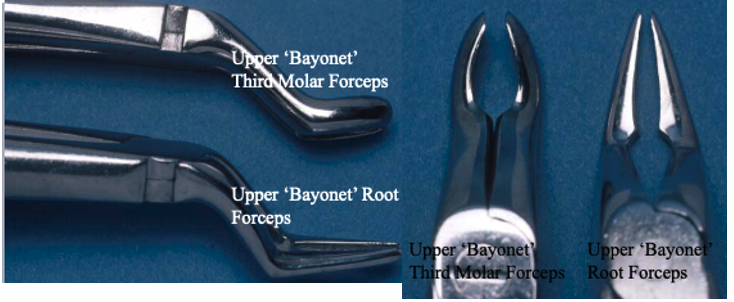
‘bayonet’ forceps
Z shaped
Uppers
- Narrow pointy one – root forceps
Upper 8s have variable morphology – common to have multiple roots fused – assume single root no furcation to grip
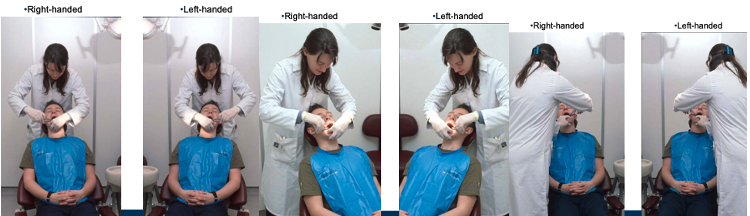
right handed operator stance for extractions
behind pt for lower right
all other in front of pt on their right
elevator functions
- Mobilise the tooth
- Widen PDL
- Before delivering tooth with forceps – more control, less chance of inhalation of loose tooth
Grab tooth higher up as forceps can go into the socket that has been widened
3 types of elevators
couplands
cryers
warwick james
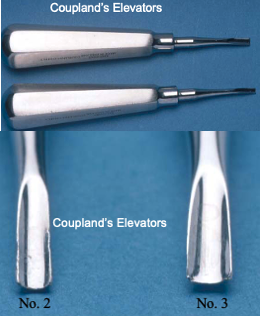
coupland’s elevators
most frequently used
- Hug rounded surface of tooth trying to elevate
- single
- Bigger number = wider the tip (1, 2, 3)
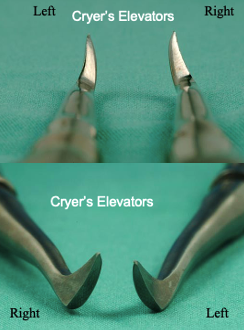
cryer’s elevators
- Sets of 2 – pairs
- Tips facing, concave surface is facing up – right hand holds right (same for Warwick James) (smile to sky)
- Elevate roots down a socket
- E.g. fractured part remains in sockets
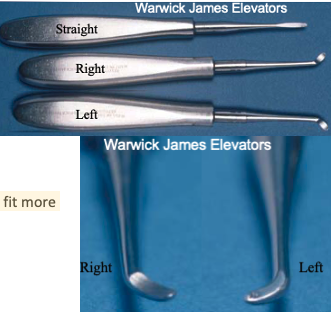
Warwick James elevators
Sets of 3
- Right
- Left
- Straight
Concave surface of right and left, but less sharp than cryers
- Uppers 8s wisdom
Straights – useful for lower 8s elevation as can fit more effectively into narrower space
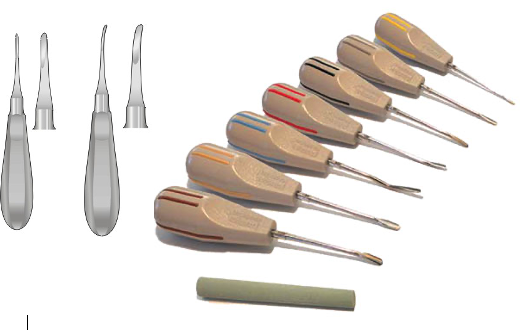
luxators
Very sharp
- Like Coupland’s ended – but sharper
Narrow – easily broken, bend
Very effective but risky as can cause harm
Designed for luxating the tooth
- Tear ligament around tooth
(not elevators)
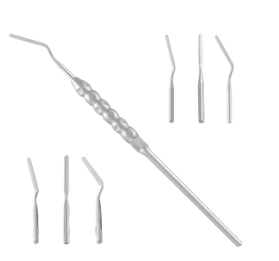
periotome
Mini blade
Work down PDL
Cut space
- Effectively cut most ligament around tooth to ease extraction
Atraumatic to adjacent bone – good for implant
- Save as much bone as possible
Timely – long procedure but more preservative for bone
Can get tips of US
3 basic modes of action for elevaotrs
- Wheel and Axle (Rotation)
- Lever
- Wedge
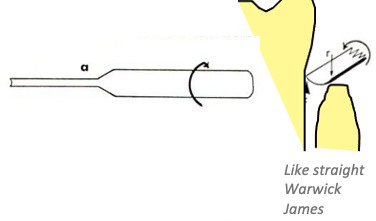
wheel and axle motion
most common - Elevators (not luxators – bend tip)
- Buccal elevation
- Twisting on axle
- Elevate tooth upwards
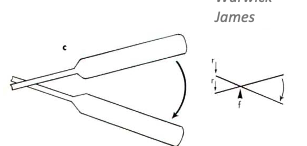
lever
- More force
- Can be dangerous – large force on bone – can fracture
wedge
- Can be used for luxators if careful of fractured root fragments
- Push down ligaments to displace fractured root out

mechanical principles of elevators
- All three actions can be used in combination with each other
- Must avoid excessive force (e.g. with bodily movement of elevator rather than rotation)
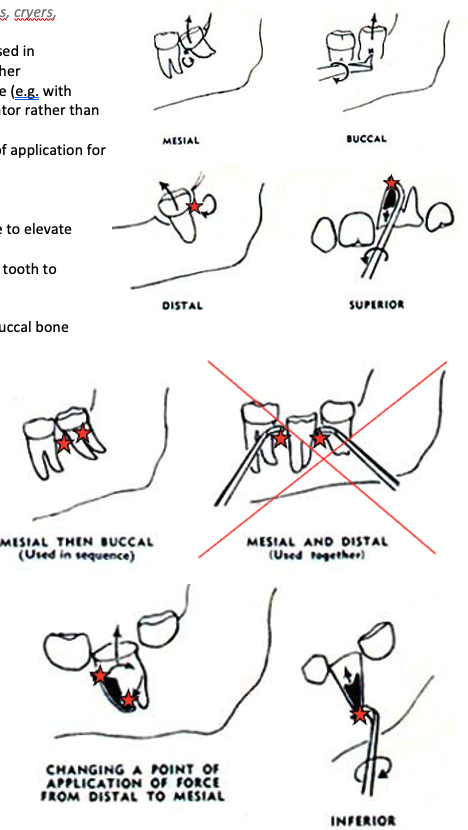
There are various points of application for the elevators
couplands, cryers, Warwick James
start mesial
- concave surface mesial to surface to elevate
- twist wrist
upwards and backwards force on tooth to displace tooth out
lower 8 go lingual (only one) as buccal bone denser
combination of sequence of mesial then buccal – best
- don’t do in unison - need to have a hand supporting pts jaw

Ash periosteal elevators - used to separate the periosteum from underlying bone

Bone file – looks nail file – single or double ended
smooth bone

Hennry Rake retractor – fancy L shaped thing – flap deflection

Howarth’s periosteal elevators – used to separate the periosteum from underlying bone






