How should monetary policy be operated in a crisis?
- Loose enough to ensure that adequate liquidity is avaliable.
- May require rapid reductions in the cash rate, based on imperfect knowledge.
- Central bankers need to discuss policy with each other.
- Central bankers need to act in the short term with an eye to the long term.
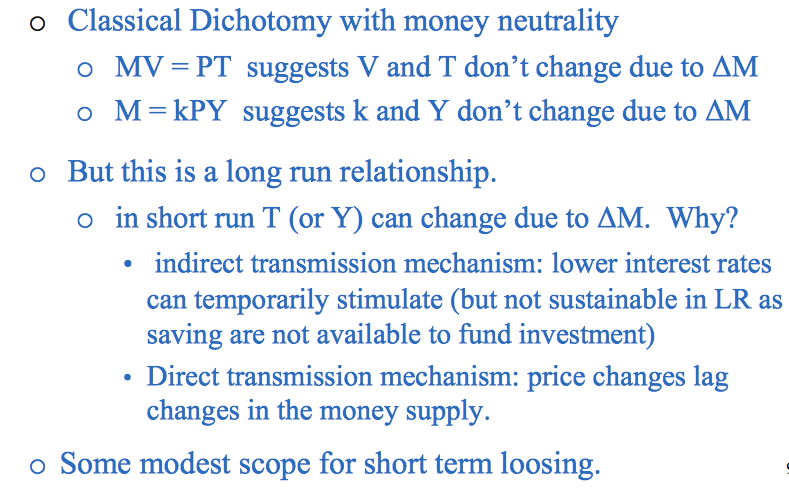
What does the classical quantity theory imply about policy in an economic and financial crisis [i.e. recession and poor financial indicators]?
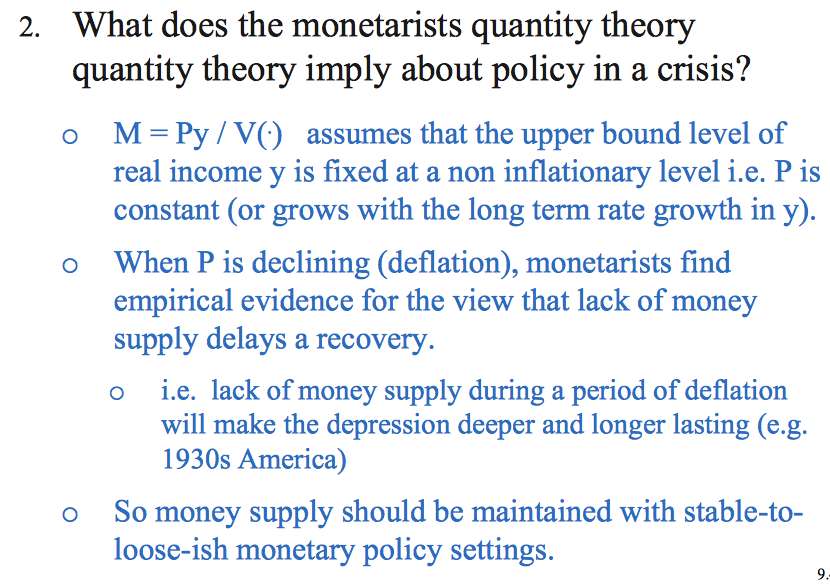
What does the monetarists quantity theory imply about policy in a crisis?
What does Keynesian theory imply about a policy in a crisis?
- Monetary policy should be loose, but a high sloped IS curve will limit effectiveness.
- Need to shift IS curve by expansionary fiscal policy.
- Ease up on expansions as full employment is reached.
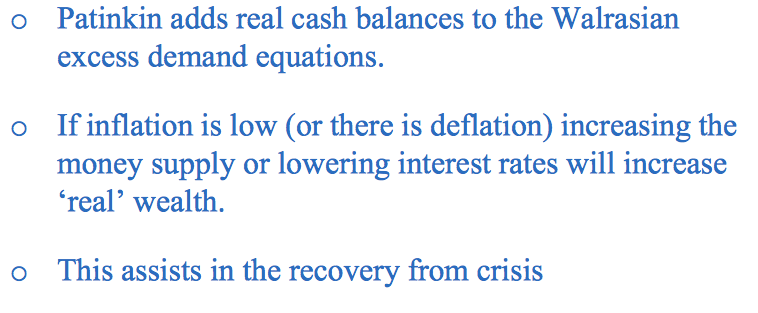
What does Patinkin’s approach imply about policy in a crisis?
Is it true to say that the classical, monetarist, Keynesian and Patinkin responses to crisis are:
a) relatively similar in regard to monetary policy; but
b) very different in regard to the fiscal policy (e.g. a fiscal stimulus package)?
- Not too wide of the mark. None of the approaches would advocate a reduction in money supply or increase in interest rates.
- None suggest it is harmful for money supply be increased moderately or interest rates reduced in the short run (though how long the short run is?).
- Classical and monetarist approaches do not make provision for fiscal stimulus. Keynes does. Patinkin accepts Keynes’s idea of effective demand, but has places more emphasis finding a monetary solution.
How would classical, monetarist, Keynesian and Patinkin inspired policy makers respond with fiscal policy?
- Classical and monetarists would not advocate deficit funding.
- Especially so for Monetarism mark II i.e. Lucas.
- Keynes regard fiscal policy as a necessary plank of a policy response to crisis.
- Patinkin is the complex one – he was sympathetic to Keynes’s monetary analysis, but also not unsympathetic to neoclassical economics. Basically he concluded that the real cash balances could do much of the work that Keynes envisaged fiscal policy doing
Following the GFC, some governments took equity in, or advanced funds to, troubled banks; and most government guaranteed deposits. How might monetarists and Keynesians have respond to that?
- Monetarists would be very concerned
- Moral hazard – make things worse in the longrun
- Markets only work well when failure is punished, just as success is rewarded.
- Question role of government in the economy
- Keynesians would be more sympathetic – concern that financial markets are cause of effective demand .
What does the classical quantity theory and the monetarists quantity theory imply about policy during the stable low inflationary periods to prevent an economic and financial crisis from emerging?
- The best way to achieve long term prosperity is to maintain price stability
- In particular, don’t fuel inflation as that is a will take economic growth beyond the non-inflationary growth rate, which sows the seed of future economic crises.
What does the Keynesian approach imply about policy during the stable low inflationary periods to prevent a crisis from emerging?
- Don’t allow underemployment to persist – take growth up with expansionary policy intermittently if necessary.
- Even outside a crisis – if unemployment is rising, it should not be tolerated as the price of preventing a crisis.
- But Keynesians also recognise the limits of fiscal and monetary policy. Expansion can only be a short run option.
- Greater public economic investment is sometimes considered a way to keep demand up without having to overdo short term fiscal and monetary expansion
What would the monetorists and classical theorists say about the taylor rule and central bank independence?
- Independence of the central bank has a greater link to the classical quantity theory and monetarist view of the world.
- Central bankers and target financial stability free of political influence
- They can, therefore, take the longer term view, which the quantity theory emphasises.
- Central bankers consider short term issues, like unemployment and economic slowdowns, but in the context of have they can be addressed without compromising long term stability.
- Taylor rule lends itself to independent central banks.
What would Keynesians say about the taylor rule and central bank independence?
- Monetary and fiscal policy need to be consistent and accommodate each other.
- What would happen if the government is inflating the economy, through increased spending, while the monetary authority was deflating the economy, through contractionary monetary policy?
- But if central bankers and Government have shared and common goals, which can be specified in Central Bank legislation, then independent central banks may complement government programs.
Compare and contrast the quantity theory of money represented by:
- The Fisher exchange equation;
- The Cambridge cash balances equation; and (iii) monetarism.
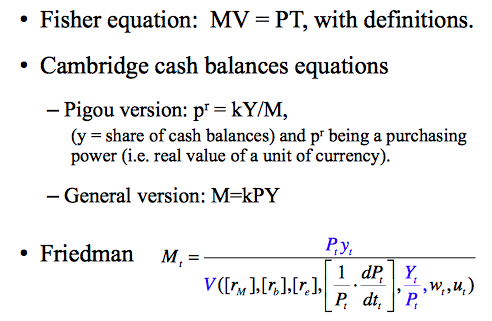
a) outline the equations.
Compare and contrast the quantity theory of money represented by:
(i) the Fisher exchange equation;
(ii) the Cambridge cash balances equation; and (iii) monetarism.
b) contrast descriptively.
- Pigou’s pr is equal to the inverse of the price level (inverse of Fisher’s P and the P in the Cambridge equation in Textbook)
- Pigou/Cambridge share of real cash balances is related to the velocity of circulation: mathematically it is the inverse, but economically the concept is different Cambridge equation is a stock notion of money, whereas Fisher’s is a flow (circulation) notion.
- Friedman’s QT is constrained by real output, which is excluded from the demand for money equation.
- Friedman’s concept of velocity is changed too, shifting focus from circulation of currency the circulation relative to the quantity of income.
Velocity tends to be stable in all, except for Friedman the stability is for the income velocity function, not velocity per se.

-
Topic 1: Money10
-
Topic 2: Standards of Money & Current Monetary Issues7
-
Topic 3: Classical Economics and Walras23
-
Topic 4: Keynesian Monetary Theory13
-
Topic 5: Portfolio Theory9
-
Topic 6: Monetarism17
-
Topic 7: Rational Expectations5
-
Topic 8: Inflationary Adjustments4
-
Topic 9: Interest Rates21
-
Topic 10: Public Sector19
-
Topic 11: Optimal Currency Areas & Exchange Rates10
-
Topic 12: Financial Crisis9
-
Topic 13: Practice Questions14



