State Milton Friedman’s quantity theory of money.
Where:
r… = interest rates on money, bonds and equities.
Thing with the derivative is the expected inflation rate. (Also cost of holding assets).
wt = share of wealth in non-human form.
ug = Liquidity preference & other tastes.
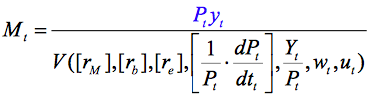
How can milton friedman’s equation be restated for real money and M/P?
M/P = Remove Yt/Pt.
M/Y = Make Use Pt/Yt instead of Yt/Pt.
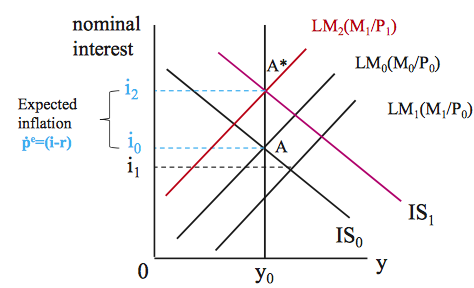
Show how an expansion in the money supply works through in the monetarist perspective in an ISLM model with nominal interest rates.
- Initial response is an increase of the LM curve to LM1
- Money demand then begins to adjust so it will return to LM0.
- But the IS curve will expand, to incorporate inflationary expectations.
- As a result, the LM curve must fall even further to LM2, leaving the economy with a higher nominal interest rate. (Due to higher expected inflation.)
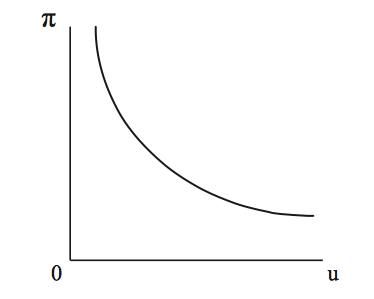
What is the philips curve?
- The suposed relationship between inflation and unemployment, which forms a convex curve.
- Observed during the 1950’s and 60’s.
What happened to the Philips curve in the 70’s and 80’s?
It disappeared.
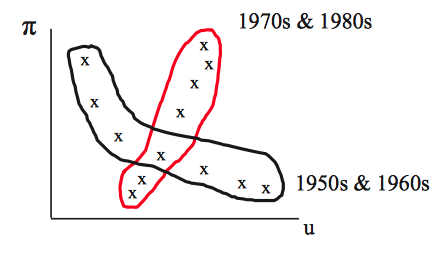
How can the supposed disapearence of the philips curve be explained?
(From the 60’s to the 80’s.)
There is a long run level of unemployment, that the short run philips curve shifts around.
In a dynamic model with constand money growth, consider the effects of an increase in the rate of that growth, from 5% to 10%, where the economy grows at 2% in real terms.
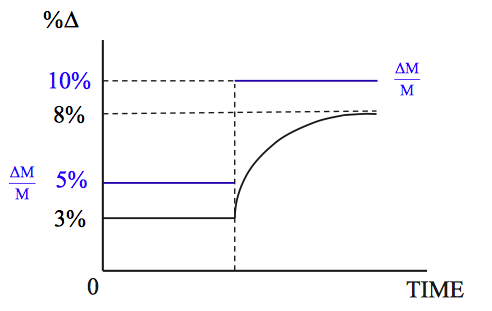
What is superneutrality?
- A static equilibrium point that is invariant to the quantity of money.
- In the absence of money growth, inflation can be zero.
- But once transitions work thourgh, legacy of monetary growth form an inflationary equilibrium -> inflation becomes self generating.
Why did the german economy undergo hyperinflation?
- Bresciani-Turroni say that it was budget deficits.
- Joan Robinson says that when faced with starvation, wage rises were guarentied.
- Conclusion: Quantity of money was the start of the problem, but it was perpetuated by wage pressure.
What are the three sources of hyperinflation?
- Depreciation of the f.c. value of the currency.
- Upward adjustment of wages.
- Budget deficits.
What are Philip Cagans puzzles?
- During period of rapid inflation, price levels rise faster then money balances so real money balances fall.
- There is a shortage of money even though printing presses run non stop.
- If inflation is the result of monetary creation, why create money in the first place?
Summarise Cagan’s model.
Addresses his ‘puzzles’ by stating:
- The expected change in demand for real cash balances is the negative of the expected rate of change in the price level.
- i.e. The elasticity of real demand for money is proportional to the expected rate of change in prices.
- Key point: what causes the expected rate of change in prices.
Formalize Cagan’s Model
Et = βCt-1 + (1-β)Et-1
Where E = Expected price change.
C = Actual price change.
So by substitution:
Et = βCt-1 + β(1-β)Et- + β(1-β)2Ct-3
i.e. People form their expectations with a weighting on the most recent periods.
How does Cagan’s model compare to Milton’s?
Cagan emphasises Friedman’s point that the cost of holding money is given by an expectation, by estimating:

Descriptively, how does Cagan see expected inflation?
- Expected inflation is not a force that acts on velocity.
- It is determined by past inflation.
- And so determined by past injections of money.
How do monetists see the printing of money by governments?
- A convienient method of taxation.
- Inflation increases the cost of hodling money, it has the same effect as a tax.
- Except the inflation can become self-perpetuating… oops.

-
Topic 1: Money10
-
Topic 2: Standards of Money & Current Monetary Issues7
-
Topic 3: Classical Economics and Walras23
-
Topic 4: Keynesian Monetary Theory13
-
Topic 5: Portfolio Theory9
-
Topic 6: Monetarism17
-
Topic 7: Rational Expectations5
-
Topic 8: Inflationary Adjustments4
-
Topic 9: Interest Rates21
-
Topic 10: Public Sector19
-
Topic 11: Optimal Currency Areas & Exchange Rates10
-
Topic 12: Financial Crisis9
-
Topic 13: Practice Questions14



