What is an element?
A substance that cannot be broken down into simpler substances by a chemical reaction
What is a compound?
A substance made by chemically combining two or more elements
What is the atomic number, Z?
The number of protons in the nucleus
What is the mass number, A?
The number of protons plus the number of neutrons in an atom
What are isotopes?
Atoms of the same element with different mass numbers
What can be said about isotopes’ chemical and physical properties
Isotopes have the same chemical properties but different physical properties
What does the stability of a nucleus depend on?
The balance between the number of protons and neutrons
What kind of nuclei emit alpha particles?
Nuclei which have too many protons to be stable
What kind of nuclei emit beta particles?
Nuclei that have too many neutrons to be stable
What are the uses of radioactive isotopes?
- Generate eneryg in nuclear power plants
- Sterilise surgical instruments
- Preserve food
- Fight crime
- Detect cracks in structural materials
How can carbon-14 be used in dating?
- The relative abundance of carbon-14 present in living plants is constant
- When organisms die, no more carbon-14 is abosrbed and the levels of it fall due to nuclear decay
- With the help of carbon-14s half-life, the time of death can be calculated
How can cobalt-60 be used in radiotherapy?
- Highly energetic gamma rays are used
- The treatment damages the genetic material inside a cell by knocking off electrons and making it impossible for the cell to grow
- Normal cells are able to recover if the treatment is controlled
How can iodine-131 be used as a medical tracer?
- Emits both beta and gamma rays
- Can be used in the form of the compound sodium iodide to investigate the activity of the thyroid gland and to diagnose and treat thyroid cancer
- Radiation levels from different parts of the body are then detected
- Short half-life → quickly eliminated from the body
How can iodine-125 be used to treat prostate cancer?
- Pellets of the isotope are implanted into the gland
- Long half-life
- Destroys the cancer cells from within
What are the stages of a mass spectrometer?
- Vaporisation
- Vaporised sample is inserted so that individual atoms can be analysed - Ionisation
- Particles bombarder with high-energy electrons to produce positively charged ions - Acceleration
- Ions accelerated by an electric field - Deflection
- Ions deflected by a magnetic field
- The amounf of deflection is proportional to the charge/mass ratio
- Ions with smaller mass are deflected more than heavier ions
- Ions with higher charges are deflected more than less charged ions - Detection
- Positive ions of a particular mass/charge ratio are detected
- The strength of the signal is a measure of the number of ions
VapIADeDe
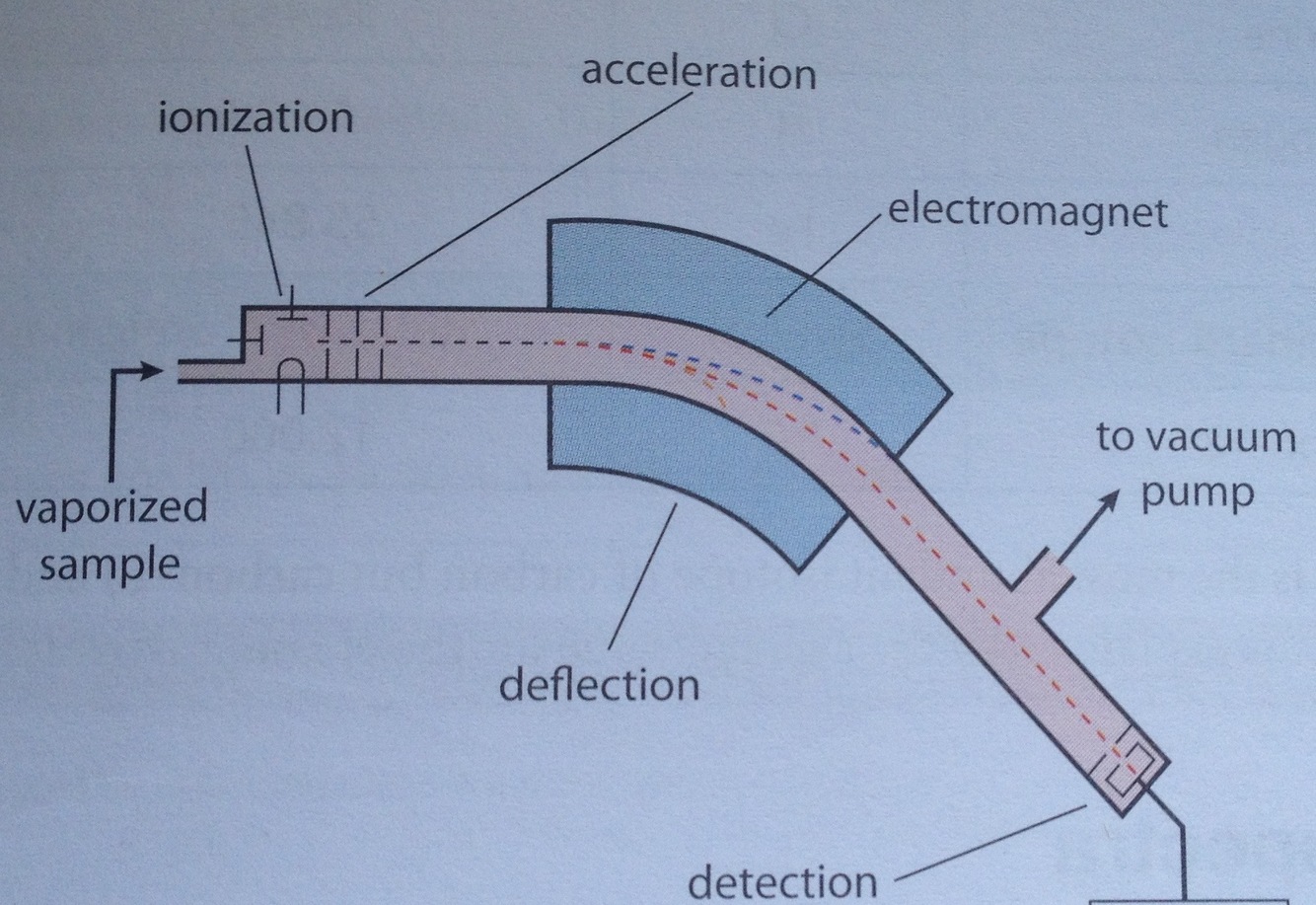
What is the mass spectrometer used for?
Measuring the mass of individual atoms
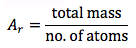
How can the relative atomic mass be calculated from mass spectra?
What is the relationship between the wavelength and frequency?
c = λf
What is the difference between a continuous spectrum and a line spectrum?
Continuous spectrum = light
LIne spectrum has only lights accoring to the emission or absorption of an element
What is the relationship between emission and absorption spectra?
The colours present in the emission spectrum are the same as those that are missing from the absorption spectrum
What is the relationship between wavelength and energy?
The smaller the wavelength, the greater the energy
What are emission and absorption spectra used for?
They can be used to identify elements like a bar code; every element has its unique abosrption and emission spectra
How do electrons give out light?
When they fall back from their excited state to the ground state, the energy is given out as electromagnetic radiation
What is the energy change of an electron when it is excited or returned to ground state?
∆Eelectron = Ephoton = hf



-
Topic 1 - Quantitative chemistry30
-
Topic 2 & 12 - Atomic structure47
-
Topic 3 & 13 - Periodicity65
-
Topic 4 & 14 - Bonding64
-
Topic 5 & 15 - Energetics32
-
Topic 6 & 16 - Kinetics26
-
Topic 7 & 17 - Equilibrium29
-
Topic 8 & 18 - Acids and bases58
-
Topic 9 & 19 - Oxidation and reduction37
-
Topic 10 & 20 - Organic chemistry91
-
Topic 11 - Measurement and data processing6
-
Option B - Human biochemistry130
-
Option D - Medicines and drugs118



