Define rate of reaction
The increase in concentration of products per unit time
(the decrease in concentration of reactants per unit time)

List suitable experimental procedures for measuring rates of reactions
- Change in volume of gas produced
- Change in mass
- Change in transmission of light (colorimetry/spectrophotometry)
- Change in concentration (titration)
- Change in concentration (conductivity)
- Clock reactions
Describe how the volume of gas produced can be used to determine the rate of reaction
- Collecting the gas and measuring the change in volume at regular time intervals gives a volume-time graph
- A gas syringe or inverted burette is used
- Using warm water will reduce error
Mg(s) + 2HCL(aq) → MgCl2(aq) + H2(g)
Describe how the change in mass can be used to determine the rate of reaction
- Can be used if the reaction is giving off gas
- Corresponding decrease in mass can be directly measured on a balance
- Allows for continuous readings
- Does not work if hydrogen is released (too light to show change)
- Mass-time graph
CaCo3(s) + 2 HCl(aq) → CaCl2(aq) + CO2(g) + H2O(l)
Describe how the change in transmission of light can be used to determine the rate of reaction
- Can be used if one of the reactants is coloured
- A light of selected wavelength is passed through the solution
- Intensity of light transmitted is measured
- As the concentration increases, it absorbs more light → less light is transmitted
- A photocell detects light and creates a current
- Allows for continuous readings and absorbance-time graph
2 HI(g) → H2(g) + I2(g)
Describe how the change in concentration (titration) can be used to determine the rate of reaction
- Measuring the concentration by titrating it against a known standard
- Cannot done continuously because it chemically changes the reaction
- Samples must be withdrawn at regular time intervals and analysed by titration
- Quenching is used to stop the reaction when withdrawn
- It’s necessary to repeat the process at several time intervals
H2O2(aq) + 2 H+(aq) + 2 I-(aq) → I2(aq) + 2 H2O(l)
Describe how the change in concentration (conductivity) can be used to determine the rate of reaction
- Electrical conductivity depends on the concentration of ions and their charges
- If this changes during a reaction, the change can be followed
- Conductivity meter is used
BrO3-(aq) + 5 Br-(aq) + 6 H+(aq) → 3 Br2(aq) + 3 H2O(l)
Describe how clock reactions can be used to determine the rate of reaction
- Used when it is difficult to record the continuous change
- Measuring the time it takes to reach a fixed point (something observable)
- Gives an average rate
e. g. time taken to react completely (no longer visible)
Mg(s) + 2 HCl(aq) → MgCl2(aq) + H2(g)
Define the kinetic theory
Temperature in kelvin is proportional to the average kinetic energy of the particles in a substance
Define activation energy Ea
The minimum value of kinetic energy which particles must posess before they are able to react
Describe the collision theory
The rate of a reaction depends on:
- collision frequency
- no. of particles with kinetic energy greater than Ea
- appropriate collision geometry
List five factors affecting the rate of reaction
- Particle size
- Temperature
- Concentration
- Pressure
- Catalyst
Predict and explain the effect of particle size on the rate of a reaction
Decreasing the particle size increases the rate of reaction. Subdividing a large particle into smaller parts increases the total surface area and allows more contact between reactants
Predict and explain the effect of temperature on the rate of a reaction
Increasing temperature causes an increase in the rate of reaction. This is due to the increase in kinetic energy of the particles, that exceed the required activation energy. There is also an increase in collision frequency which further increases the rate.
Predict and explain the effect of concentration on the rate of a reaction
Increasing the concentration of reactants increases the rate of reaction. This is due to the increase in the frequency of collisions.
Predict and explain the effect of pressure on the rate of a reaction
Increasing pressure (in gases) increases the rate of reaction. Higher pressure compresses the gas, effectively increasing its concentration.
Describe the effect of a catalyst on the rate of a reaction
A catalyst increases the rate of a chemical reaction without itself undergoing chemical change (can be reused). Provides an alternate route with a lower Ea. Doesn’t increase the temperature. Also causes an equal reduction for both forward and reverse reaction, thus does not change the position of the equilibrium or the yield.
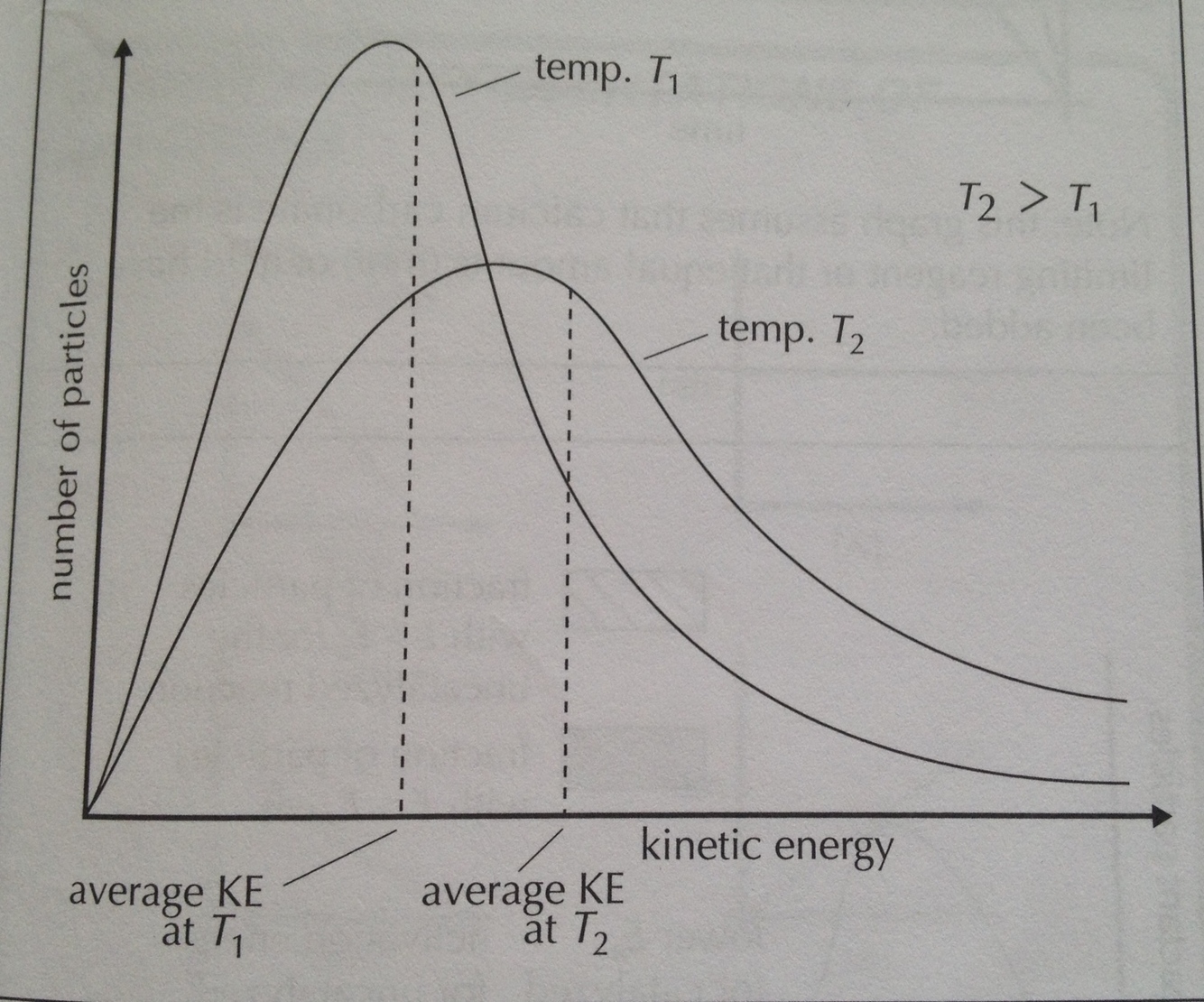
Sketch and explain the Maxwell-Boltzmann energy distribution curve for a gas at different temperatures and its consequences for changes in reaction rate
- The area represents the no. of particles
- The area under the curve does not change as the total no. of particles remains constant
- With increased temperature, more particles have a higher velocity, which shifts the curve to the right
Distinguish between *rate constant, overall order of reaction *and order of reaction
**Rate constant, k **= a constant for a particular reaction at a specified temperature
Order of reaction = the powers (m,n) to which the concentrations of reactants are raised
rate = k[A]m[B]n
Overall order = the sum of the individual orders, m + n
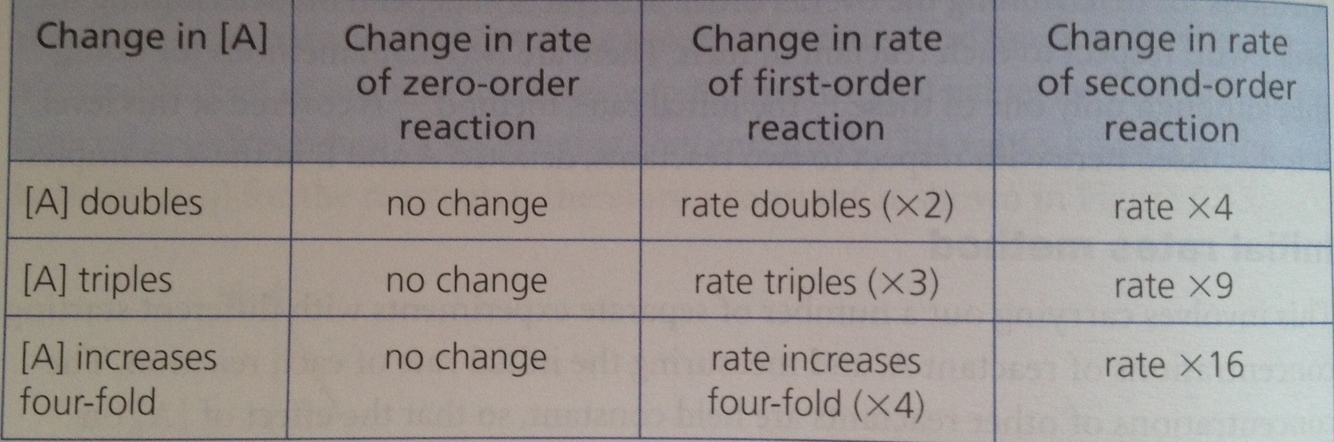
Distinguish between zero, first, second and third order reactions
zero
rate = k
first
rate = k[A]
second
rate = k[A]2
third
rate = k[A]3
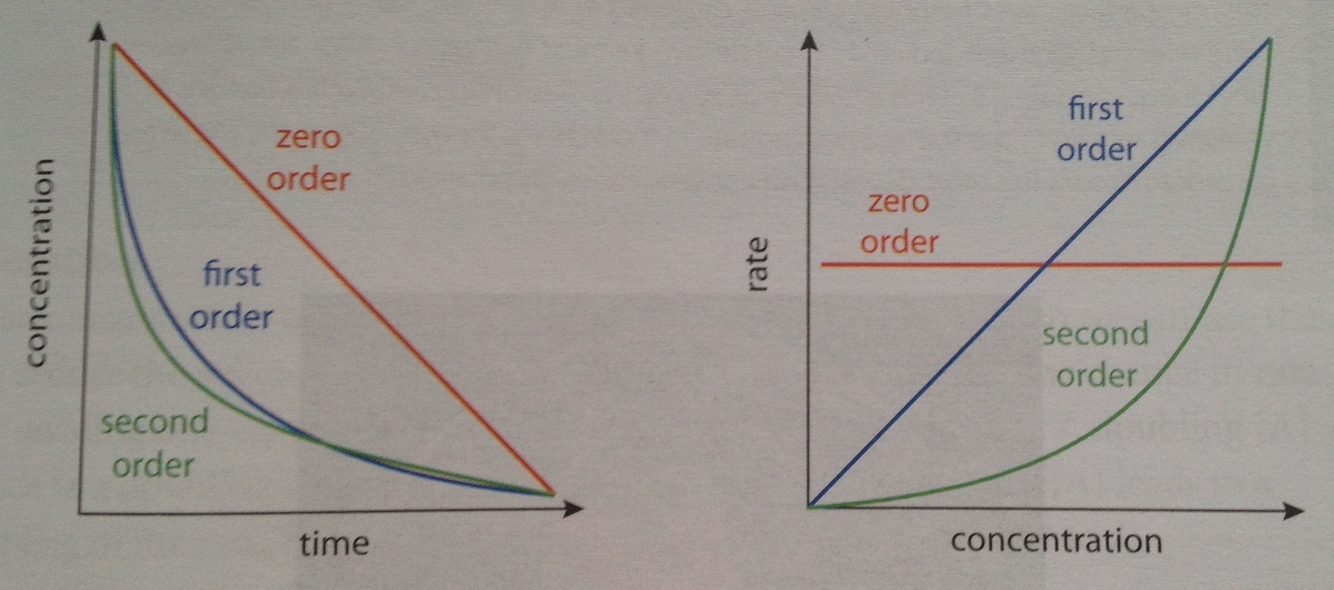
How is the order of a reaction determined?
In the end the orders are added up
What can you deduce if a reactant has a constant half-life?
It is first order with respect to that reactant
Can reactions occur by more than one step?
Yes
Which step of a reaction determines the rate of the whole reaction?
The slowest step

-
Topic 1 - Quantitative chemistry30
-
Topic 2 & 12 - Atomic structure47
-
Topic 3 & 13 - Periodicity65
-
Topic 4 & 14 - Bonding64
-
Topic 5 & 15 - Energetics32
-
Topic 6 & 16 - Kinetics26
-
Topic 7 & 17 - Equilibrium29
-
Topic 8 & 18 - Acids and bases58
-
Topic 9 & 19 - Oxidation and reduction37
-
Topic 10 & 20 - Organic chemistry91
-
Topic 11 - Measurement and data processing6
-
Option B - Human biochemistry130
-
Option D - Medicines and drugs118



