What is the estimation of the population of every country that has a disability that will affect interaction with computers?
10%
What are the statistics for canadian disabilities?
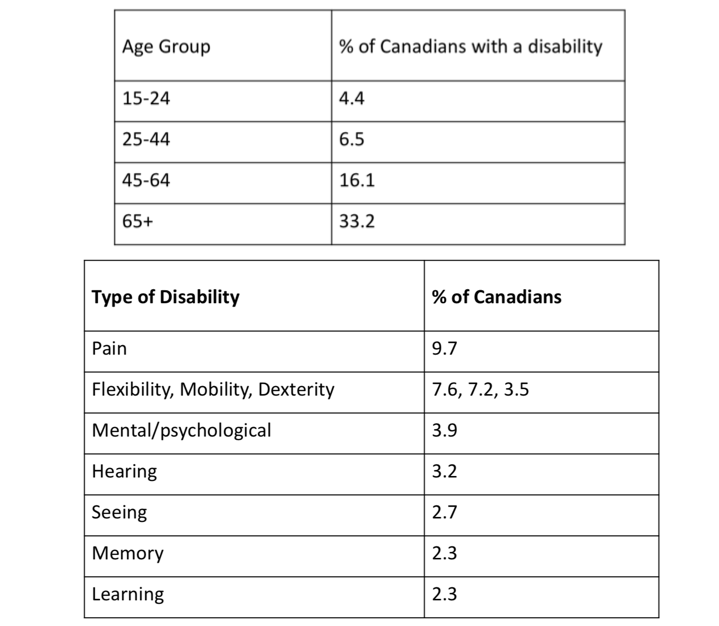
What are the forms of “temporary” disabilities?
Driving a car
- Limited attentional bandwidth
Sick, injured
- Temporarily impaired cognitive capabilities
- Temporary loss of motor capabilities
Sleep deprivation when caring for an infant
- Affects memory
Underwater diving
- Impaired sight, hearing, mobility
What are the aging population stats?
In 2001, 12% of Canadians were 65 years or over.
- By 2026, it is estimated that this number will grow to 25%.
Aging adults prefer to be autonomous as long as possible
- Don’t want to be institutionalized, reliant on others
Aging has impact on cognitive, physical capabilities
- 1 in 4 adults over age 80 has some form of dementia
- Motor skills, senses decline
What are the age-related changes?
Decreased visual acuity
Problems with low levels of illumination
Reduced ability to distinguish colors, especially in short wave lengths (blue, green)
Decreased contrast sensitivity
Glare becomes more problematic
Visual search is harder, takes longer
Pattern recognition more difficult
Tracking and processing moving targets harder Reduced spatial abilities
Increased difficulty with motor movements Decline in auditory function
Why design for disabilities?
It’s the ethical thing to do
Because it’s the law in some countries
Business opportunities
Because you’re likely to be in that boat someday
Because of the “curb cut phenomenon”
What is the W3C Web accessibiity initiative?
Guidelines and technical specifications for universal web design, for example:
Supporting screen reading
Use of styles which can be customized by accessibility plugins
Tools for designers / developpersAccessibility “Check lists”
Evaluation tools (for automated checks)
http://www.w3.org/WAI/
What are the legal details for accessability?
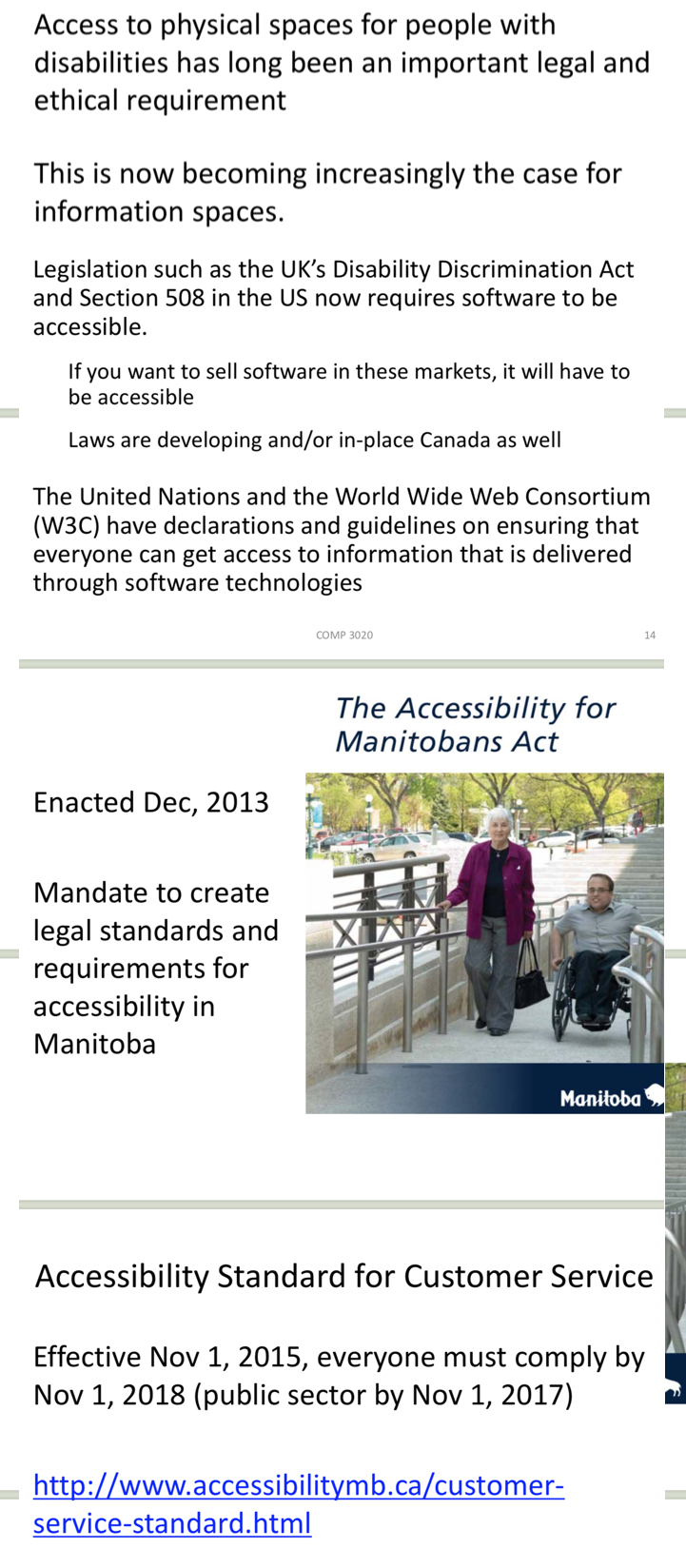
What are the accessibility standards for customer servivce?
To fulfill the Accessibility Standard in Customer Service, organizations must:
- address physical barriers that prevent customers from receiving service
- meet the communication needs of clients
- allow service animals
- allow assistive devices, such as wheelchairs, walkers and oxygen tanks
- let customers know the accessibility policies and procedures
- let customers know when accessible services are not available
- invite customers to provide feedback
- train staff on accessible customer service, including reasonable accommodations under The Human Rights Code (Manitoba).
What is the Curb-cut phenomena?
Designing to accommodate users with disabilities can benefit everyone
- Dubbed the “curb cut phenomenon”
Sidewalk curbs must be “cut” to allow wheelchair access
- But benefits more than just wheelchair users
- Easier to roll luggage, use strollers, carts, etc.
What are Curb cut “Classic” examples:
Cassette tape
- Developed as an alternative to reel-to-reel tape so visually impaired individuals could use books on tape more easily
- Engineers didn’t think average user would buy it because of inferior audio quality
Remote control for TV
- Originally designed for those with mobility impairments
Closed captioning
- Designed for deaf
- Data mining, gyms, language learners, even children reading
Voice-actuated telephone
- Hands-free dialing originally for paralyzed
“Personal Digital Assistant”
- developed in support of enabling persons who are deaf to send and receive messages
What is the concept of Universal Design?
The concept of Universal Design is about ensuring that technology is inclusive of all users
Beyond physical and cognitive disabilities, what other factors might make technology accessible for some, but not others?
With regard to universal design, what are Economic and Cultural Exclusions?
Economic:
- People are excluded if they cannot afford some essential technology.
Cultural:
- Assumptions embedded in technology that exclude certain cultures.
- E.g., using a metaphor based on American football would exclude those who do not understand the game.
When can Social Exclusion occur?
Can occur if technology is unavailable at an appropriate time and place
Or if people are not members of a particular social group and cannot understand particular social mores or messages.
E.g., new high tech assistant, only on Facebook
What are Physical Exclusions?
Inappropriate positioning of equipment
Input and output devices making excessive demands on user abilities.
Examples:
- an ATM may be positioned too high for a person in a wheelchair to reach
- a mouse may be too big for a child’s hand
What are Conceptual Exclusions?
People may be excluded because they cannot understand complicated instructions or obscure commands or they cannot form a clear mental model of the system.
E.g., Command line interface for statistics (e.g., the program R). Statistics knowledge not the barrier
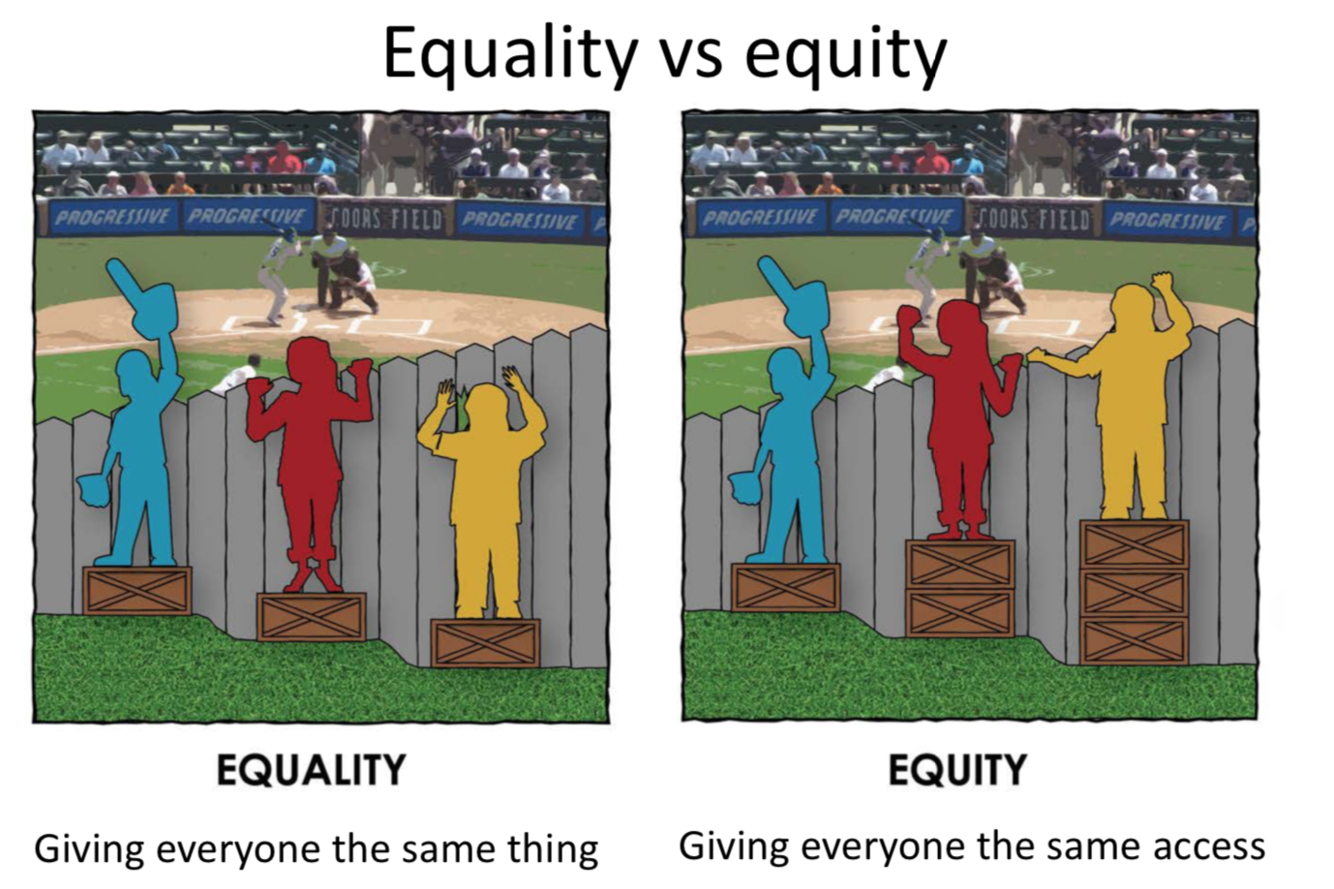
What is the difference between Equality vs Equity?
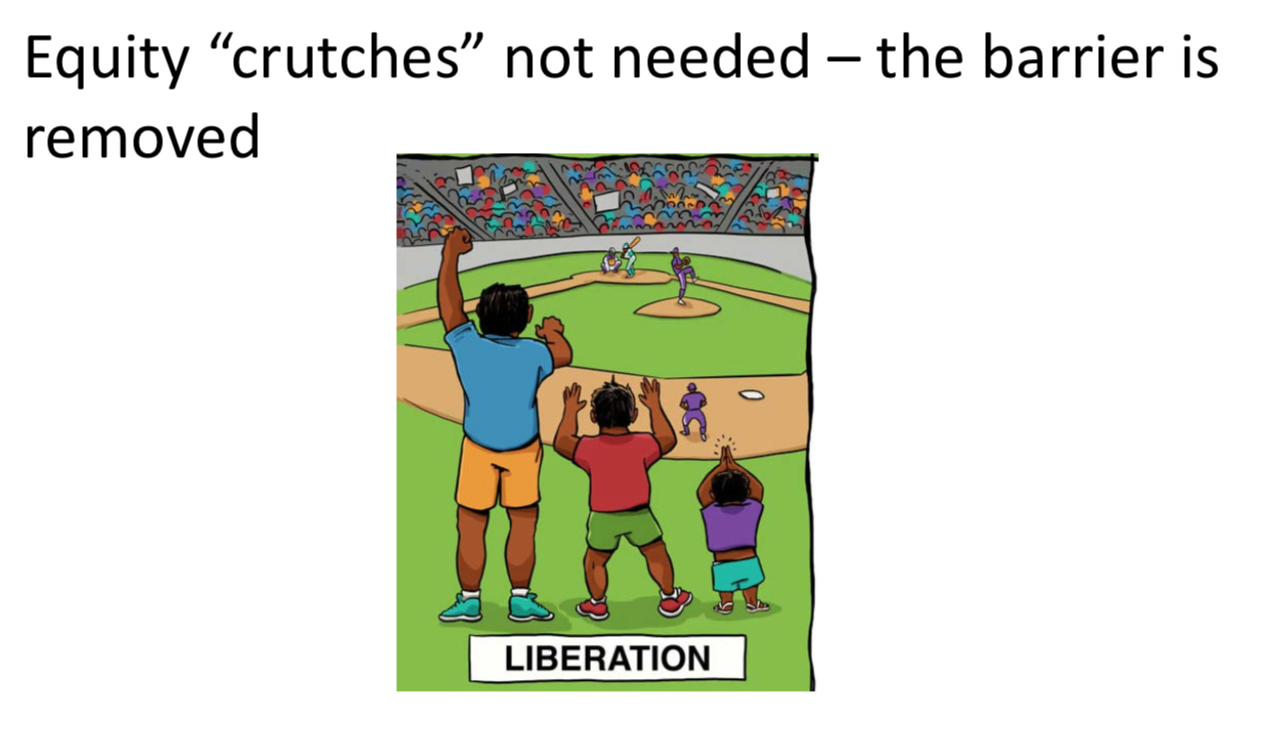
What effect does good universal design have on equity?
What are the principles of Universal Design?
Equitable Use: The design does not disadvantage or stigmatize any group of users.
Flexibility in Use: The design accommodates a wide range of individual preferences and abilities.
Simple, Intuitive Use: Use of the design is easy to understand, regardless of the user’s experience, knowledge, language skills, or current concentration level.
Perceptible Information: The design communicates necessary information effectively to the user, regardless of ambient conditions or the user’s sensory abilities.
Tolerance for Error: The design minimizes hazards and the adverse consequences of accidental or unintended actions.
Low Physical Effort: The design can be used efficiently and comfortably, and with a minimum of fatigue.
Size and Space for Approach and Use: Appropriate size and space is provided for approach, reach, manipulation, and use, regardless of the user’s body size, posture, or mobility.
What kind of overlap is there with standard usability principles and universal design?
LOTS OF OVERLAP
What is the built-in support modern operating systems have?
Typical support includes:Built-in screen readers
- Ability to magnify portions of screen
- Ability to increase contrast of screen
- Ability to control interface using only keyboard
- Ability to increase cursor size
Fonts
- People also adjust system-wide font size for minor visual impairments
What are Accessibility Toolkits?
GUI toolkits like Java and those for MS Windows provide hooks to integrate with accessibility functions
- In Java: Accessibility API
- Windows: UI Automation
Toolkits provide features that allow you to provide additional information about your interface, individual components, and the functions they serve
- This information allows accessibility software to expose your interface to users using different output modalities (e.g., screen readers)
- Also allows accessibility software to control your software using alternative input methodologies (e.g., voice command)
What are basic ideas for designing for accessibility?
Use accessibility API’s/toolkits to encode information about interface and its use within the components themselves.
- Information is made available to accessibility software
- Allows application to employ alternative input/output modalities by accessibility software
Ensure users can accomplish same task with multiple input devices
Create visual designs with expectation that users with visual impairments will be using your application
Test software under conditions of those with disabilities
How can one assist when designing for visual impairment?
A visual impairment can limit ones ability to view text and graphical output
With text output, a common solution is to use a screen reader
What about with graphical output?
There are a number of ways to provide alternative access to the information in graphical output including:
- Providing alternative text for graphics so that a screen reader can be used (e.g., webpages)
- Using sound to provide auditory cues regarding the graphical elements in the interface (e.g., mouse-over sounds for buttons)
- Using tactile output to provide more information about graphics (Example: braille)





