AH
Authentication Header
Protocol Guarantes integrity (connectionless) and authentication of the source of the data. Does not guarantee confidentiality.
SPI: Security assaciation for this datagram (session id and how to verify signature)
Is inserted between IP header and payload.
Routers process datagrams as always, but NAT has problems with it.
ESP
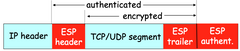
Encapsulating Security Payload
Guarantees authenticity of source, integrity and privacy to IP packets: authenticates and encrypts packet payload.
IKE
Internet Key Exchange Protocol
A IKE SA must be established between A and B to negotiate about the secret keys used in the child SA.
IKE allows preshared secret keys or certificates.
ISAKMP
Internet Security Association Key Management Protocol
It’s an IKE sub-protocol to rinegotiate secrets keys periodically in a secure way.
IPSec VPNs
IPsec tunnel between VPN gateways.
Provides encryption, authentication, encapsulation.
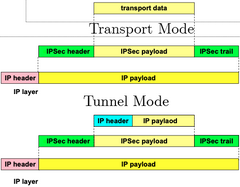
Modes of operation:
- Transport mode: IP header is not fully protected, authenticated if AH is used.
- Tunnel mode: protects both IP header and payload.
IPsec does not define which algorithms should be used to authenticate and encrypt the connection, the two parties agree upon the above negotiating.
Why VPN?
Virtual Private Networks reduce costs:
- Private Networks are expensive:
- Private leased lines
- Long distance dial-up solutions
VPN enables selective and flexible access tocorporate network (services):
- Limited services available to external users
- All intranet functionalities available tocorporate users accessing from the Internet
Access/Remote/Dial-in VPN
One of two VPN flavors.
- Connects terminal to remote network
- Virtualizes (dial-up) access connection
- e.g., ISDN, PSTN, cable, DSL
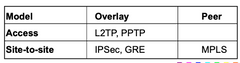
- PPTP, L2TP
Authentication/Authorization: performed by vpn gw; policies and info of the corp. network.
Address allocation: corp. addr. dynamically allocated, same address as when directly connected.
Security: by vpn gateway if customer provisioned, by provider otherwise.
Site-to-Site VPN
One of two VPN flavors.
- Connect remote networks
- Virtualizes leased line
- IPsec, GRE, MPLS
Intranet VPN
One of two deployment scenarios.
Interconnection of corporate headquarters, remote offices, branch offices, telecommuter, traveling employee
Extranet VPN
One of two deployment scenarios.
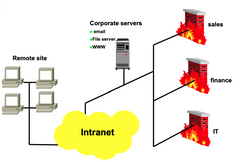
Interconnection of customers, suppliers, partners, or communities of interest to a corporate intranet
- -Provide controlled access to an individual customer/partner/provider user
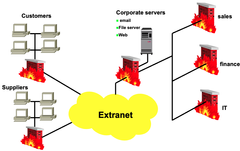
Extranet VPN specific issues
- Gateway positioning (restricted access to network resources from interconnected networks)
- Firewall at the VPN
- Overlapping address spaces between networks connected to the extranet
- NAT
- Open, standard-based solution
- Enables interoperability among different organization
- Traffic control
- Avoid that partner traffic compromises performance on corporate network.
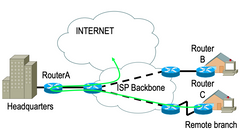
Centralized internet access
Remote branches/users access public IP network only to reach headquarters.
Internet access only from HQ.
VPN carries also traffic to and from the internet.
Centralized access control (firewall)
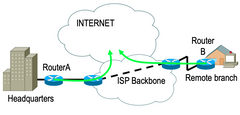
Distributed internet access
Remote branches/users access the internet through their ip network connection.
VPN is deployed only for corporate traffic.
Deployment models
- Overlay Model
- Peer Model
Internet Access types
- Centralized
- Distributed
VPN Flavors
- Site-to-Site
- Access VPNs
Deployment Scenarios
- Intranet
- Extranet
Overlay Model
Deployment model.
The public network does not participate in realizing the VPN, it just provides means of communication between them.
Each VPN GW knows every other VPN GW.
Routing is performed by the VPN Gateways.
Peer Model
Each VPN gateway interacts with a public router (its peer):
- To exchange routing information
- SP network distributes routing info
- Public network routes traffic between gateways of the same VPN.
VPN Provision
- Customer Provisioned
- Provider Provisioned
Customer Provisioned
Customer (from SP POV), builds and manages the VPN by theirself, tunnels are instantiated between Customer Edges (CE).
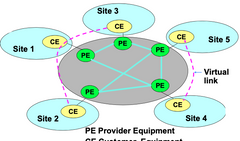
Provider Provisioned
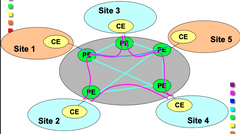
Provider implements the solution: owns, configures, mangages devices implementing vpn functionalities.
Traffic belonging to different vpns is separated by the provider devices.
CE may behave as if they were connected to a private network.
PE terminates tunnels.
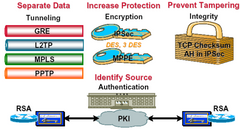
VPN Components
VPN Topologies
Hub and spoke:
- Each pair of nodes can communicate only through the HQ -> problem: bottlenecks
- Fits data flow of many corporations.
Mesh:
- Large number of tunnels (harder config)
- Optimized routing






