What is water hardness?
The ability to work up a lather. The harder the water, the more difficult it is to lather
What are the 3 available water sources?
- Surface Water - low in minerals, high in organics
- Ground Water - high in minerals, low in organics
- Municipal Supply Water - variable
Which water source is generally purer?
Surface or ground water?
Ground water is purer due to inherent filtration as the water seeps through the ground to the bed rock
What are the 3 categories of water in the brewery?
- Brewing water
- Service water
- Cleaning water
Ozone can be used for water sterilization. Which material is Ozone agressive towards and lead to faster failure?
Rubber gaskets and membranes
Chlorine is the most common method of water sterilization. What are 3 benefits of using chlorine dioxide?
- Does not produce taints in the water
- It is non-corrosive
- It is non-toxic (once in solution)
What makes water hardness permanent?
The presence of calcium and magnesium sulfates
What makes water hardness temporary?
The presence of calcium and magnesium bicarbonates and carbonates
What are 4 impacts of water hardness in the brewery?
- Calcium and magnesium decrease pH
- Bicarbonates increase pH
- Calcium and magnesium cause scaling
- High hardness requires more detergent use
What are the 3 methods to remove temporary hardness?
- Boiling
- Addition of lime
- Addition of acid
What are the 2 methods to remove permanent hardness?
- Ion exchange
- Reverse osmosis
How does Burton water compare to Pilsen water?
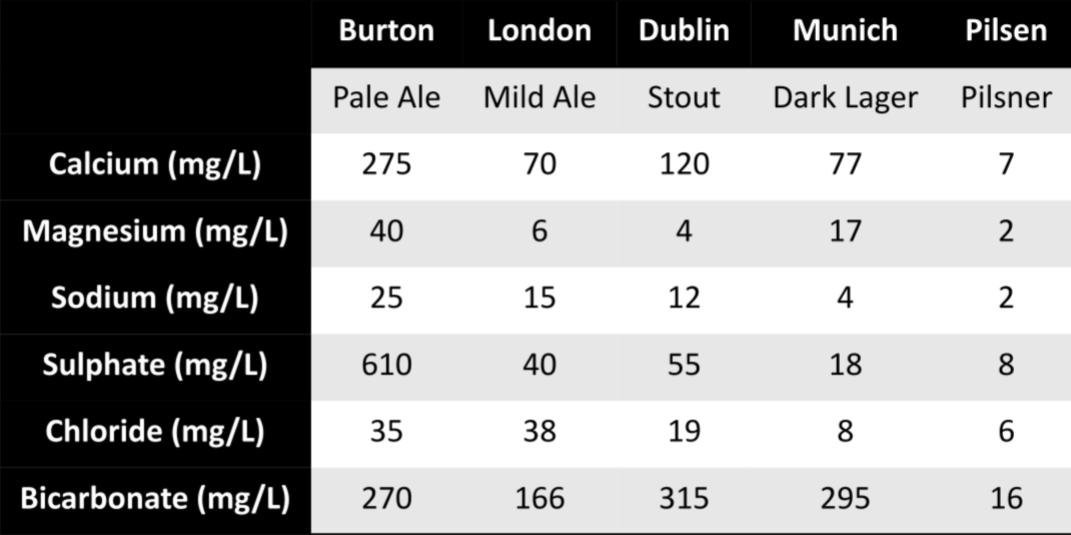
Burton has very high permanent and temporary hardness. Pilsen has very soft water
What is “beer stone”?
Beer stone is calcium oxalate and forms scaling on vessels and pipes. It is important to have enough calcium in the water supply to precipitate the oxalate in the mash and remove it with the spent grain or it will causes issues/plugging downstream.
Why is zinc important?
Zinc is a vital yeast nutrient and must be in the water to promote proper fermentation and yeast health
What are the typical mineral concentration levels in water?
- 0-50 ppm is low
- 50-100 ppm is medium
- 100-150 ppm is high
- >150 ppm is a problem and requires action
What is residual alkilinity?
It is the difference between effects of the Total Alkilinity and the Hardness on the mash pH.
RA=TA - (Ca + 0.5*Mg)/3.5
Ca has twice the effect that Mg has
What is the range for typical mash pH?
5.2-5.6
What temperature should mash pH be measured at?
Mash should be cooled to room temperature before measuring pH
Describe the water cube:
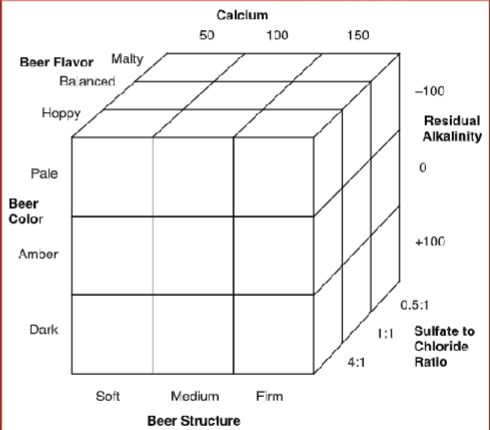
Water profile is given by Calcium, RA, and Sulfate to Chloride ratio.
- Beer color is adjusted by RA
- Flavor is adjusted by Sulfate to Chloride ratio
- Structure is adjusted by Calcium level
Where is it required to use deaerated water?
- Water used for pushing beer
- Water used in packaging
- Water used for dilution
Should CIP use hard or soft water?
Should use soft water to improve detergent utilization and provide good rinsing
What is the benefit of RO water?
It is a blank slate that you can make whatever water composition you want out of it. The downside is it is more expensive

-
Barley/Malt50
-
Adjuncts18
-
Water22
-
Milling/Mashing15
-
Wort Separation/Boiling29
-
Hops16
-
Yeast/Fermentation51
-
Maturation/Clarification29
-
Packaging59
-
Brewery Engineering51
-
Sensory52
-
Beer Styles29
-
Flavor, Haze, Foam34
-
Quiz Adjuncts10
-
Quiz Sweet Wort Production10
-
Quiz Water10
-
Micro Quizzes20
-
Maturation, cold conditioning, carbonation and clarification Quiz10



