what is investment project?
The term investment project is interpreted very broadly to include any proposal to outlay cash in the expectation that future cash inflows will result
capital expenditure management involves the
planning and control of expenditures incurred in the expectation of deriving future economic benefits in the form of cash inflows
capital expenditure process involves
- generation of investment proposals
- evaluation and selection of those proposals
- approval and control of capital expenditures
- post-completion audit of investment projects.
investment proposals: Investment ideas or projects:
¡simple upgrades of equipment,
¡replacing inefficient exiting equipment,
¡plant expansions,
¡new product development,
¡bidding for commercial contracts,
¡entering new markets. or
¡corporate takeovers.
types of invesment projects
what are independent investments?
¡Projects that can be considered and evaluated in isolation from other projects.
¡This means that the decision on one project will not affect the outcomes of another project
- technically feasible to undertake one of the projects, irrespective of the decision made about the other project(s).
- The net cash flows from each project must be unaffected by the acceptance or rejection of the other project(s).
what are mutually exclusive investments?
¡Alternative investment projects, only one of which can be accepted.
¡For example, a piece of land is used to build a
factory, which rules out an alternative project of
building a warehouse on the same land.
methods of project evaluation include
Methods of project evaluation include:
- Payback period
- Net present value (NPV)
- Internal rate of return (IRR)
- Benefit–cost ratio (profitability index)
simple project evaluation methods
payback period
payback period, a non discounted cash flow method,
The amount of time required for an investment to generate cash flows to recover its initial cost.
simple project evaluation methods
payback period
when is an investment acceptable?
An investment is acceptable if its calculated payback is less than some maximum acceptable payback period
.
pros of payback period
- Easy to understand/simple
- Adjusts for uncertainty of later cash flows.
- knowledge of how soon funds in the project will be recouped provides managers with info to facilitation cash budget preparation –> better liquidity management
disadvantages of payback period
- Time value of money (timing of all cash inflows and outflows) and risk ignored.
- arbitrary determination of acceptable payback period.
- Ignores cash flows after the point net cash flows = intial outlay, thus, discriminates long term projects and projects that generate large cash flow later
advantages of benefit cost ratio
¡Includes time value of money
¡Easy to understand
¡Does not accept negative estimated NPV investments
¡Biased towards liquidity
disadvantages of benefit cost ratio
- May reject positive NPV investments
- Arbitrary determination of acceptable payback period
- Ignores cash flows beyond the cutoff date
- Biased against long-term and new products
what are discounted cash flow methods
Discounted cash flow (DCF) methods involve the process of discounting a series of future net cash flows to their present values.
DCF methods include:
¡The net present value method (NPV).
¡The internal rate of return method (IRR).
projects should be accepted if
they increase shareholders’ wealth
postive NPV represents
the immediate increase in the company’s wealth that will result from accepting the project—that is, a positive net present value means that the project’s benefits are greater than its cost, with the result that its implementation will increase shareholders’ wealth
If a company implements a project that has a positive net present value, the company will be
more valuable/better off than before it undertook the project, and therefore, other things being equal, the total market value of the company’s shares should increase immediately by the same amount as the net present value of the new project.
what is the internal rate of return
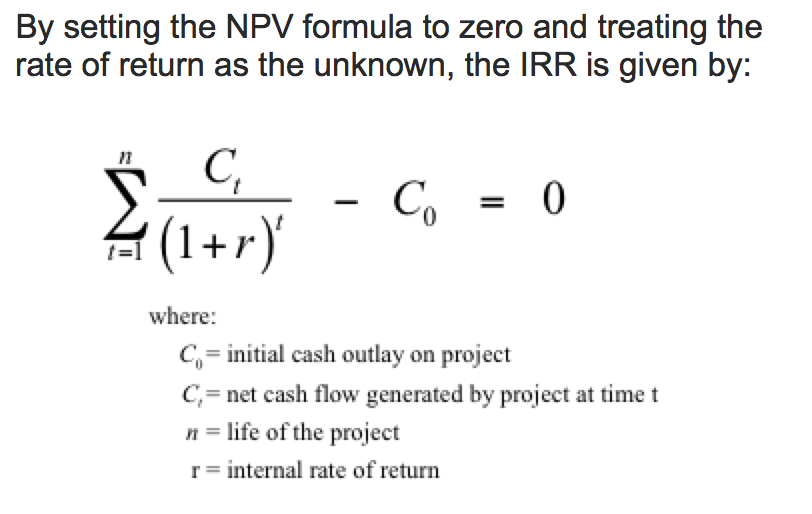
The internal rate of return for a project is the rate of return that equates the present value of the project’s net cash flows with its initial cash outlay.
IRR is the discount rate (or rate of return) at which the net present value is zero.
decision rule for IRR
The IRR is compared to the required rate of
return (k).
If IRR > k the project should be accepted.
If the required rate of return is the minimum return that investors demand on investments then, other things being equal, accepting a project with an internal rate of return greater than the required rate should result in an increase in the price of the company’s shares.
¡Situations where the IRR rule and NPV rule may be in conflict:
nDelayed Investments
nNonexistent IRR
nMultiple IRRs
Hence, the number of cash flow sign reversals corresponds to
maximum, but not necessarily the actual, number of internal rates of return.
. IRR measures
the average return of the investment and the sensitivity of the NPV to any estimation error in the cost of capital
IRR rule and mutually exclusive investments: differences in scale
¡If a project’s size is doubled, its NPV will double. This is not the case with IRR. Thus, the IRR rule cannot be used to compare projects of different scales.
For independent investments, both the IRR and NPV methods of investment evaluation lead to
the same accept/reject decision, except for those investments where the cash flow patterns result in either multiple internal rates of return or no internal rate of return. In other words, if a project has an internal rate of return greater than the required rate of return, the project will also have a positive net present value when its cash flows are discounted at the required rate of return—that is, NPV > 0 when r > k, NPV < 0 when r < k, and NPV = 0 when r = k





