What is the difference between a primary and secondary thyroid disease?
Primary thyroid disease affects the thyroid gland itself. Can occur with or without goitre, and is most commonly autoimmune in origin
Secondary thyroid disease affects the hypothalamus or the pituitary gland, without thyroid involvement.
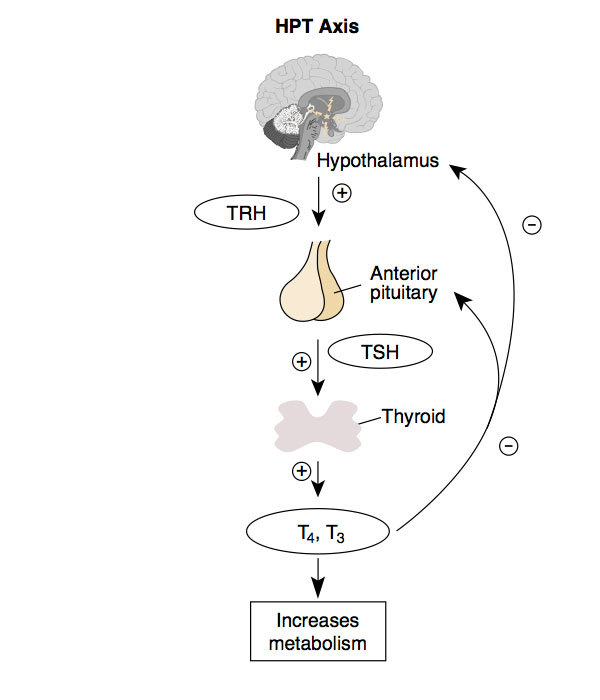
Describe the Hypothalamic-Pituitary-Thyroid Axis
Thyrotrophin Releasing Hormone (TRH) is released from the Hypothalamus, and acts on Pituitary gland.
This causes release of Thyroid Stimulating Hormone (TSH), aka Thyrotropin, from the Anterior Pituitary, which acts on the Thyroid gland to release T4 (Thyroxin, 80% of hormone secreted) and T3 (Levothyroxine, remaining 20%)
Only T3 is active, T4 needs to be de-iodinated in the Liver to T3
T4 and T3 then have a negative feedback effect on the Pituitary and the Hypothalamus
How would TSH and T3/T4 levels appear in Primary Hypo/Hyperthyroidism?
Primary Hypothyroidism
- TSH - high
- Free T3/T4 - low
Primary Hyperthyroidism
- TSH - low
- Free T3/T4 - high
How would TSH and T3/T4 levels appear in Secondary Hypo/Hyperthyroidism?
Secondary Hypothyroidism
- TSH - Low or ‘normal’
- Free T3/T4 - Low
Secondary Hyperthyroidism
- TSH - High or ‘normal’
- Free T3/T4 - High
What is myxoedema?
In what condition is Pretibial myxoedema (rarely) seen?
Myxoedema, or myxoedema coma, is a severe hypothyroidism and is a medical emergency
Pretibial myxoedema is a rare clinical sign of Grave’s Disease (i.e. autoimmune hyperthyroidism)
What are some of the causes of Primary Hypothyroidism? Both goitrous and non-goitrous, be sure to get the most common causes!
Goitrous
- Chronic Thyroiditis (Hashimoto’s Thyroiditis)
- Iodine deficiency
- drug induced e.g. amiodarone, lithium
- maternally transmitted
Non-goitrous
- Atrophic Thyroiditis (same as Hashimoto’s but no goitre)
- Post-ablative therapy
- Post-radiation therapy
- congenital developmental defect
Self-limiting
- following the withdrawal of antithyroid drugs
- post-partum thyroiditis (weeks/months following childbirth)
Generally, what could cause Secondary Hypothyroidism?
Any disease of the Hypothalamus or Pituitary, of which there are many
- Infiltrative
- Infectious
- Malignant
- Traumatic
- Congenital
- Cranial radiotherapy
- Drug induced
What is Hashimoto’s Thyroiditis? What is it characterised by?
Most common cause of hypothyroidism in the Western World
Autoimmune destruction of the thyroid gland and reduced hormone production
Often a family history, women more affected than men
Characterised by:
- antibodies against thyroid peroxidase (TPO)
- T-cell infiltrate and inflammation
What are some of the clinical features of Hypothyroidism?
Hair and Skin
- course hair
- dull, expressionless face
- periorbital puffiness
- pale cool skin, doughy to the touch
- vitiligo
- hypercarotenaemia
Thermogenesis
- cold intolerance
Fluid retention
- pitting oedema
Cardiac
- reduced heart rate
- cardiac dilatation
- pericardial effusion
- worsening of heart failure
Metabolic
- hyperlipidaemia (xanthelasma may be seen)
- decreased appetite/weight gain
GI
- constipation
- megacolon and intestinal obstruction
Respiratory
- deep, hoarse voice
- macroglossia
- obstructive sleep apnoea
Neurological
Gynae/reproductive
What does the thyroid auto-antibody profile look like for…
- Grave’s Disease?
- Autoimmune hypothyroidism (Hashimoto’s)?
Grave’s
- Anti-TPO antibody - 70-80% are positive
- Anti-thyroiglobulin antibody - 30-50% are positive
- TSH receptor antibody - 70-100% are positive
Autoimmune Hypothyroidism
- Anti-TPO antibody - 95% are positive
- Anti-thyroiglobulin antibody - 60% are positive
- TSH receptor antibody - 10-20% are positive
Hypothyroidism - treatment
Normal metabolic rate should be restored gradually, rapid restoration could lead to cardiac arrythmias
Main treatment is levothyroxine (T4)
- younger patients are started at 50-100 micrograms daily
- in older patients with a history of IHD, start at 25-50 micrograms and review every four weeks
- check TSH 2 months after any changes in dose. Once stable, check TSH every 12-18 months
When is levothyroxine best taken?
What are the benefits of taking both T4 and T3?
How does the dosing change in pregnancy?
T4 is preferrably taken prior to breakfast.
No benefit seen in combining treatments of T4 and T3
Dose requirements may increase by 25-50% during pregnancy
(Calcium supplements and PPIs should also be avoided as these can interfere with the action of levothyroxine)
Myxoedema coma - findings and treatment
Findings
- ECG - bradycardia, low voltage complexes, varying degrees of heart block, T wave inversion, prolongation of the QT interval
- Type 2 respiratory failure
- Co-existing renal failure is seen in 10% of patients
Treatment
- Intensive care - A B C!!!
- Passively rewarm, aiming for a slow rise in body temperature
- Cardiac monitoring for arrthythmias
- Broad spec. antibiotics
- Thyroxine cautiously
What is the difference between Thyrotoxicosis and Hyperthyroidism?
Thyrotoxicosis - the clinical state of the body’s tissues being exposed to excessive amounts of thyroxin
Hyperthyroidism - refers specifically to conditions of overactivity in the thyroid, resulting in thyrotoxicosis
Thyrotoxicosis (hyperthyroidism) - signs and symptoms
Cardiac
- palpitation, AF
- very rarely, cardiac failure
Sympathetic
- tremors
- sweating
CNS
- Anxiety, nervousness, irritability etc.
GI
- frequent, loose bowel movements
Vision
- lid retraction
- double vision
- Proptosis (bulging eyes)
Hair and Skin
- brittle, thin hair
- rapid fingernail growth
Reproductive
- menstrual cycle changes
Muscles
- muscle weakness
Metabolism
- weight loss, despite an increase in appetite
Thermogenesis
- intolerance to heat
What are some of the causes of Thyrotoxicosis associated with Hyperthyroidism?
Excessive thyroid stimulation
- Grave’s disease - by far the most common
- Hashitoxicosis - initial hyperthyroidism before long term hypothyroidism
- Thyrotropinoma (THSoma, very rare)
- Thyroid cancer
Thyroid nodules with autonomous function
- Toxic solitary nodule
- Toxic multinodular goitre
What are some of the causes of Thyrotoxicosis not associated with Hyperthyroidism?
Thyroid inflammation
- Subacute (de Quervian’s) thyroiditis
- Post-partum thyroiditis
- drug induced thyroiditis (e.g. amiodarone)
Exogenous thyroid hormones
- Over-treatment with levothyroxine
- Thyrotoxicosis factitia (self-poisoning, mental health related)
Ectopic thyroid tissue
- Metastatic thyrooid carcinoma
- Struma ovarii
Who gets Graves’ disease? What are the TSH and free T3/T4 profiles like?
Women more commonly than men (2:1)
Younger people (age 20-50)
Genetic susceptibility. Sisters and children of women with Graves’ have a 5-8% risk of developing an autoimmune thyroid disease
Smokers - makes Graves’ harder to treat and the disease is a worse form
TSH is low, free T3/T4 is high
What antibody test can be done if Graves’ is suspected?
TSH Receptor Antibody (TRAb) - 70-100% are positive
No need to image thyroid if TRAb is positive
What obvious clinical signs may be seen on inspection in patients with Graves’?
And on auscultation?
What other condition is very noticeable on inspection and could feature in Graves’?
Pretibial myxoedema
Finger clubbing
Thyroid bruits (very rare), only heard in very large goitres
Graves’ Eye Disease (aka thyroid eye disease) - seen in 20% of Graves’ patients
How is Thyroid Eye Disease graded and treated?
Graded with a clinical activity score (CAS, Mourits)
Mild disease is treated with topical lubricants
More severe disease is treated with steroids or radiotherapy. Surgery to decompress can also be used
In which group does nodular thyroid disease more commonly occur? How does it present?
What tests are done to confirm the diagnosis?
Typically presents in older patients
Thyroid may feel nodular, and an asymmetric goitre may be apparent
Tests
- Free T3/T4 is raised - NB, if this is extremely high then Graves’ disease is more likely
- TSH is lowered
- Classically is TRAb negative (unlike Graves’)
- Thyroid ultrasound can be done to confirm
Thyroid storm is a medical emergency! What might you see?
How do you treat it?
Severe hyperthyroidism
Respiratory and cardiac collapse - may require mechanical ventilation
Hyperthermia
Exaggerated reflexes
Typically seen in hyperthyroid patients with an acute infection/illness, or recent thyroid surgery
Treatment
- ABC
- iodine
- glucocorticoids
- propylthiouracil (PTU) - blocks thyroid hormone production and conversion of T4 to T3
- beta blockers
- fluids and monitoring
Name some anti-thyroid drugs (ATDs).
What is their mechanism of action?
Carbimazole
- 1st line, once daily dosing
- lower rate of side effects compared to PTU
Propylthiouracil (PTU)
- 1st line if the patient is in the 1st trimester of pregnancy, twice daily dosing
- 10 times less potent than carbimazole






