Peptide/protein hormones
- synthesized by
- specificity
- storage
- solubility/transport in blood
- receptor type
- Half life
- Metabolism
- syn: polyribosome
- spec:primary AA, post translational modification
- stor: exocytosis from vesicles
- sol/trans: soluble/unbound
- receptor: cell membrane
- half life: short
- met: endocytosis or lysosomal degradation
Catecholamines
- synthesized by
- specificity
- storage
- solubility/transport in blood
- receptor type
- Half life
- Metabolism
- syn: adrenal medulla
- spec: enzymatic modifications of tyrosine
- stor: exocytosis from vesicles
- sol/trans: soluble/unbound
- receptor: cell membrane
- half life: short
- met: endocytosis or lysosomal degradation
Steroids
- synthesized by
- specificity
- storage
- solubility/transport in blood
- receptor type
- Half life
- Metabolism
- syn: adrenal cortex, ovaries, testes, placenta
- spec: cholesterol
- enzymatic modifications
- stor: hydrophobic
- sol/trans: insoluble/bound
- receptor: intracellular
- half life: long
- met: conjugation in liver
Thyroid
- synthesized by
- specificity
- storage
- solubility/transport in blood
- receptor type
- Half life
- Metabolism
- syn: thyroid
- spec: thyroxine structures
- stor: extracellular
- sol/trans: soluble/bound
- receptor: intracellular
- half life: long
- met: conjugation in liver
List the structures included in endocrine axis and what they release
Hypothalamus–releasing hormone to Pituitary–Trophic hormone to Peripheral endocrine gland–hormone to Target organs
Hipthalamic-Pituitary-Adrenal axis
Hypothalamus–corticoid releasing hormone to Anterior pituitary–Adreno corticotropic hormone (ACTH) to Adrenal gland (zona fascicullata)–cortisol
How is ACTH released?
on pituitary gland: CRH binds to CRH1 (G coupled protein receptor)–alpha subunit binds to Adenyl cyclase–ATP to cAMP–increase to PKA–increases Ca–release ACTH
How is cortisol made?
on adrenal cortex: ACTH binds to MC2R (gcoupled protein receptor)–adenyl cyclase–ATP to cAMP–increase in PKA–creates enzymes–enzymes change cholesterol to adrenal cortex
Effects of cortisol–Liver, fat, collagen, muscle, pancreas, reproductive organs, immune system, cardiac
Liver: increase blood glucose, increase gluconeogenesis, increase glyconeolysis
Fat: increase lypolysis, increase release of FFA and glycerol, decrease in glucose intake
Collagen: decrease in collagen formation
Muscle: decrease in glucose uptake, decrease in protein synthesis, intake proteolysis
Pancreas: decrease insulin, increase glucagon
Reproductive organs: decrease reproductive organs
Immune system: anti-inflamm/immune system bc will inhibit nfKappaB, stopping transcriptoin of cytokines
Cardiac : increase in cardiac output and increase in peripheral vascular tone
Glucose tolerance test -normal results
overnight fasting–fasting blood glucose sample (should be low)–oral glucose load (taking in glucose)–post-load BG sampling (should be between 140-199)
Glucose tolerance test -abnormal
overnight fasting–fasting BG sample (will be elevated)–oral glucose load–post load blood glucose (will be over 200)
Dexamthasome testing– why and how?
to see which part of axis is not working;
if ACTH is normal in morning=level of adrenal cortex, if ACTH is elevated=at the level of pituitary gland
Why check cortisol sample in urine vs plasma?
Cortisol is cyclic so urine gives accurate total collection of cortisol while plasma will only give you level of cortisone at that specific moment which depends on what part of cycle it is in (low or high)
Sympathoadrenal medullary axis
symp will release Ach on nictonic receptors of chromafin cells–chromafin will then release epi in blood
Effects of Epi on: liver, adipose tissue, muscle, pancreas, lungs, heart
- liver: increase in blood glucose,
- gluconeogenesis, and glycolysis
- adipose tissue: increase in lipolysis, release of FAA, decrease in glucose uptake
- muscle: decrease in glucose and protein synthesis, increase in release of AA and glycolysis
- pancreas: decrease in insulin, increase in glucagon
- lungs: bronchodilation
- heart: increase heart rate, contractility, peripheral vascular tone
Hypothalamic-pituitary-gonadal axis (female)
Hypothalamus: makes Gonadotropin Releasing Hormone released to
Ant. Pituitary: makes lutinizing hormone (LH)and Follicle stimulating hormone (FSH) released to
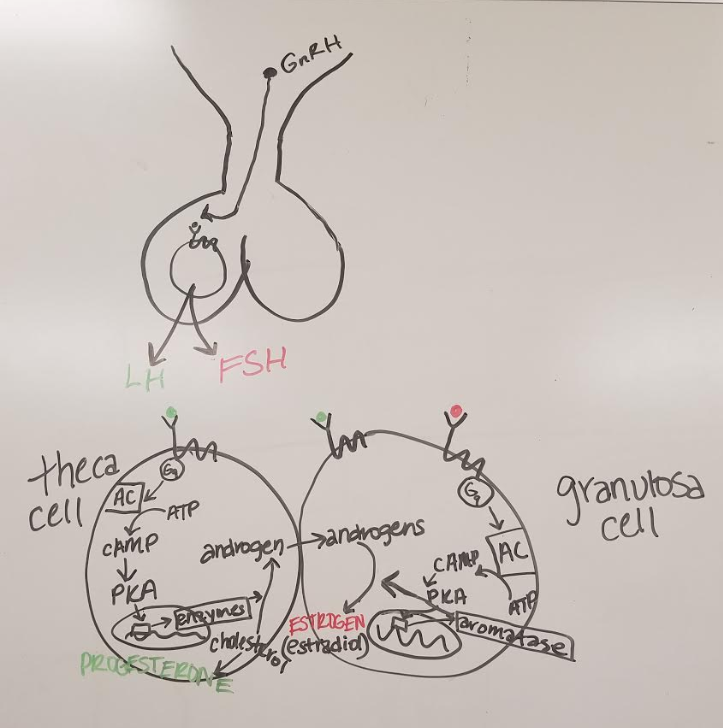
Theca cells: make androgens (to granulosa) and progestin
AND
Granulosa cells: make progestin and estrogen from aromatization of androgen. Will also make inhibins and activins to have feeback to anterior pituitary
Regulation of HPA
Hypothalamus: +/- from progestin and estrogen
Anterior pituitary: +/- from progestin and estrogen AND + from activin, - from inhibin (granulosa cell)
Ovary: + from estrogen and progestin
How are FSH and LH made?
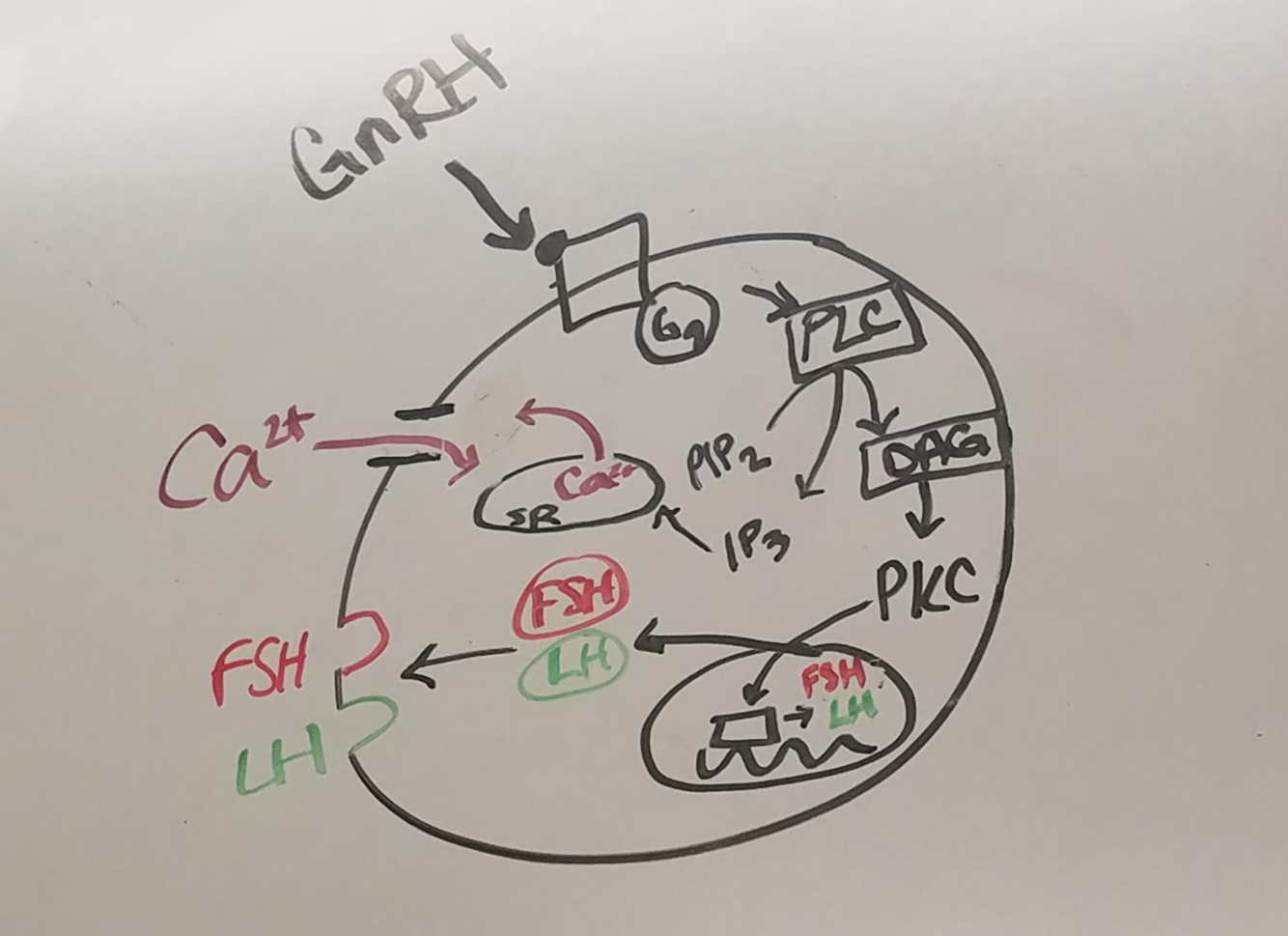
GnRH binds to g-protein coupled receptor, Alpha q subunit will activiate PLC causing Pip2 to differentiate into IP3 and DAG. DAG activates PKC, which will bind to transcription factor in nucleus and activates transcription of FSH and LH, they will be translated in ER and finished in golgi where they wait to be excreted. At same time IP3 will bind to SR which will release Ca into cytoplasm and then causes influx of extracellular Ca into cell, the increase in Ca intracellularly will cause the release of FSH and LH in vessicles through exocytosis
How are estrogen and progesterone made?
LH binds to theca cell on g-protein coupled receptor (GPCR). The Alpha-s subunit of GPCR activates adenyl cyclase, which will convert ATP to cAMP. cAMP will activate PKA which will bind to transcription factor of DNA in nucleus to transcribe enzymes. The enzymes will finish transcription, be translated in ER and finished in golgi. Finished enzymes will then be used to convert cholesterol into androgen and progesterone. Androgen will be sent to granulosa cell.
FSH will bind to g- protein coupled receptor (GPCR). The q subunit of GPCR activates adenyl cyclase, which will convert ATP to cAMP. cAMP will activate PKA which will bind to transcription factor of DNA in nucleus to transcribe aromatase. The aromatase will finish transcription, be translated in ER and finished in golgi. Finished aromatase will then be used to convert androgen into estrogen.
What are the steps of oogenesis
- oogonium through mitosis (2n-fetal stage) making primary oocyte which will start meosis I
- primary oocyte will arrest in prophase of meosis I; with increase in estrogen before first period primary oocyte will finish meosis I making secondary oocyte and polar body
- secondary oocyte will start meosis II and stall in mitosis, it is then released in ovulation and does not progress unless fertilized
- If fertilized then secondary oocyte will finish meosis II and form 2nd polar body
- If not fertilized secondary oocyte will not finish meosis II and instead will die off and be shed with endometrium
Phases in ovary
- Follicular (before ovulation) with rise in estrogen
- Luteal (after ovulation) with rise in progesterone
Phases in Endometrium
- menstruation
- proliferative (before ovulation) with estrogen
- secretory (after ovulation) with progesterone
What phase is constant?
Luteal (14 days) before menstration
Follicular phase can be incosistent
Phases of spermatogenesis
germinal cells divide into primary spermatocyte (2n), primary spermatocyte will go through meosis I which creates secondary spermatocytes (n), secondary spermatocyte then goes through meosis II creating spermatids (n), spermatids will then go through metamorphosis and form spermatozoa
-is constantly occurring after puberty is reached and there is no arrest in meotic phases




