What is a spectrogram?
The spectrogram is defined as the display of successive spectra
calculated from time intervals Ti = L Δt which are shorter than
the total time of the recordings T = N Δt such that Ti < T, L < N
The time interval Ti ?
- The time interval Ti used for the calculation of the spectrum is defined by a moving window.
- A moving window is defined by a fixed length window with a start time which increases for each calculation of a spectrum
- This increase is named time shift of the spectrogram and it is typically some fraction of the time interval Ti
The choice of window and time shift?
The choice for the window and the time shift used for the calculation of the spectrogram depends on the application
A typical spectrogram with a rectangular window of length Ti uses
a time shift of Ti , before shift:
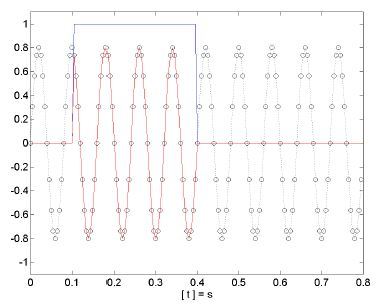
A typical spectrogram with a rectangular window of length Ti uses
a time shift of Ti , after shift:
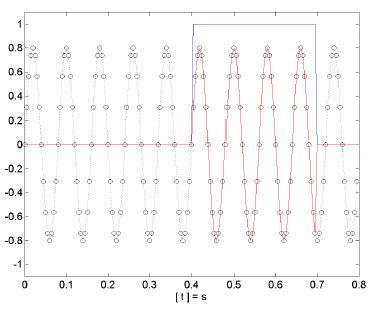
A typical spectrogram with a Hannning window of length Ti uses
a time shift of Ti/2 before shift
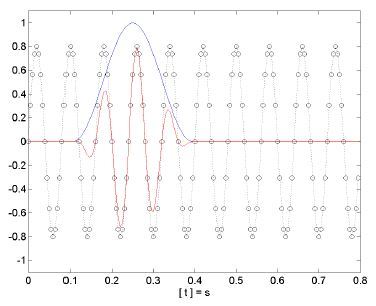
A typical spectrogram with a Hannning window of length Ti uses
a time shift of Ti/2 after shift
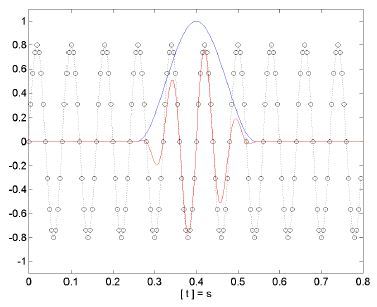
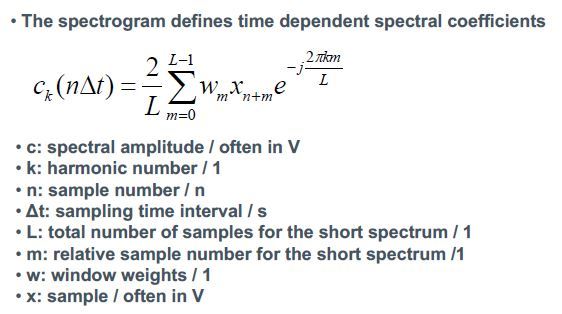
The equation for the spectrogram spectral coefficients?
The uncertainty principle?
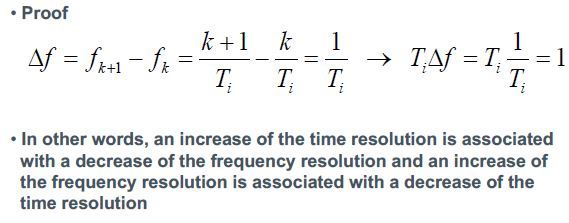
The uncertainty principle for the spectrogram states that the product of the time resolution Ti and the frequency resolution Δf is constant:
TiΔf = 1
Proof of the uncertainty principle?
What does a spectrogram display?
The spectrogram displays the temporal evolution of the spectral content of a signal
Dimensions of a spectrogram?
time and frequency
how are amplitudes displayed on a spectrogram?
- As a result, the spectral amplitudes are displayed in a third dimension, typically as a colour coded image or gray scale image
- On colour coded spectrograms, small spectral amplitudes are typically displayed in blue and large spectral amplitudes in red
- In gray scale coded spectrograms, small spectral amplitudes are typically displayed in black and large spectral amplitudes in white
The two fundamentally different pieces of information displayed by a spectrogram?
- signals which are localised in a narrow range of frequencies,
e. g., a whistle, or a radio carrier wave - signals which localised in a short time frame, e.g., a hand
clap, or a radio pulse
Uses of spectrogram?
The spectrogram is typically used to detect signals and to determine their time/frequency (or spectral) evolution
spectrogram successful detection?
For the successful detection of signals in the spectrogram, it is critically important to determine the necessary frequency resolution and the minimum length of the time interval Ti
Spectrogram and leakage?
- In addition, the possibility for leakage needs to be considered
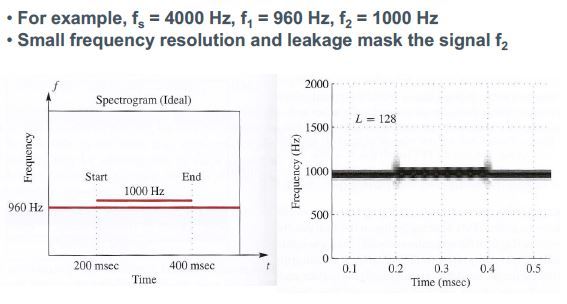
- Choosing the wrong frequency resolution can mask the signal of interest and result in wrong conclusions
spectrogram, low sample rate
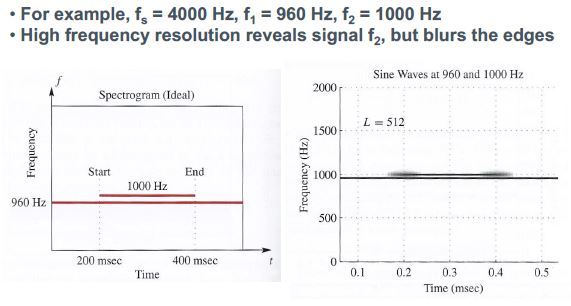
spectrogram, high sample rate

-
2 Assessing time varying signals11
-
3 Assessing Complex Sinusoids12
-
4 Assessing spectral coefficient7
-
5 Assessing Discrete Fourier Transform20
-
6 Assessing Aliasing24
-
7 Assessing Leakage12
-
8 Assessing Windowing18
-
9 Assessing Spectrograms19
-
Lec1 : Introduction to filters26
-
Lec2: FIR filtering17
-
Lec3: FIR filter responce5
-
Lec4; The Z transform5
-
Lec0: Useful Maths0
-
Lec5: The IIR filter24
-
Lec 6: Design Considerations28
-
Lec7: Practical Filters13



