Common diagnoses (by age) in a child who is limping or non-weight bearing
Toddler (1-4 years)
- Developmental dysplasia of the hip (DDH)
- Toddlers fracture
- Transient synovitis of the hip (Irritable hip)
- Child abuse
Child (4-10 years)
- Transient synovitis of the hip
- Perthes Disease
Adolescent (>10 years)
- Slipped upper femoral epiphysis (SUFE)
- Overuse syndromes / stress fractures
Common diagnoses in a child who is limping or non-weightbearing (any age group)
All ages:
- Infections: Osteomyelitis / Septic Arthritis, discitis, soft tissue, viral myositis
- Trauma (see Fractures)
- Non accidental or inflicted injury (see Child abuse guideline) - fracture, sprain, haematoma
- Malignancy - Acute lymphoblastic leukaemia, bone tumours, eg: spine or long bone
- Rheumatological disorders and reactive arthritis
- Intra-abdominal pathology, eg: appendicitis
- Inguinoscrotal disorders, eg: testicular torsion
- Vasculitis, serum sickness
- Functional limp
Important history questions in a child who is limping/non-weight bearing
- Duration of symptoms
- Complete refusal to weight bear
- Trauma - there is often a coincidental history of trauma in a non-traumatic condition or there may be no history of trauma and the child may have a significant injury.
- Preceding illness - there is often a history of a simple viral infection preceding a transient synovitis or reactive arthritis
- Fever or systemic symptoms - suggests infective or inflammatory causes
- Pain - site and severity. Pain on changing the nappy, causing back flexion, may be present in discitis
- Morning stiffness
- Previous injuries or child protection concerns
Things to examine in child who is limping/non-weight bearing
- General appearance, temp
- Gait - running may exaggerate a limp
- Neurological examination - look for ataxia, weakness
- Generalised lymphadenopathy (viral infection / haematological cause)
- Excessive bruising or bruising in unusual places (NAI, haematological)
- Abdomen, scrotum and inguinal area (masses)
- Bony tenderness
- All joints
- knee pain can be referred from the hip, and thigh pain can be referred from the spine
- Include sacro-iliac joints and spine in joint assessment - look for pain on flexion and/or midline tenderness which may be present in discitis
- Exaggerated lordosis (discitis)
- Hip abduction and internal rotation are often the most restricted movements in hip pathology
Investigations for child who is limping
Unless suspecting a specific diagnosis, investigations are usually not required in children with limp <3 days duration.
Discuss with senior staff, then consider:
- Bloods:
- FBE, CRP, ESR, blood culture
Imaging:
- plain films
- Further imaging should be discussed with senior staff:
PLAIN XRAY
- Perthes / SUFE
- Chronic osteomyelitis (bony changes only evident after 14 - 21 days)
- Tumours
- Developmental dysplasia of hips (> 6 months of age)
USS
- septic hip
Bone scan
- Osteomyelitis
- Discitis
- Perthes
- Occult fracture
CT/MRI
- Only after orthopaedic consultation
What is Perthes disease
Perthes disease
- Avascular necrosis of the capital femoral epiphysis.
- Age range 2-12 years (majority 4-8yrs)
- 20% bilateral
- Present with pain and limp
- Restricted hip motion on examination
What is Slipped Upper Femoral Epiphysis?
Slipped Upper Femoral Epiphysis
- Late childhood/early adolescence.
- Weight often > 90th centile.
- Presents with pain in hip or knee and associated limp.
- The hip appears externally rotated and shortened.
- There is decreased hip movement - especially internal rotation.
- May be bilateral.
When to consider outpatient rheumatology referral in a child with acutely swollen joint?
Consider outpatient referral to Rheumatology if:
- Symptoms for >4 weeks
- A significant joint effusion
- Significant limitation of activity
- Multiple joint involvement
- Evidence of joint contractures
- Vasculitis other than HSP
Outline approach to hsitory taking in a child with acutely swollen joint
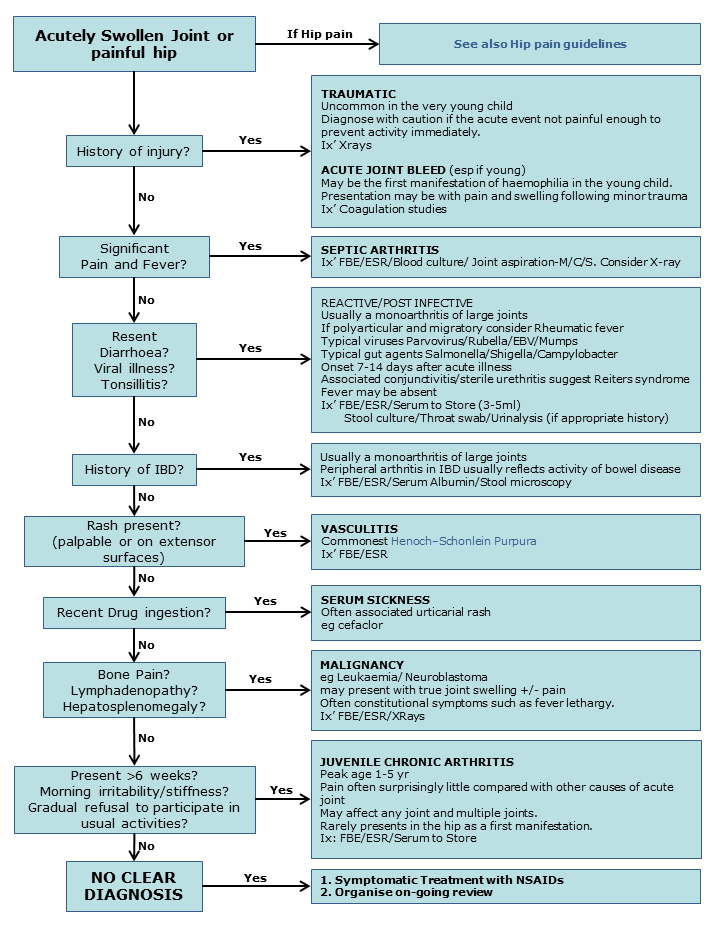
Outline the difference in presentation between septic arthritis and osteomyelitis
Septic arthritis
- Acute onset of limp / non-weight bearing / refusal to use limb
- Pain on movement and at rest
- Limited range / loss of movement
- Soft tissue redness / swelling often present
- Fever
Osteomyelitis
- Subacute onset of limp / non-weight bearing / refusal to use limb
- Localised pain and pain on movement
- Tenderness
- Soft tissue redness / swelling may not be present & may appear late
- +/- Fever
Common causative organisms of septic arthritis/osteomyelitis
Both are most commonly caused by
- Staphylococcus aureus
- can be caused by group A b -haemolytic streptococci and Haemophilus influenzae
- Children with sickle cell anaemia are prone to infection by salmonellae.
Management of osteomyelitis/septic arthritis
Management
- Refer to Orthopaedics if osteomyelitis/septic arthritis suspected or confirmed
- Septic arthritis requires urgent aspiration +/- arthrotomy and washout* Flucloxacillin 50mg/kg (max 2g) 6 hourly IV
- Elevate and immobilise limb
Investigations for osteomyelitis/septic arthritis
- FBC
- ESR (may be useful for monitoring progress)
- blood culture
- xray (often normal, but may exclude trauma, etc)
- Bone Scan.
What is juvenile idiopathic arthritis? What are the classifications?
- a group of conditions that present in childhood with joint inflammation lasting 6 weeks for which no other cause is found
- Up to 1 in 1000 children may be affected during childhood
- classification depends on the presentation, but may not be reliably assigned for 6 months
- Treatment = aimed at treating the pain and inflammation and maintaining good joint mobility
- In the majority there is resolution during childhood
- A multidisciplinary approach is needed
CLASSIFICATIONS
- Systemic (Still’s disease): 9%
- Polyarticular: 19%
- Pauciarticular ( ≤4 joints): 49%
- Spondyloarthropathies (HLA B27): 7%
- Juvenile psoriatic arthritis: 7%
- Other
Outline the presentation, features, and prognosis of Still’s disease
Presentation
• Spiking fever, severe malaise
• Salmon-pink rash
• Anaemia, weight loss
• Hepatosplenomegaly, pericarditis
• Arthralgia and myalgia but may have minimal joint
symptoms
• May resemble malignancy
Features
• Both large and small joints affected
• 25% have severe arthritis
• Rheumatoid factor negative
• Associated with HLA-DR4
Prognosis
• In 25%, arthritis persists into adulthood
• Long term prognosis improved with introduction of
biological therapies
Outline the presentation, features, and prognosis of polyarticular arthritis in children
Polyarticular = >4 joints
Presentation
• Symmetrical involvement of large and small joints
• There may be poor weight gain and mild anaemia
• Morning stiffness
• Irritability in young children
Features and prognosis
• Rheumatoid factor negative in 97%, ANA may be positive
• Low risk of eye involvement
• 12% develop severe arthritis but prognosis is generally good
Polyarticular (more than four joints)
• Temporomandibular joint may be involved, causing
micrognathia
Outline the presentation, features, and prognosis of Pauciarticular arthritis in children
Pauciarticular = <4 joints
Presentation
• Most common form of JIA
• Usually affects large joints (knees, ankles, elbows)
• Commonly affects girls under the age of 4 years
• Minimal systemic symptoms
Features and prognosis
• Rheumatoid factor negative, antinuclear antibody
(ANA) may be positive
• High risk of chronic uveitis (inflammation of
anterior eye structures), especially if ANA +ve.
Needs regular slit-lamp examination to screen
for this
• Arthritis resolves completely in 80%
What is Developmental dysplasia of the hip (DDH)?
- abnormal development of the hip joint
- The ball at the top of the thighbone (called the femoral head) is not stable within the socket (called the acetabulum)
- The ligaments of the hip joint which hold it all together may also be stretched and loos
- Sometimes, the hips dislocate after birth and this may not be noticed until your child starts to walk.
Signs + symptoms of DDH?
Signs and symptoms
- a stiff hip joint
- the legs are different lengths
- your child may lean to the affected side when standing
- your child’s leg may turn outward on the affected side
- the skin folds may be uneven on their bottom
What causes DDH?
- Pregnant women secrete hormones in their bloodstream which allows their ligaments to relax
- These hormones help the delivery of the baby through the mother’s pelvis
- Some of these hormones enter the baby’s blood and can make the baby’s ligaments relaxed as well
- This can make the hip joint loose in the socket
- The way the baby lies in the uterus can also cause the hip joint to become loose or dislocate.
- DDH is more common in girls, firstborn children, babies born in the breech position (i.e. bottom first) and in families where a parent has had a dislocated hip joint. DDH can be in one or both hip joints.
What is the treatment for DDH?
- splints
- holds the hip joint in the correct position so that the ligaments tighten
- child may need to wear the splint for several months, until the hip is stable or X-rays are normal
- 1 commonly used splint is called a ‘Pavlik Harness’.
- closed reduction procedure
- The hip joint is moved into the correct position while child is under anaesthetic
- Children then need to wear a ‘hip spica’ plaster
- open reduction surgery
- The hip joint is moved into the correct position while child is under anaesthetic
- The hip joint is made more stable by surgery to the surrounding tendons. This is done through a small cut in the groin.
- Children then need to wear a ‘hip spica’
- hip spicas
- a plaster cast that covers your child’s body from the knees to the waist
- may need to be worn for a number of months
- Children may then need to wear different splints or braces to make sure the hip joint remains stable and in the right position.
- osteotomy
- when DDH is diagnosed late, more surgery to the thigh or pelvic bones may need to be done to make sure the hip joint stays in place
Risk factors for developmental dysplasia of the hip
- First born
- Female
- Breech
- FmHx

-
Asthma36
-
Obesity16
-
Puberty6
-
Failure to thrive18
-
Febrile convulsion8
-
Bronchiolitis16
-
Febrile child11
-
Jaundice15
-
Croup9
-
Child with breathing difficulties0
-
Irritable infant13
-
Child with heart murmur16
-
Child with pallor0
-
6 week check0
-
Child with abdo pain0
-
Child with vomiting/diarrhoea0
-
Child with abdo/groin swelling0
-
ALOC0
-
Headache14
-
Toxin ingestion0
-
Rash0
-
Epilepsy11
-
Abnormal gait22
-
Sore joints10
-
Generalised swelling9
-
Cerebral palsy0
-
Development14
-
NPS medication2
-
NAI1



