How do we ensure that there is a BCR and/or TCR that can recognise every antigen?
The diversity of both the B and T cell repertoires is primarily produced by a process called somatic recombination or V (D) J recombination.
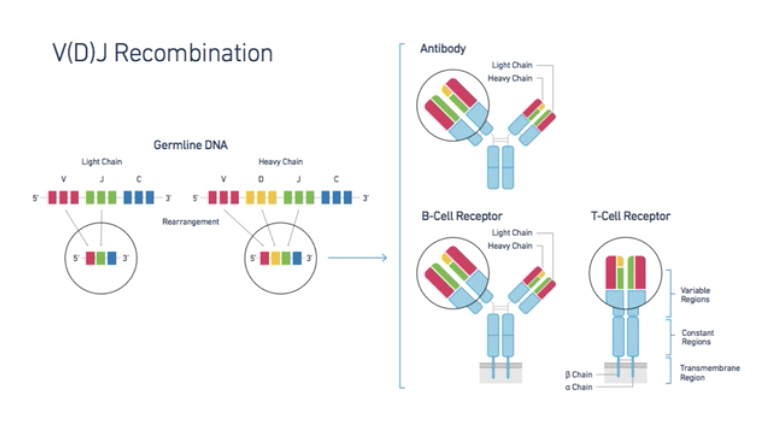
The primary mechanism for generating immune cell diversity is through the process of …
The primary mechanism for generating immune cell diversity is through the process of VDJ recombination - this is the genetic recombination of a variable region with a diversity region and a joining region. This process occurs in both B cells (immunoglobulin gene) and T cells (T cell receptor gene) and generates a vast array of different B cell receptors and T cell receptors. The key enzymes responsible for this process are the recombination-activating genes, RAG-1 and RAG-2
VDJ recombination is the genetic recombination of a variable region with a … region and a … region. This process occurs in both B cells (immunoglobulin gene) and T cells (T cell receptor gene) and generates a vast array of different B cell receptors and T cell receptors. The key enzymes responsible for this process are the recombination-activating genes, RAG-1 and RAG-2
VDJ recombination is the genetic recombination of a variable region with a diversity region and a joining region. This process occurs in both B cells (immunoglobulin gene) and T cells (T cell receptor gene) and generates a vast array of different B cell receptors and T cell receptors. The key enzymes responsible for this process are the recombination-activating genes, RAG-1 and RAG-2
VDJ recombination is the genetic recombination of a variable region with a diversity region and a joining region. This process occurs in both B cells (… gene) and T cells (… … … gene) and generates a vast array of different B cell receptors and T cell receptors. The key enzymes responsible for this process are the recombination-activating genes, RAG-1 and RAG-2
VDJ recombination is the genetic recombination of a variable region with a diversity region and a joining region. This process occurs in both B cells (immunoglobulin gene) and T cells (T cell receptor gene) and generates a vast array of different B cell receptors and T cell receptors. The key enzymes responsible for this process are the recombination-activating genes, RAG-1 and RAG-2
VDJ recombination is the genetic recombination of a variable region with a diversity region and a joining region. This process occurs in both B cells (immunoglobulin gene) and T cells (T cell receptor gene) and generates a vast array of different B cell receptors and T cell receptors. The key enzymes responsible for this process are the recombination-activating genes, …-1 and …-2
VDJ recombination is the genetic recombination of a variable region with a diversity region and a joining region. This process occurs in both B cells (immunoglobulin gene) and T cells (T cell receptor gene) and generates a vast array of different B cell receptors and T cell receptors. The key enzymes responsible for this process are the recombination-activating genes, RAG-1 and RAG-2
BCR germline sequences
- In B cells, V(D)J recombination takes place in the immunoglobin heavy chain gene (found on chromosome …) and kappa or lambda light chain genes found on chromosome … and … respectively
- The D in V(D)J is always in brackets because only the heavy chain gene contains diversity segments and so the light chain only undergoes VJ recombination.
- These recombination events can result in a vast array of new immunoglobulin genes. In B cells there are approximately 100 trillion possible combinations
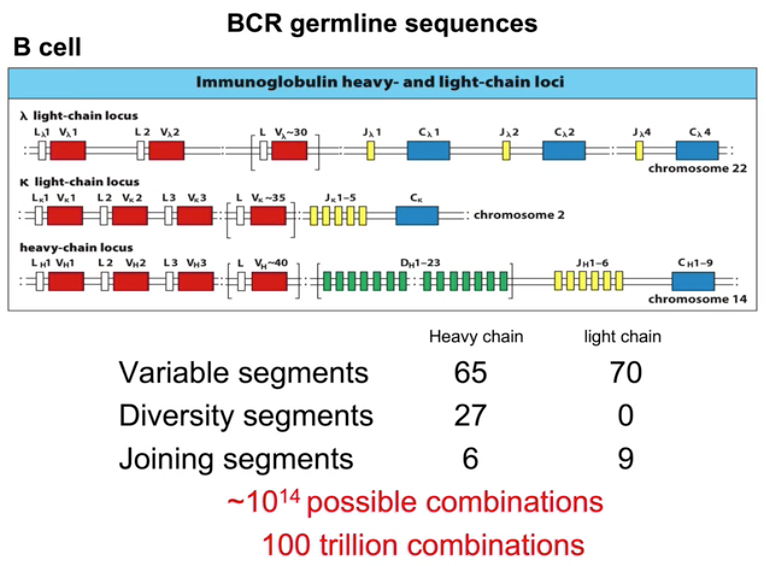
- In B cells, V(D)J recombination takes place in the immunoglobin heavy chain gene (found on chromosome 14) and kappa or lambda light chain genes found on chromosome 2 and 22 respectively
- The D in V(D)J is always in brackets because only the heavy chain gene contains diversity segments and so the light chain only undergoes VJ recombination.
- These recombination events can result in a vast array of new immunoglobulin genes. In B cells there are approximately 100 trillion possible combinations
In B cells, V(D)J recombination takes place in the … heavy chain gene (found on chromosome 14) and kappa or lambda … chain genes found on chromosome 2 and 22 respectively
In B cells, V(D)J recombination takes place in the immunoglobin heavy chain gene (found on chromosome 14) and kappa or lambda light chain genes found on chromosome 2 and 22 respectively
The D in V(D)J is always in brackets because only the … chain gene contains diversity segments and so the … chain only undergoes VJ recombination.
The D in V(D)J is always in brackets because only the heavy chain gene contains diversity segments and so the light chain only undergoes VJ recombination.
Recombination events can result in a vast array of new immunoglobulin genes. In B cells there are approximately … trillion possible combinations
Recombination events can result in a vast array of new immunoglobulin genes. In B cells there are approximately 100 trillion possible combinations
TCR germline sequences
- V(D)J recombination takes place in the alpha chain gene (found on chromosome ….) and the beta chain gene found on chromosome … Like B cell immunoglobulin light chains, the alpha chain does not contain diversity segments and so only undergoes VJ recombination.
- V(D)J recombination in T cells can theoretically produce even more diversity than B cells – approximately a million trillion combinations!
- The probable reasons for this are two-fold:
- New B cells are being born every day whereas the T cell pool is pretty much fixed from late adolescence due to thymic involution.
- B cells can induce further diversity due to somatic hypermutation – T cells do not undergo this process.
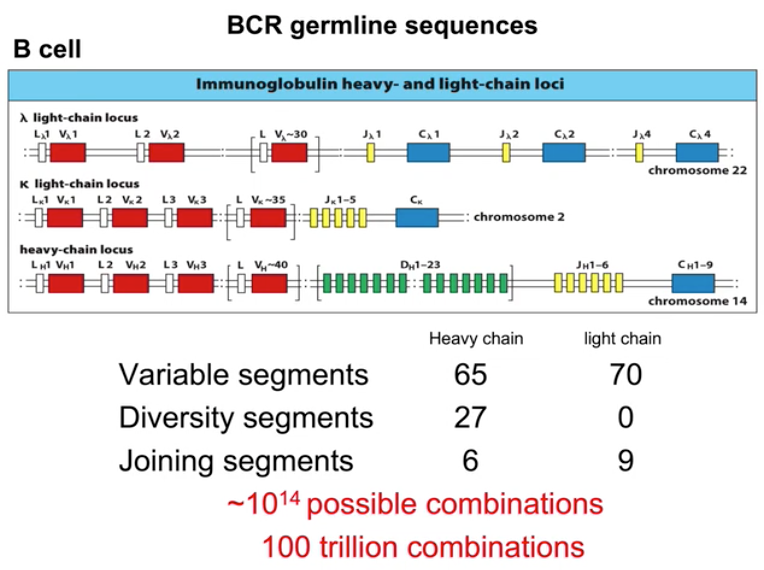
- V(D)J recombination takes place in the alpha chain gene (found on chromosome 14) and the beta chain gene found on chromosome 7. Like B cell immunoglobulin light chains, the alpha chain does not contain diversity segments and so only undergoes VJ recombination.
- V(D)J recombination in T cells can theoretically produce even more diversity than B cells – approximately a million trillion combinations!
- The probable reasons for this are two-fold:
- New B cells are being born every day whereas the T cell pool is pretty much fixed from late adolescence due to thymic involution.
- B cells can induce further diversity due to somatic hypermutation – T cells do not undergo this process.
TCR germline sequences
- V(D)J recombination takes place in the … chain gene (found on chromosome 14) and the … chain gene found on chromosome 7. Like B cell immunoglobulin light chains, the … chain does not contain diversity segments and so only undergoes VJ recombination.
- V(D)J recombination in T cells can theoretically produce even more diversity than B cells – approximately a million trillion combinations!
- The probable reasons for this are two-fold:
- New B cells are being born every day whereas the T cell pool is pretty much fixed from late adolescence due to thymic involution.
- B cells can induce further diversity due to somatic hypermutation – T cells do not undergo this process.
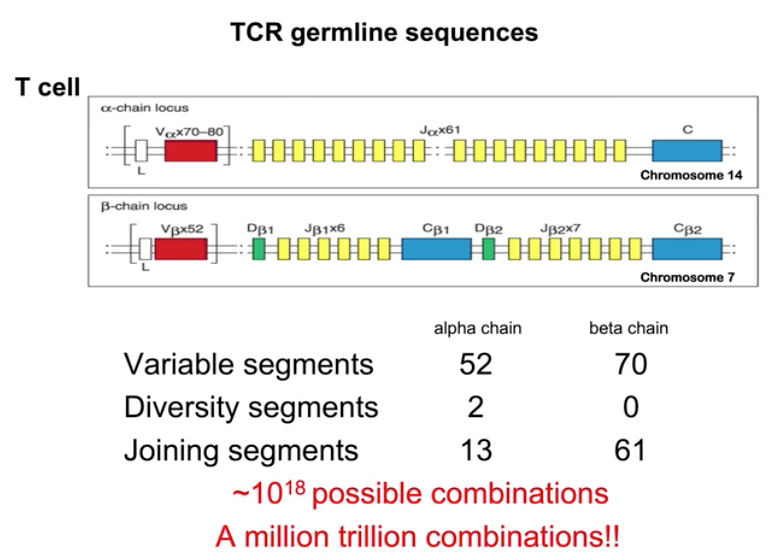
- V(D)J recombination takes place in the alpha chain gene (found on chromosome 14) and the beta chain gene found on chromosome 7. Like B cell immunoglobulin light chains, the alpha chain does not contain diversity segments and so only undergoes VJ recombination.
- V(D)J recombination in T cells can theoretically produce even more diversity than B cells – approximately a million trillion combinations!
- The probable reasons for this are two-fold:
- New B cells are being born every day whereas the T cell pool is pretty much fixed from late adolescence due to thymic involution.
- B cells can induce further diversity due to somatic hypermutation – T cells do not undergo this process.
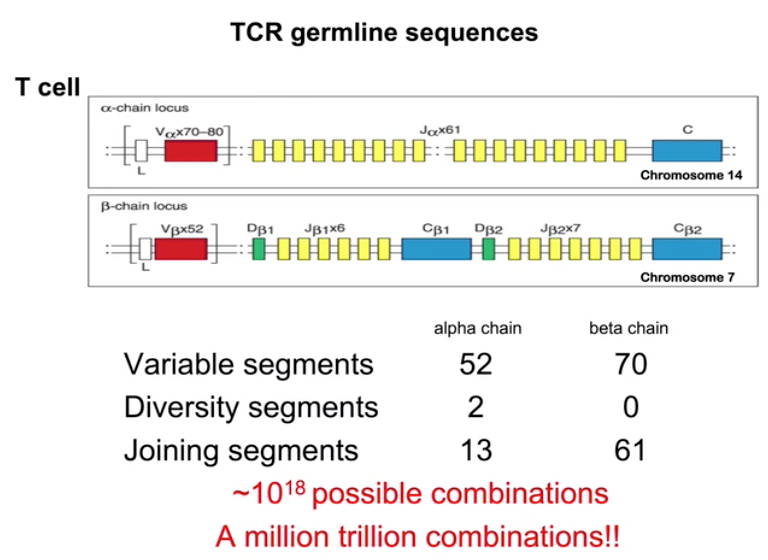
V(D)J recombination in T cells can theoretically produce even more diversity than B cells – approximately a million trillion combinations! Why is this?
- The probable reasons for this are two-fold:
- New B cells are being born every day whereas the T cell pool is pretty much fixed from late adolescence due to thymic involution.
- B cells can induce further diversity due to somatic hypermutation – T cells do not undergo this process.
- V(D)J recombination in T cells can theoretically produce even more diversity than B cells – approximately a million trillion combinations! Why is this?
- The probable reasons for this are two-fold: 1) New B cells are being born every day whereas the T cell pool is pretty much fixed from late … due to … involution. 2) B cells can induce further diversity due to … … – T cells do not undergo this process.
- V(D)J recombination in T cells can theoretically produce even more diversity than B cells – approximately a million trillion combinations! Why is this?
- The probable reasons for this are two-fold: 1) New B cells are being born every day whereas the T cell pool is pretty much fixed from late adolescence due to thymic involution. 2) B cells can induce further diversity due to somatic hypermutation – T cells do not undergo this process.
Like B cell immunoglobulin light chains, the … chain does not contain diversity segments and so only undergoes VJ recombination (In T cells)
Like B cell immunoglobulin light chains, the alpha chain does not contain diversity segments and so only undergoes VJ recombination. (In T cells)
New gene sequences are produced through V(D)J recombination
- During the pro B (and pro T) cell phase of development, the cells undergo … recombination. In the case of B cells this occurs in the Immunoglobin Heavy chain gene and in T cells this occurs in the beta chain gene. Subsequently, these respective genes recombine their new … segments with a new … segment. Finally, the light chain genes undergo … recombination.
- These new pieces of genetic code are then transcribed into mRNA and then translated into proteins. Assembly of the IgH chain and one of the light chains (either kappa or lambda) results in the formation of membrane bound immunoglobulin IgM (and IgD) that are expressed on the surface of immature B cells.
- During the pro B (and pro T) cell phase of development, the cells undergo DJ recombination. In the case of B cells this occurs in the Immunoglobin Heavy chain gene and in T cells this occurs in the beta chain gene. Subsequently, these respective genes recombine their new DJ segments with a new V segment. Finally, the light chain genes undergo VJ recombination.
- These new pieces of genetic code are then transcribed into mRNA and then translated into proteins. Assembly of the IgH chain and one of the light chains (either kappa or lambda) results in the formation of membrane bound immunoglobulin IgM (and IgD) that are expressed on the surface of immature B cells.
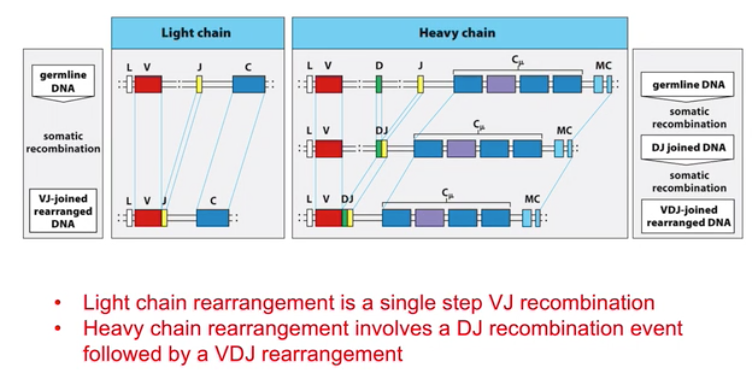
New gene sequences are produced through V(D)J recombination
- During the … B (and … T) cell phase of development, the cells undergo DJ recombination. In the case of B cells this occurs in the … gene and in T cells this occurs in the … chain gene. Subsequently, these respective genes recombine their new DJ segments with a new V segment. Finally, the light chain genes undergo VJ recombination.
- These new pieces of genetic code are then transcribed into mRNA and then translated into proteins. Assembly of the IgH chain and one of the light chains (either kappa or lambda) results in the formation of membrane bound immunoglobulin IgM (and IgD) that are expressed on the surface of immature B cells.
- During the pro B (and pro T) cell phase of development, the cells undergo DJ recombination. In the case of B cells this occurs in the IgH gene and in T cells this occurs in the beta chain gene. Subsequently, these respective genes recombine their new DJ segments with a new V segment. Finally, the light chain genes undergo VJ recombination.
- These new pieces of genetic code are then transcribed into mRNA and then translated into proteins. Assembly of the IgH chain and one of the light chains (either kappa or lambda) results in the formation of membrane bound immunoglobulin IgM (and IgD) that are expressed on the surface of immature B cells.
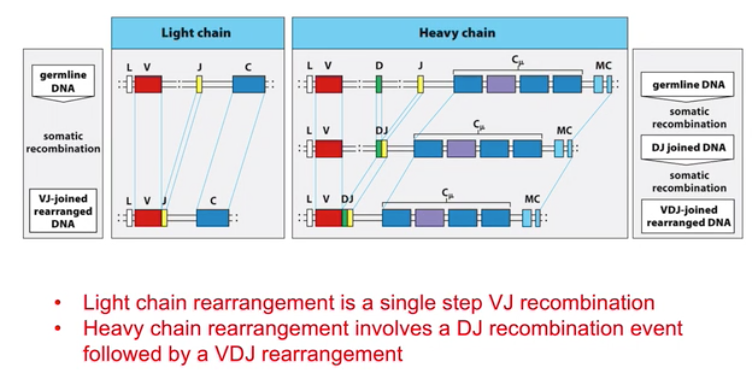
… chain rearrangement is a single step VJ recombination
Light chain rearrangement is a single step VJ recombination
… chain rearrangement involves a DJ recombination event followed by a VDJ rearrangement
Heavy chain rearrangement involves a DJ recombination event followed by a VDJ rearrangement
How Does Rearrangement Occur?
- Rearrangement occurs between specific sites on the DNA called … … … (RSSs)
- These sequences contain conserved segments of DNA composed of a heptamer, a spacer and a nonomer
- They are found on the 3’ side of V segments, the 5’ side of J segments and both the 3’ and 5’ side of D segments
- Rearrangement is catalysed by two Recombination Activating Genes: RAG-1 and RAG-2
- Rearrangement occurs between specific sites on the DNA called Recombination Signal Sequences (RSSs)
- These sequences contain conserved segments of DNA composed of a heptamer, a spacer and a nonomer
- They are found on the 3’ side of V segments, the 5’ side of J segments and both the 3’ and 5’ side of D segments
- Rearrangement is catalysed by two Recombination Activating Genes: RAG-1 and RAG-2
How Does Rearrangement Occur?
- Rearrangement occurs between specific sites on the DNA called Recombination Signal Sequences (RSSs)
- These sequences contain conserved segments of DNA composed of a …, a spacer and a …
- They are found on the 3’ side of V segments, the 5’ side of J segments and both the 3’ and 5’ side of D segments
- Rearrangement is catalysed by two Recombination Activating Genes: RAG-1 and RAG-2
- Rearrangement occurs between specific sites on the DNA called Recombination Signal Sequences (RSSs)
- These sequences contain conserved segments of DNA composed of a heptamer, a spacer and a nonomer
- They are found on the 3’ side of V segments, the 5’ side of J segments and both the 3’ and 5’ side of D segments
- Rearrangement is catalysed by two Recombination Activating Genes: RAG-1 and RAG-2
How Does Rearrangement Occur?
- Rearrangement occurs between specific sites on the DNA called Recombination Signal Sequences (RSSs)
- These sequences contain conserved segments of DNA composed of a heptamer, a spacer and a nonomer
- They are found on the 3’ side of … segments, the 5’ side of … segments and both the 3’ and 5’ side of … segments
- Rearrangement is catalysed by two Recombination Activating Genes: RAG-1 and RAG-2
- Rearrangement occurs between specific sites on the DNA called Recombination Signal Sequences (RSSs)
- These sequences contain conserved segments of DNA composed of a heptamer, a spacer and a nonomer
- They are found on the 3’ side of V segments, the 5’ side of J segments and both the 3’ and 5’ side of D segments
- Rearrangement is catalysed by two Recombination Activating Genes: RAG-1 and RAG-2
How Does Rearrangement Occur?
- Rearrangement occurs between specific sites on the DNA called Recombination Signal Sequences (RSSs)
- These sequences contain conserved segments of DNA composed of a heptamer, a spacer and a nonomer
- They are found on the 3’ side of V segments, the 5’ side of J segments and both the 3’ and 5’ side of D segments
- Rearrangement is catalysed by two Recombination Activating Genes: … and …
- Rearrangement occurs between specific sites on the DNA called Recombination Signal Sequences (RSSs)
- These sequences contain conserved segments of DNA composed of a heptamer, a spacer and a nonomer
- They are found on the 3’ side of V segments, the 5’ side of J segments and both the 3’ and 5’ side of D segments
- Rearrangement is catalysed by two Recombination Activating Genes: RAG-1 and RAG-2
The … encode enzymes that play an important role in the rearrangement and recombination of the genes of immunoglobulin and T cell receptor molecules during the process of VDJ recombination
The RAGs encode enzymes that play an important role in the rearrangement and recombination of the genes of immunoglobulin and T cell receptor molecules during the process of VDJ recombination
Steps in V(D)J Joining
- Rearrangement begins with the binding of the …-1:…-2 complexes to the recombination signal sequences or RSSs which flank the coding sequences to be joined.
- The … complex is then activated to cut one strand of the double-stranded DNA precisely at the end of the heptamer sequences. The 5′ cut end of this DNA strand then reacts with the complementary uncut strand, breaking it to leave a double-stranded break at the end of the heptamer sequence, and forming a hairpin by joining to the cut end of its complementary strand on the other side of the break.
- Subsequently, through the action of additional proteins such as Ku70:Ku80 that join the complex, the DNA hairpin is cleaved at a random site to yield a single-stranded DNA end.
- This end is then modified by the action of TdT (indicated in pink), which creates diverse, imprecise ends.
- Finally, the two heptamer sequences, which are not modified, are ligated to form the precise signal joint, while the coding joint is also ligated, both by the action of DNA ligase IV.
- Rearrangement begins with the binding of the RAG-1:RAG-2 complexes to the recombination signal sequences or RSSs which flank the coding sequences to be joined.
- The RAG complex is then activated to cut one strand of the double-stranded DNA precisely at the end of the heptamer sequences. The 5′ cut end of this DNA strand then reacts with the complementary uncut strand, breaking it to leave a double-stranded break at the end of the heptamer sequence, and forming a hairpin by joining to the cut end of its complementary strand on the other side of the break.
- Subsequently, through the action of additional proteins such as Ku70:Ku80 that join the complex, the DNA hairpin is cleaved at a random site to yield a single-stranded DNA end.
- This end is then modified by the action of TdT (indicated in pink), which creates diverse, imprecise ends.
- Finally, the two heptamer sequences, which are not modified, are ligated to form the precise signal joint, while the coding joint is also ligated, both by the action of DNA ligase IV.



-
An Overview of Immunology84
-
Innate Immune Defences & Inflammation 1160
-
Innate Immune Defences & Inflammation 2: The Induced Response183
-
Adaptive Immunity 199
-
Adaptive Immunity 256
-
Adaptive Immunity 349
-
Mechanisms of Tolerance108
-
Vaccines115
-
Regulating Immunological Responses: Role of Cytokines and Chemokines87
-
Overview and Classification of Immunological Diseases64
-
Mucosal Immunology 153
-
Mucosal Immunology 256
-
Autoimmune Diseases 163
-
Autoimmune Diseases 281
-
Pharmacological Aspects of Immunology 1127
-
Pharmacological Aspects of Immunology 2 : Biological Therapies97
-
Causation & Study Design: HIV & AIDS68
-
Randomised Control Trials: Vaccines85
-
Psychoneuroimmunology93
-
Introduction to Transplantation Immunology68
-
Immunodeficiency Diseases46
-
The Immunology of COVID-1972
-
Allergy58
-
The Hierarchy of Evidence38
-
Introduction to the Endocrine System96
-
The Nuts and Bolts of the Endocrine System: Anatomy and Histology Roadshow152
-
Thyroid Hormone Physiology49
-
Thyroid disease: Hyper, Hypo and other74
-
Adrenal Cortex - Hormones, Physiology57
-
Introduction to the Hypothalamic-Pituitary Axis80
-
Hypothalamic-pituitary-adrenal axis: clinical aspects45
-
Adrenal Causes of Hypertension45
-
Lactation, Galactorrhoea, Prolactinomas43
-
Physiology of Thirst and Fluid Balance and it's Disorders41
-
Calcium Homeostasis, Hyper and Hypocalcaemia51
-
Endocrine Aspects of Male Hypogonadism52
-
Transgender Healthcare and Hormone Therapy16
-
Physiology of Appetite and Weight58
-
Effects of Age and Diet on Endocrine Function50
-
Type 2 Diabetes Mellitus55
-
Drug Treatment of Type 2 Diabetes45
-
Type 1 Diabetes Mellitus39
-
Acute Complications of Diabetes30
-
Long Term Complications of Diabetes49
-
Psycho-sexual Dysfunction in Men and Women with Diabetes12
-
Hormonal Drug Delivery51
-
Thinking about Populations over time: Incidence and Cohort Studies31
-
Diagnostic Biochemistry of Calcium and Bone Disorders36
-
Diagnostic Biochemistry of Endocrine disorders44
-
Anterior Pituitary Disorders: Acromegaly and Hypopituitarism47
-
Morphological Plan of the Upper Limb154
-
Nerve and Blood Supply to the Upper Limb134
-
Anatomy of the Shoulder Region88
-
Introduction to Surgery of the Shoulder45
-
Anatomy of the Forearm123
-
Anatomy of the Hand119
-
Upper Limb Nerve Injuries107
-
Introduction to Surgery of the Hand71
-
Morphological Plan of the Lower Limb205
-
Anatomy of the Knee132
-
Anatomy of the Leg and Foot112
-
Introduction to Surgery of the Foot and Ankle96
-
Gait36
-
Lower Limb Nerve Injuries118
-
Face, Temporal and Infratemporal Fossa33
-
Neck and Oral Cavity43
-
Orbit and Nasal Cavity40
-
Structure and Function of the Spinal Cord64
-
Motor Learning and Neurological Syndromes57
-
The Cerebellum and Motor Learning39
-
Autonomic Nervous System62
-
Physiology of Pain70
-
Anatomy and Function of the Basal Ganglia37
-
Physiology of Vision43
-
Physiology of Hearing58
-
Physiology of Balance, Taste and Smell43
-
Physiology of Pain 249
-
Neurobiology and Neurochemistry of Reward and Addictive Behaviours54
-
Psychobiology of Emotion144
-
Schizophrenia: Clinical Aspects73
-
Schizophrenia: Neurobiology and Treatment42
-
Affective Disorders Clinical Aspects46
-
Affective Disorders: Neurobiology and Treatment73
-
Anxiety Disorders: Clinical Picture66
-
Anxiety Disorders: Neurobiology, Neurochemistry and Treatment46
-
Pathology of the Female Reproductive Tract 141
-
Pathology of the Female Reproductive Tract 245
-
Pathology of the Female Reproductive Tract 354
-
Talking about Gender27
-
Ovarian Cysts - Benign and Malignant Cysts41
-
Collecting Data about people and Comparing the Health of Groups - Ovarian Cancer28
-
The Cervix in Health and Disease68
-
Sexual Health59
-
Pathology of the Testis111
-
Sexually Transmitted Diseases79
-
Developmental Origins of Disease - Symposia Part 119
-
Why Subtle Gene Changes Mean Every Child is Different - Symposia Part 211
-
Defining the Pelvic Region28
-
Defining the Reproductive Tracts44
-
Imaging of the Pelvis Angiography/Ultrasound/MRI34
-
Sexual Differentiation: How to Make a Boy or a Girl40
-
Disorders of Ovulation46
-
Physiology of Puberty35
-
Male and Female Reproductive Endocrinology16
-
Fertility Control15
-
Thinking about Populations at a moment in time: Prevalence and Cross-Sectional studies: Infertility41
-
Causes and Treatments of Subfertility46
-
The Short but Happy Life of a Sperm28
-
Sperm-Racing15
-
Assisted Reproduction: Social and Ethical Issues18
-
Pregnancy and Birth24
-
Prenatal Screening47
-
Physiology Of Pregnancy38
-
The Ethics of Screening29
-
Placenta and Intra-Uterine Growth Restriction58
-
Multiple Pregnancies38
-
Pregnancy and Diabetes39
-
Congenital Abnormalities and Teratology48
-
Congenital Heart Disease Symposium33
-
The Loss of a Baby54
-
The Moral Status of the Embryo24
-
Gynae and the law/women's rights - Female Genital Mutilation & Termination of Pregnancy33
-
Congenital Lesions of the Face and Neck26
-
Children with Renal Abnormalities35
-
Defining the Pelvic Region COPY28
-
Defining the Reproductive Tracts COPY44
-
Imaging of the Pelvis Angiography/Ultrasound/MRI COPY34
-
Disorders of Ovulation COPY46
-
Sexual Differentiation: How to Make a Boy or a Girl COPY40
-
Physiology of Puberty COPY35
-
Fertility Control COPY15
-
Thinking about Populations at a moment in time: Prevalence and Cross-Sectional studies: Infertility COPY41
-
Causes and Treatments of Subfertility COPY46
-
Physiology of Skeletal Muscle Contraction122
-
Pathophysiology of Skeletal Muscle126
-
Physiology of Bone Formation and Repair122
-
Principles of Articulation121
-
Multi-system Autoimmune Disease113
-
Clinical Biochemistry; Musculoskeletal System105
-
Principles of Fracture Management33
-
Introduction to Diseases of the Musculoskeletal System116
-
Synaptic Transmission16
-
Skull and Cranial Cavity85
-
Topography of the Brain118
-
Neural Tissues65
-
Physiology of Neurons54
-
Chemicals in the Brain58
-
Chemistry and Physiology of the Synapse47
-
Global Brain Activity30
-
Basal Principles of Memory27
-
How Drugs Control the Brain58
-
Neuropsychology of Memory31
-
Ventricular System55
-
Consciousness2
-
Dementia: Neuropathology & Clinical Aspects36
-
Neuropathology42
-
Physiology of the Spinal Cord9
-
Synaptic Plasticity in Learning and Memory40
-
Anaesthetic Drugs32
-
Use of Blood Chemistry for Diagnosis of Neurological Disease63
-
Dementia - The Grand 21st Century Challenge30
-
Analgesics, Anaesthetic and Sedative Drugs30



