what is an amyloid deposit?
Any histological tissue specimen that:
- binds the cotton wool dye, Congo red
- demonstrates green birefringence (under polarised light)
How is amyloidosis classified?
- acquired / inherited
- local / systemic
- named after the precursor plasma protein (20<)
How do amyloid proteins tend to deposit? (process)
Process: locally (one organ) or systemically (>1 organ)
What are the consequences of amyloid deposition?
progressive amyloid deposition in particular organ (extracellular space)
–> insoluble abnormal fibrils deposited (beta pleated sheets)
–> fibrils are resistant to proteolysis
–> disrupts function of the organ
–> dysfunction
What the most common types of amyloidosis?
AL = light
- i.e. ~primary; lots of excess abnormal protein
AA = serum amyloid A
- i.e. ~secondary; small proportiong of seruma amyloid A –> misfold
When does [serum amyloid A protein] increase?
Acute phase protein, hence during inflammation
e.g rhematoid arthritis, IBD, cancers, famililal meditarrean fever
What are the risk factors for amyloidosis?
- monoclonal gammopathy of undetermined significance (MGUS)
- inflammatory polyarthropathy
- incl. rheumatoid arthritis, juvenile arthritis, psoriatic arthritis, and ankylosing spondylitis.
- chronic infections
- IBD
- familial periodic fever syndromes
- e.g. familial Mediterranean fever
- TNFr-associated periodic fever syndromes
Summarise the epidemiology of amyloidosis
- males > females
- black > (due to increased incidence of multiple myeloma + MGUS)
- incidence of AA is falling, only = 3% of systemic amyoidosis
What are the presenting symptoms of amyloidosis?
clinical features depend on organ involved.
commonly:
- GI: Weight loss, steatorrhoea, faecal incontinence (alternating w 4 days constipation)
- CNS: paraesthesias, neuropathies, orthostatic hypotension
- lung: dyspnoea
- upper GI: pseudo-obstructive : nausea, vomiting, post-prandial cramping
- heart: fatigue & dyspnoea on exertion, (presyncope), angina <
- kidney: presyncope
- musculoskeletal: jaw, calf, limb claudication
what are the signs of amyloidosis on physical examination?
commonly:
- (lower extremity) oedema
- increased JVP
specific pathognomic findings (only 15% of patients):
- Amyloid purpura
- Eyelid petechiae
- Macroglossia (AL)
- larger submandibular salivary glands (AL) —> sicca syndrome
- Palpable hepatomegaly < (AL)
- Splenomegaly << (AL)
- shoulder pad sign <<< (AL)
- Amyloid peripheral neuropathy (only AL) –> carpal tunnel syndrome
What are the primary investigations for amyloidosis?
immunofixation of:
- serum
- urine
- Ig free light chain assay
green bifringerence on Congo red stain essential - present in all forms (and systemic + local)
bloods:
- FBC
- serum alkaline phosphatase
- serum albumin
- serum creatinine
- urinary protein
what are the secondary investigations required for diagnosis of amyloidosis?
- tissue biopsy - s.c. fat aspirate + bone marrow
- (serum electropherisis of urine is not enough due to the high prevalenve of Bence Jones proteinurea –>hence no monoclonal spike seen)
What is the gold standard for amyloid protein typing?
mass spectrometry
electron microscopy is limited to renal specimens to identify fibrillar nature of protein
What are common sites of biopsy for amyloidosis diagnosis?
- s.c. fat aspirate
- bone marrow
- lip
- rectum
- temporal artery
- skin.
If these studies are negative, biopsy of an affected organ (heart, liver, kidney or nerve) should be performed
Which investigations are required after a diagnosis of amyloidosis is made?
- ECG
- (to find conduction abnbormalities)
- Imaging of affected organs
- (end-organ damage + prognosis)
- Echocardiogram / cardiac MRI if echo difficult to diagnose cardiac involvment
- (to find cardiac involvement)
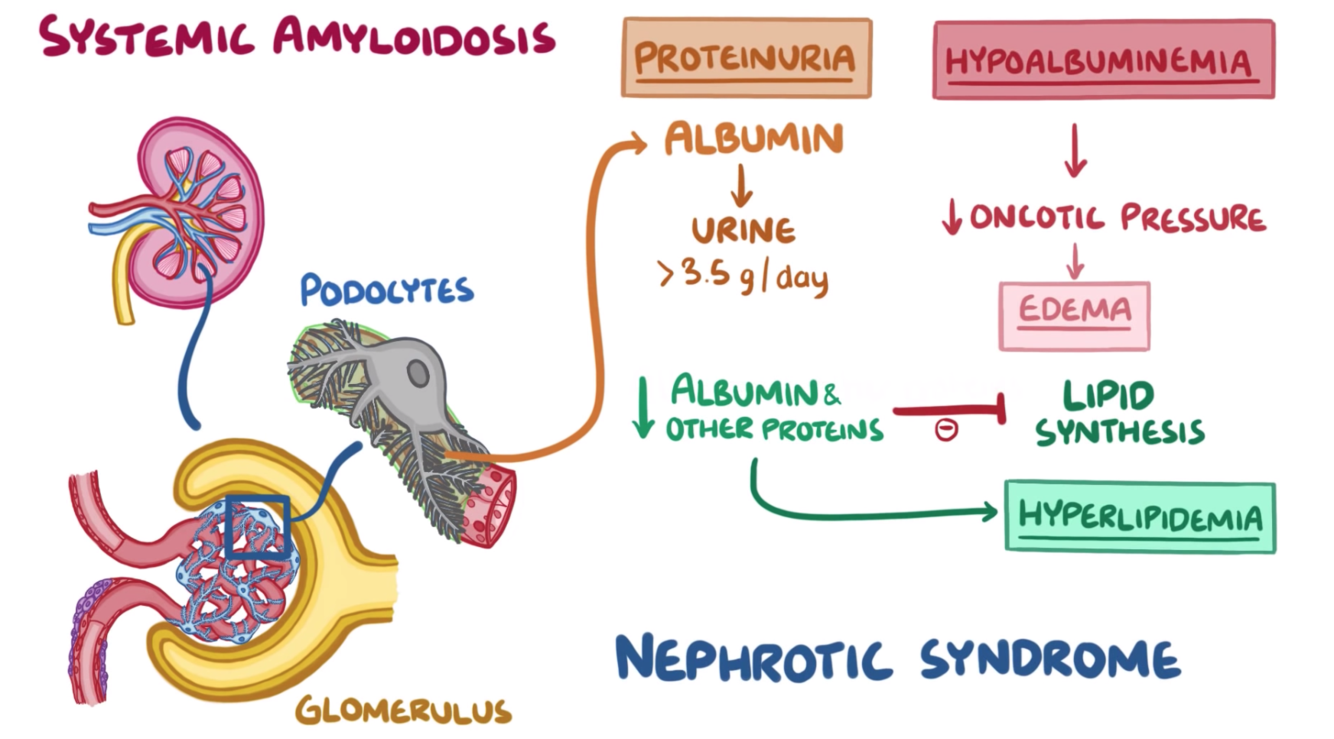
What is nephrotic syndrome?

-
ECGs121
-
ECG examples10
-
Aortic regurgitation- valvular18
-
Aortic stenosis - valvular18
-
Mitral stenosis - valvular0
-
Mitral regurgitation - valvular0
-
Tricuspid regurgitation - valvular18
-
Atrial fibrillation/flutter - arrhythmias5
-
Cardiac arrest - arrhythmias0
-
Heart block (1st, 2nd, 3rd degree) - arrhythmias10
-
Supraventricular tachycardia - arrhythmias0
-
Vasovagal syncope - - arrhythmias0
-
Ventricular fibrillation - arrhythmias0
-
Ventricular tachycardia - arrhythmias0
-
Wolff–Parkinson–White syndrome - arrhythmias0
-
Cardiomyopathy - intrinsic17
-
Restrictive cardiomyopathy - intrinsic0
-
Pericarditis - intrinsic35
-
Constrictive Pericarditis - intrinsic15
-
Infective endocarditis - intrinsic18
-
Myocarditis - intrinsic19
-
Ischaemic heart disease (angina pectoris, acute coronary syndrome, myocardial infarction) - intrinsic0
-
Rheumatic Fever - intrinsic25
-
Abdominal aortic aneurysm11
-
Aortic dissection - vascular10
-
Dyslipidaema (hypercholesterolaemia & hypertriglyceridaemia)0
-
Hypertension0
-
Rheumatic fever0
-
Amyloidosis16
-
Arterial ulcers0
-
Venous ulcers0
-
Deep vein thrombosis (DVT)0
-
Varicose veins - vascular0
-
Peripheral vascular disease (acute and chronic limb ischaemia)0
-
Cardiac failure (acute and chronic)63
-
Pulmonary HTN - vascular0
-
PE - vascular0
-
Gangrene0
-
Buzz words: Cardiology71
-
Buzz words: Vascular11
-
Blackboard Chest Pain EMQs58
-
Blackboard EMQs CVS80
-
Cardiology - DPD75



